Silver Dollars & Trade Dollars of the United States - A Complete Encyclopedia
Q. David Bowers
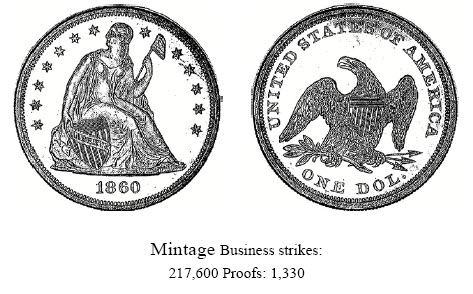
1860 Liberty Seated Dollar
Coinage Context
Another export issue: Like its immediate predecessors, Liberty Seated dollars dated 1860 are believed to have been intended primarily for use in the export trade to China. (As Jim Loyd has pointed out (letter to the author, March 22, 1992), if indeed the coinage was intended for shipment to China, it would have been more economical to have shipped Nevada-mined silver to San Francisco for coinage. Of course, New York and other Eastern ports had trade with China, too.) They never were available from the Mint at face value, and all were paid out at $1.08 each to bullion dealers, banks, and others who fed them into the Orient trade. A small percentage of the mintage circulated domestically after the resumption of specie payments in autumn 1876, the results of the acts of January 14, 1875 and April 17, 1876.
Numismatic Information
Circulated grades: Despite a relatively high business strike mintage, worn examples are few and far between on the market today. This date seems to be slightly more available than the 1859, but opinions differ. Writing in 1982, Donald Vettel stated that in EF grade 1860 dollars were the scarcer of the two. ("Some Thoughts on Liberty Seated Dollars: A Scarcity and Price Analysis." The Gobrecht Journal, July 1982.)
Mint State grades: The 1860 is likewise very scarce in Mint State. When seen, examples often have a partially prooflike surface. The mint frost on typical specimens is apt to be satiny rather than deeply coruscating and frosty.
Business strikes ignored: There was virtually no collector interest in business strike Liberty Seated dollars of any kind during this era. Numismatists desiring date sequences of dollars (mintmarks were completely ignored) were satisfied with Philadelphia Mint Proofs, which probably accounted for the placing of fewer than a dozen Proofs in cabinets each year during the decade of the 1840s, and increasing numbers after that, reaching a production of several hundred pieces by 1859. Still, despite mintages which sometimes met or broke the 1,000 mark, Proof dollars were not popular, and many coins were spent once the novelty of owning them passed. The number of unimpaired Proofs surviving from the total mintage of the 1860s is undoubtedly on the order of 50% to 60%, some of the reduction being attributed to coins never released and subsequently melted, and the rest to attrition: spending, cleaning, friction from other coins, improper storage, etc.
Proofs: By 1860 the Mint issue price for a copper and silver Proof set climbed from $2.02 (for $1.94 face value of coins) to $3, for a set which contained a copper-nickel Indian cent, silver three-cent piece, half dime, dime, quarter dollar, half dollar, and silver dollar, again $1.94 face value. This premium of $1.06 represented a charge of 55% over face value for each coin. Proof dollars were sold for $1.60 each in 1860 (and also in 1861; not in later years). (Per letter from R.W. Julian to the author, March 20, 1992.)
By July 1, 1867 the $3 charge for a set was still in effect, (Per "Circular letter in Relation to American Medals and Cabinet Coins, July 1,1867," quoted by Breen, p. 28.) although by this time several new denominations had been added, namely the bronze two-cent piece, and the nickel alloy three-cent and five-cent pieces. On a pro-rata basis, a Proof 1860 dollar would have cost about $1.50, but it was customary to charge proportionally more for smaller denominations. Perhaps on its own a Proof 1860 dollar should have been priced in the $1.25 range but, as noted, the price was just $1.08.
Proof production of the 1860 dollar was abnormally large: 1,330 pieces, the highest Proof figure in the entire Liberty Seated series, all delivered on March 8th. Only 527 were eventually sold, and the rest were consigned to the melting pot. R.W. Julian has written the following on the subject: ("Philadelphia Coinage Statistics: 1853-1873." Numismatic Scrapbook Magazine, August 1964.)
The 1860 Proof coinage of dollars is not the same as the coinage of the other denominations heretofore printed for 1860. The extra 330 pieces coined were produced because the Mint felt that there would be an extra demand for these over the other silver Proofs; this points out that in addition to Proofs being sold in sets, single pieces were sold very frequently, For example, in April 1860, there were 69 full silver sets sold (presumably including a copper-nickel cent in each set) plus 10 silver dollars, 3 half dollars, 16 dimes, 14 half dimes, 16 trimes and 10 cents. It would appear that the Mint officials were wrong in believing that a large number of dollars would be sold beyond the regular set sales because after 1860 all silver coins were made in the same amounts for Proof sets.
Varieties
Business Strikes:
1. Normal Date: Breen-5463. Business strikes are all of one general type, although minor varieties in date positions occur. Some Mint State pieces survive, some of which are prooflike and can be confused with Proofs. On the reverse of some high grade coins there is unfinished die surface in the lower right half of the shield interior.
Proofs:
1. Proof issue: Breen-5463. Obverse: With horizontal marks in stripes 5, 6, and 7 in shield. Shield point midway between tip and upright of 1; left base of 1 over right edge of denticle. Some are lightly struck at the top of the obverse. Reverse: No description at hand, but apparently different from any used earlier.
Note: Walter H. Breen suggests that some Proofs may have the "new reverse of 1861" showing the claws and arrowheads on the eagle more delicate than used earlier, a subject which merits further research. Enlarged photographs would be helpful.