Silver Dollars & Trade Dollars of the United States - A Complete Encyclopedia
Q. David Bowers
1851 Original Liberty Seated: Market Values
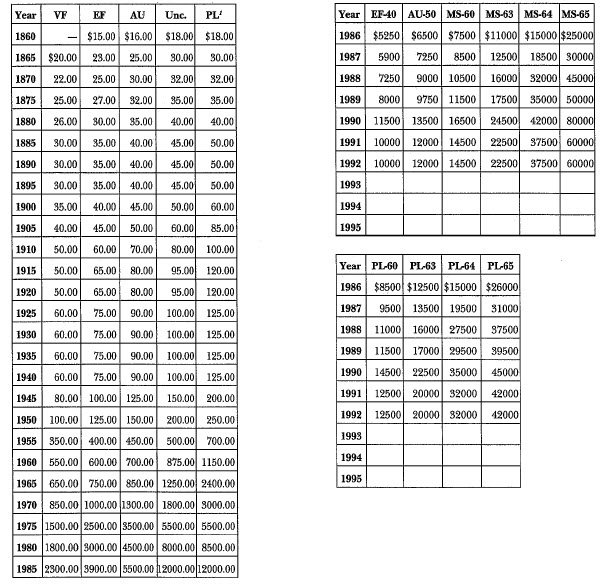
1. The surface quality often referred to as "Proof'' over the years.
1851 Original Liberty Seated: Summary of Characteristics
Business Strikes:
Enabling legislation: Act of January 18, 1837 Designer of obverse: Robert Ball Hughes (after Gobrecht)
Designer of reverse: Robert Ball Hughes (after Reich)
Weight and composition: 412.5 grains; .900 silver, .100 copper
Melt-down (silver value) in year minted: $1.034 Dies prepared: Obverse: 1; Reverse: 1.
Business strike mintage: 1,300; Delivery figures by month: June or December (not certain, one or the other; existing Mint records are imperfect): 1,300.
Estimated quantity melted: Unknown
Approximate population MS-65 or better: 2 to 4 (URS-2)
Approximate population MS-64: 4 to 8 (URS-3)
Approximate population MS-63: 5 to 10 (URS-4)
Approximate population MS-60 to 62: 5 to 10 (URS-4)
Approximate population VF-20 to AU-58: 10 to 20, most of which are EF or AU (URS-6)
Characteristics of striking: Stars on the right obverse are usually flat; otherwise, the coins are average strikes. Frosty business strike coins have numerous die striae. Later strikings from highly polished dies have prooflike surfaces.
Known hoards of Mint State coins: None
Proofs: None
Commentary
This is the rarest Philadelphia Mint silver dollar in the Liberty Seated series 1840-1873.
Additional Information
The Silver Situation
In his book, The United States Trade Dollar, John M. Willem stated the following concerning the silver market of the era:
"The exploitation of gold from California beginning in 1848, increasing rapidly in 1849, and influencing the world markets in the early 1850s, plus additional gold discovered in Australia, made gold 'common' in relation to silver, with the result that silver rose in value, and the meltdown value of a silver dollar became worth over $1.03, with corresponding increases in lesser denominations ....
"As silver dollars were not readily seen in circulation, well over 10 million gold dollars minted in 1849-1853 were in common use, accounting for the wear seen on these pieces today. Typical coins in American circulation consisted of copper cents, well-worn earlier U.S. silver coins, and low grade Mexican coins and fractional denominations."
The Silver Three-Cent Piece
The new silver three-cent denomination, later called a trime by Mint Director James Ross Snowden, made its debut in 1851. Instead of consisting of .900 fine silver, as other denominations, the new three-cent piece was only .750 fine. The Mint coined the pieces from its own bullion supply and distributed them at a profit to the public, an unprecedented deviation from the concept that silver coins (and gold) should have a bullion content essentially equal to their face value. However, in 1854 the fineness was changed to .900, by which time (after the Act of 1853) the weights of .900 fine subsidiary silver coins were such that they were worth less than face value.
The new coin was created not with the specific intention of bringing a profit to the Mint, but as a way for the government to acquire foreign fractional coins, especially Mexican silver issues which were usually quite worn, and not show a loss on the transaction. (Adapted from Carothers, Fractional Money, pp. 106-110.)
The Spanish coins would be accepted in exchange for the new coins at ratings of 25, 12-1/2, and 6-1/4 cents for the 2- real, 1-real, and half real (media) pieces respectively. The three-cent denomination was selected because it fit easily into the common 6- and 12-cent ratings of the media and real, although it was a misfit in the United States decimal system. Around the same time the letter postage rate reduction from five cents to three cents nevertheless made the coin useful. Silver three-cent pieces were made in large quantities 1851- 1853, including a modest mintage at New Orleans in 1851. The appearance of many worn specimens in collections today suggests that the denomination circulated successfully.
Retail Trade Conditions
Neil Carothers noted the following in Fractional Money, pp. 110 ff.:
"Before the year 1851 conditions in retail trade had become chaotic. Trade was being carried on with gold dollars, three-cent pieces and underweight dimes and half dimes and badly worn Spanish reals and medios. The gold dollars were too small in size and too large in value. The dimes and half dimes were the few survivors of a-systematic culling out of good-weight coins. The adverse ratio had long since stopped the importation of Spanish [Mexican] of good condition, but badly worn pieces were still brought in. Sumner [History of American Currency] says that the whole world was ransacked for Spanish coins that had been discarded as unfit for circulation. Ordinary business was hampered and retarded by the state of the currency [coins]. No United States or Spanish silver coin could circulate unless it was reduced by wear as much as 3%. The average depreciation was much larger, possibly as great as 15%.
"Copper coins, if they had been in general circulation, might have been very useful, but they were very large, were unattractive in use, and had an uncertain legal status. The coinage of one-cent pieces showed a marked increase in 1851, but the total coinage from 1851 to 1853, inclusive, was only one piece for each person in the country. The total [circulating] fractional coin currency of all kinds was quite inadequate.
"Railways, hotels, and stores, which required small change as a business necessity, were buying small coins at a premium, first gold dollars, then three-cent pieces, and finally any sort of United States or foreign silver coins whatever. A customer who offered a gold dollar in payment for a small article would receive in exchange perhaps 10 or 15 three-cent pieces and a half dozen almost unrecognizable reals and medios. A Philadelphia paper referred derisively to shopkeepers scooping up three-cent pieces with a ladle to make change for a $5 bank note."!