Silver Dollars & Trade Dollars of the United States - A Complete Encyclopedia
Q. David Bowers
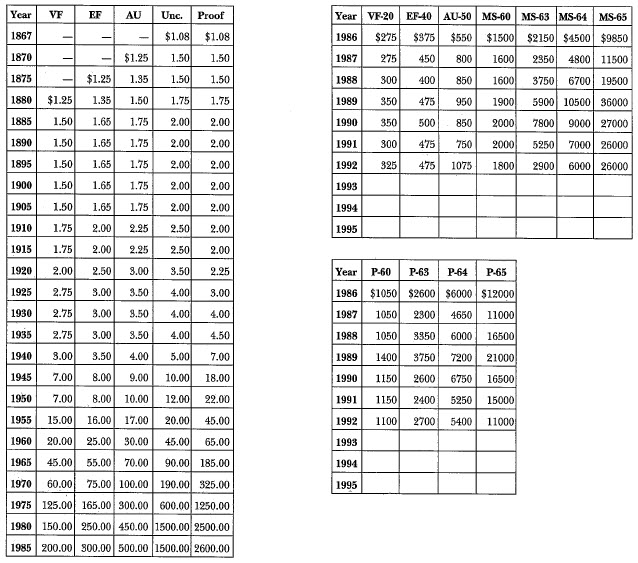
1867 Liberty Seated: Market Values
1867 Liberty Seated:Summary of Characteristics
Business Strikes:
Enabling legislation: Act of January 18, 1837 (weight and fineness); Act of March 3, 1865 (motto)
Designer of obverse: Robert Ball Hughes (after Gobrecht)
Designer of reverse: J,B. Longacre (after Hughes and Reich)
Weight and composition: 412.5 grains; .900 silver, .100 copper
Melt-down (silver value) in year minted: $1.027 Dies prepared: Obverse: Unknown; Reverse: Unknown
Business strike mintage: 46,900; Delivery figures by day: January 17: 6,000; March 20: 10,300; May 22: 6,600; June 18: 13,700; November 22: 10,300.
Estimated quantity melted: Unknown
Approximate population MS-65 or better: 2 to 4 (URS-2)
Approximate population MS-64: 6 to 10 (URS-4)
Approximate population MS-63: 10 to 15 (URS-5)
Approximate population MS-60 to 62: 20 to 40 (URS-6)
Approximate population VF-20 to AU-58: 130 to 225 (URS-9)
Characteristics of striking: Varies; some have slight weakness at stars 8 and g.
Known hoards of Mint State coins: None
Proofs:
Dies prepared: Obverse: 4; Reverse: 2.
Proof mintage: 625; delivery dates: February 5: 25 delivered; February 18: 100; February 25: 200; March 13: 200;June: 100.
Approximate population Proof-65 or better: 34+/- (URS-7)
Approximate population Proof-64: 82+/- (URS-8)
Approximate population Proof-63: 170+/- (URS-9)
Approximate population Proof-60 to 62: 150+/- (URS-9)
Commentary
The 1867 is quite rare at all grade levels. Mint State coins are especially elusive.
Additional Information
The Year 1867 in History
Secretary of State William Henry Seward negotiated the purchase of Alaska from Russia for $7,200,000, which amounted to less than two cents per acre. The transaction was consummated through the Riggs National Bank in Washington, D.C. Nebraska was admitted to the Union as the 37th state.
The directors of the Union Pacific Railroad were making unconscionable personal profits on the construction of the rail link with the West. To avoid a government investigation they gave shares to congressmen and sold shares at low prices in the Credit Mobilier Company, a newly-formed enterprise intended to capture some of the profits from the construction. Cornelius Vanderbilt acquired control of the New York Central Railroad. The Pullman Palace Car Company was formed by George Pullman and Andrew Carnegie, the latter being well on his way to becoming one of America's wealthiest industrialists. Jay Gould and Jim Fisk printed counterfeit stock certificates of the Erie Railroad, sold them, and then fled to New Jersey with $6 million in illicit profits.
Christopher Latham Sholes devised a typewriting machine and asked a court reporter to test it, who produced the instant cliche, "Now is the time for all good men to come to the aid of the party." In October, William Cody began an eight month spree in which he killed 4,300 bison, giving rise to his nickname, Buffalo Bill.
Johann Strauss, Jr.'s The Blue Danube Waltz was first played publicly on February 15th and went on to create a sensation. By a century later, more sheet music had been sold of this than of any other popular musical composition ever written.
The British North America Act of March 29, 1867 united Ontario, Quebec, New Brunswick, and Nova Scotia into the Dominion of Canada with its capital at Ottawa. Puppet monarch Emperor Maximilian surrendered on May 15th to Mexican troops, and on June 19th he was executed by a firing squad.
From the early 1850s onward, large amounts of gold coins and bars were shipped from San Francisco to New York City. An 1867 account by Albert D. Richardson in Beyond the Mississippi (pp. 542-3), told of the transfer of the treasure on the Atlantic side of Panama:
"Eleven miles from Panama we crossed the summit .... From these mountains one can see both Atlantic and Pacific at once .... Aspinwall has an excellent harbor, enabling first-class steamers to come to the wharf without ferriage. On the chief street is a long row of wooden buildings, with projecting roofs or sheds, used as trading houses and eating and drinking saloons. The motley population of less than one thousand is composed of natives, Jamaica Negroes, and Americans .... It is the dreariest, wretchedest, most repulsive city of fact or fiction, not excepting Cairo, Illinois in the days of [Dickens' novel character] Martin Chuzzlewit ....
"An hour after us arrived a second train bringing only the specie. Once admitted through the great gate and over the long wharf to the steamer New York, we could not leave the boat while the treasure was being transferred. Muscular, half-naked Negroes received from freight cars the bare bricks of silver, bars of gold sewn in canvas, and boxes of coin, each taking a ticket describing his parcel, to deliver with it on the ship. Bending and perspiring under these precious burdens, the tawny workmen marched in constant procession between rows of men, illuminating wharf gangway and deck with lanterns. This novel spectacle lasted for two hours; convincing me that a million dollars in bullion is a good deal of money, and would be awkward to carry around."
In 1867, the mint directorship of William Millward ended in April and that of the infamous Richard Henry Linderman began the same month. Linderman used his office (his first term April 1867 to April 1869 and his second term, April 1873 to December 1878) to feather his own numismatic nest and to create vast numbers of unauthorized (except by himself) pattern and fantasy coins. Whether or not such coins are official is a matter for logicians to decide. In one sense, inasmuch as a Mint officer made them or caused them to be made, they are official.