Silver Dollars & Trade Dollars of the United States - A Complete Encyclopedia
Q. David Bowers
1852 Liberty Seated Dollar
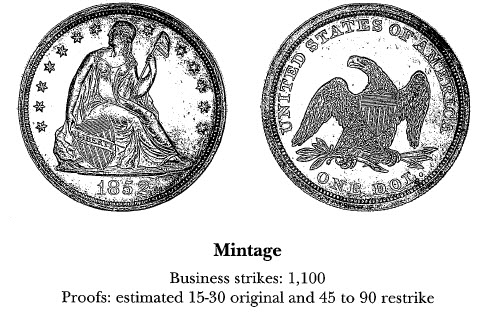
Coinage Context
Low mintage: The price of silver continued to be high in 1852. The Mint struck a very limited quantity of silver dollars for this reason and also because for dollar coinage the Treasury much preferred the gold dollar. Most domestic transactions requiring this value were taken care of by gold dollars, which had been minted since 1849 and which were becoming popular in circulation. In the year 1852 the production of gold dollars at the Philadelphia Mint alone amounted to 2,045,351 coins. It is not known if the 1852 silver dollars were coined for depositors or for the account of the government. (R.W.Julian, letter to the author, March 10, 1992.)
Numismatic Information
Circulated grades: As is the case with circulated 1851 dollars, specimens of the 1852 were taken from circulation in the nineteenth century, when the date was already recognized as being scarce and valuable in any grade.
Today, the 1852 is a classic rarity. When specimens in such grades as VF and EF come on the market they furnish an opportunity for numismatists to acquire an example without having to pay the going rate for a higher level coin such as a Mint State or Proof example.
Mint State grades: Mint State coins seen by me have satiny, lustrous surfaces with minute die striations. Perhaps the Mint saved a few of these for trading purposes at the time of issue. In high grades the 1852 seems to be slightly rarer than the 1851, but the population is so small that no unequivocal conclusions can be drawn. I graded the Norweb Collection coin (Lot 3799) as MS-65, prooflike.
Original Proofs: As with original 1851 Proof coins of all denominations, little is known about the origin of Proof coins or sets dated 1852. There appears to be no documentation of the issuance of copper-silver-gold Proof sets of this year, and no complete sets have appeared in past sales or records of collections. However, a few copper-silver Proof sets were made. Most of what we know about Proof coins dated 1852 is from examination of scattered examples of various specimens. There are more Proofs of dollars dated 1852 than Proofs of any other denomination of this date.
Restrike Proofs: As business strikes of the 1852 dollar were recognized as rarities at an early date, the "Midnight Minters" set about restriking Proofs of these coins, probably as early as 1858 and until mid-1860, when Director James Ross Snowden seized the dies and sealed them in a carton. When Director Henry Richard Linderman opened the carton in 1867, more may have been restruck. Several reverse die varieties exist, suggesting restriking on different occasions. Some of the pieces listed below (following the Breen listing in his Proof coins Encyclopedia) may in fact be restrikes; the present writer considers this very likely. Perhaps future research will help pinpoint specific dates when this was done.
As a class, about 90% of the 1852 Proof dollars offered are restrikes (per Breen). Originals, per the current state of numismatic knowledge, are given below.
Estimates of the rarity of certain die combinations of originals versus restrikes is guesswork at this point. With the exception of Walter H. Breen's studies, virtually no one has examined the situation in detail; auction and sale catalogues are not useful as a source for information, etc. More than for any other date in the Liberty Seated series dated in the 1850s, research remains to be done on the 1852.
Unlike restrikes of the 1851 Proof dollar, which are usually referred to as restrikes in catalogues, restrikes of the 1852 dollar have not been studied as closely, are from the same obverse die as originals, and are usually catalogued simply as 1852 Proofs, without mention of original or restrike status.
Restrike impressions were made in silver (usually seen) and copper (exceedingly rare).
Several reverse varieties of restrikes are known, including the reverse of 1840-1850 with two minute points on the right slanting edge of the final A. Another reverse is that used on 1858-1859 Proofs and is seen on silver strikes as well as the rare copper restrikes. This may indicate restriking on multiple occasions. See description of varieties below.