Silver Dollars & Trade Dollars of the United States - A Complete Encyclopedia
Q. David Bowers
1869 Liberty Seated Dollar
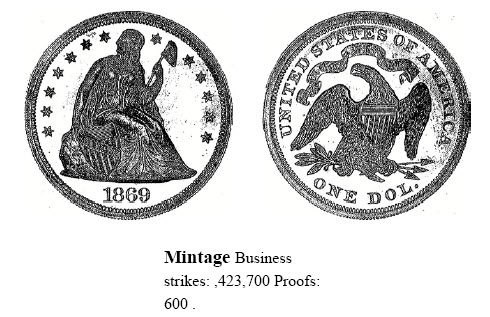
Coinage Context
The silver situation: Domestic silver production increased many fold during the 1860s as Nevada's Comstock Lode reached high production. The metal, once scarce in the United States, now became plentiful, and Nevada mine owners and other Western producers pressured their political representatives to help find new markets.
Philadelphia Mint Liberty Seated dollars of 1869 and 1870 were minted in larger quantities than were any recent issues in the series. Willem states that the Mexican peso fell out of favor with Chinese merchants (due to a new tax in Mexico), and that the large business strike coinage of Liberty Seated dollars from 1869 onward was accomplished to provide coins for export to take advantage of the situation. (Willem, The United States Trade Dollar, pp. 50-51.) However, opinions differ on this (see immediately below).
Heavy coinage of dollars: The following is by R.W. Julian: (Created for inclusion in the present text, February 1992.)
The heavy coinage of silver dollars in the late 1860s can be shown to be the result of another imbalance in trade for silver. Prior to about 1868 the U.S. usually exported more silver than it produced and imported and there was little need for a dollar coinage. After that time, however, there was no other place for the excess silver to go and it was therefore coined into dollars, even though they did not circulate. It was a practical way to store silver with a readily known and guaranteed value. That some of these dollars did go to the Orient I again have no doubt, but I think that there was less than 25,000 annually and perhaps considerably less considering the ready availability of silver ingots in any purity desired.
The government did not coin dollars in the 1860s on its own account-except, perhaps, in small quantities for special purposes and those that wound up in government vaults, for disposal as late as the early 1960s, were simply flowbacks from the banking system. Some of the Liberty Seated bags, for example, might well have arrived at a Treasury vault in the 1880s or 1890s.
Hepburn in History of Currency in the United States, p.270, tells of the increased silver dollar coinage "chiefly due to the rich discoveries of Nevada," and goes on to say, "The coinage of silver dollars increased at once and from 1868 to 1872 ... practically all were exported." As chairman of the board of the Chase National Bank and former Comptroller of the Currency, he would seem to have been in a position to know what happened to those increased mintages of dollars. (Citation and commentary courtesy of Harty E. Salyards, M.D.)
Numismatic Information
Circulated grades: In circulated grades the 1869 is yet another prime issue in this decade of Philadelphia Mint rarities. As noted, most were exported.
Mint State grades: In Mint State, 1869 dollars are very rare, far rarer than Proofs, and are seldom encountered. Most high-grade coins are prooflike.
An anecdote: A prominent Eastern dealer, now deceased, was well known for his braggadocio and regaled me with the tale that his firm possessed a mint-sealed bag of Uncirculated dollars dated 1869. I asked to see them but was told that the coins were "in the vault" and could not be inspected. A year or two later, Edmund A. Rice, a well-known collector and dealer from Cranbury, New Jersey, was with me in this particular dealer's shop, and the dealer was endeavoring to dazzle me with stories of original mint rolls of 1955 Doubled Die cents he owned and to startle Mr. Rice by saying that he had thousands of crisp new-grade 1896 "Educational" $5 notes in his vaults; this being immediately after Rice tried to sell him one such note.
"I have had enough of your lies!" Rice exclaimed. "I will pay you one thousand dollars just to see a pack of such notes. Put up or shut up." The dealer demurred by saying he was too busy to get them from the vault, etc., and Rice departed from the store knowing he had put the wiseacre in his place.
Later, rumors surfaced that the firm with which the dealer was connected had a bag of 1871 dollars. Years later, I learned in confidence from an individual who had audited the firm's inventory that no bags of Mint State Liberty Seated dollars were ever owned by the company.
John W. Dannreuther may have heard similar comments concerning the 1869 dollar, for in an essay in John W. Highfill's Comprehensive U.S. Silver Dollar Encyclopedia he comments: "Date rumored to exist in hoards but I doubt if they exist."
The Salyards study: In The Gobrecht Journal, March 1986, Harry E. Salyards, M.D. contributed "Rarity of the 1869 Dollar," which told of his survey of 57 different coins which appeared in 128 auction sales, 1975-1985. He noted that despite the fact that 423,700 business strikes were made as opposed to just 600 Proofs, 36 Proofs appeared in comparison to only 23 business strikes. The latter broke down to eight Uncirculated coins and 14 in lesser grades. The lowest grade seen was Choice VF.
Proofs: 600 Proofs were coined this year from three obverse dies. Proof dollars were sold with silver Proof sets, which were produced at exceptionally widely spaced intervals throughout the year (see Summary of Characteristics below).
Varieties
Business strikes:
1-3. Normal Date: Breen-5481. At least three obverse die varieties are known, distinguished from each other by minor variations in the position of the date, not by date size or other dramatic differences. Cf. "1869 Seated Dollars," David H. Cohen, The Gobrecht Journal, November 1984. At least one coin seen has the reverse misaligned 15° to the right from normal. (Lawrence N. Rogak, "Rotated Reverses on Liberty Seated Dollars." Article in The GobrechtJournal, July 1990. Also see 1859-S.)
Proofs:
1. Proof issue: Breen-5481. Obverse: Low date. Shield point left of center of the upright of 1. Reverse of 1868 No. 1.
2. Proof issue: Breen-5481. Obverse: High date. Shield point over left edge of upright of 1. Reverse: Heavily lapped, with scroll or ribbon incomplete below ING and ST in motto. Most 1869 Proof dollars are from this die combination. This reverse die was also used to coin 1870 Proof silver dollars.
3. Proof issue: Breen-5481. Obverse: Date slightly above center. Shield point over the tip of the serif of 1 in date. Reverse of No. 2.