Silver Dollars & Trade Dollars of the United States - A Complete Encyclopedia
Q. David Bowers
1844 Liberty Seated Dollar
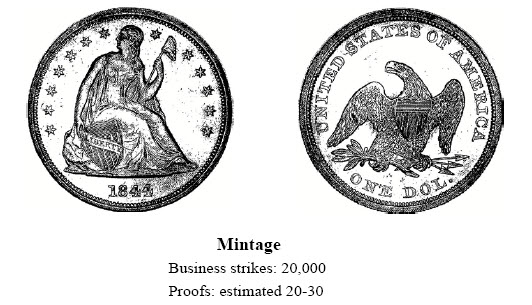
Coinage Context
Inactivity: The year 1844 was notable for the first of low-mintage silver dollars of this design. Scant supplies of silver bullion continued to be one of the main problems facing the mint, and the situation was not made easier by the fact that many United States silver coins were shipped to Europe and Asia in payment for import transactions. Only one delivery of silver dollars was made this year; that of 20,000 pieces on December 31st. The China trade in particular demanded silver in later years, although as certain ports of China were opened for the first time to Westerners in 1842, it probably is the case that by 1844 relatively little trade had yet developed between the United States and that country
Numismatic Information
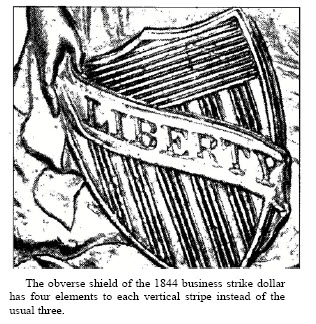
Four stripes: Business strikes of the year 1844 have four tiny vertical stripes composing each large vertical stripe on the obverse shield, whereas all other business strikes in the Liberty Seated series from 1840 to 1873 have just three stripes, as do Proofs of all years (including Proofs of 1844). The fourth or extra stripe, to the right side of the normal three, is in all cases more lightly defined than the other three and is somewhat irregular. The feature is considered to be a doubled die. A few other elements of die doubling are present, including a doubling of the pointed top to the shield and the presence of three border lines (instead of the normal two) on the right edge of the shield. Apparently, the feature of four elements to each stripe is unique in the series.
In articles in The Gobrecht Journal this aspect of business strike 1844 dollars has been called "quad stripes." Outside of the circle of the Liberty Seated Collectors Club this has not been extensively publicized, although it is becoming better known as copies of Walter Breen's Complete Encyclopedia of U.S. and Colonial Coins reach an ever wider circle of readers, for this book devoted about a quarter page (p. 437) to an illustration and description of it.
Circulated grades: Although the mintage of the 1844 is an enticingly low 20,000 pieces, examples of this date in circulated grades appear on the market with regularity. Although numismatically scarce, the 1844 is not a rarity in worn grades. I believe that bank tellers and others recognized the desirability of the 1844 and certain other low-mintage issues (such as 1845 and 1848 and the Carson City coins) and picked them out of circulation beginning in the 1890s and continuing through the first decade or so of the twentieth century. Contemporary coin premium guides confirm this.
Mint State grades: In Mint State the low-mintage 1844 dollar is very rare. In MS-63 or better condition the date is an extreme rarity. What few Mint State coins I have seen have all been very frosty, sometimes with prooflike reverse fields. As time goes on and as the quad stripe feature of the 1844 business strike dollars becomes. more widely known among numismatists, the 1844·will probably take on special meaning to collectors and become even more desired than it is already. By any standard, a Mint State 1844 dollar is a desirable coin to own.
In 1982, Bruce Amspacher stated that he knew of only one that could be called MS-65, a grade that today would be equal to MS-63 or so. This coin was via a second-hand report from another dealer, Robert Emmer.(Article, "Liberty Seated Dollars," in the Monthly Summary, Coin Dealer Newsletter, July-August, 1982.)
Proofs: The Proof dollar of this date is a significantly different major variety from business strikes. On Proofs the vertical stripes on the obverse shield are triple (normal for the Liberty Seated type 1840-1873), while on business strikes they are quadruple.
Proofs are great rarities, but may be slightly more available than those dated 1841 or 1843. In the 1950s I had two specimens of this date at the same time, these having been from Sol Kaplan (Cincinnati dealer) and, earlier, from the holdings of William H. Woodin.
Proof sets: Matthew A. Stickney had early Proof sets from 1844 onward obtained directly from the Mint. It is likely that he had earlier sets as well, but sold or traded them. In the sale of his collection in 1907, sets before 1844 were not present. (Walter Breen's Encyclopedia of u.s. and Colonial Proof Coins, 1722-1989, p. 23. The Stickney Collection was sold in June 1907 in Philadelphia by Henry Chapman.)
Several copper and silver 1844 Proof sets are recorded in numismatic annals, as are a couple of sets from the half cent to the $10, notably the examples in the John Jay Pittman and National Coin Collection cabinets, the Pittman set still in its original case of issue.(Some pieces have been lost from the National Coin Collection (Smithsonian) set.)In the early 1970s I had a partial copper and silver set, purchased from coin dealer Robert Hughes (from whom I also purchased an 1846 set); the coins were sold separately, with the rare 1844 dime (famous as a business strike dime, thus imparting additional desirability to the Proof) being among the first to find a buyer.
Varieties
Business strikes:
1. "Quad Stripes" issue: Breen-5431. The 20,000 business strikes produced may have been made from the same die, with "quad stripes" to the obverse shield, the result of die doubling. The reverse, called the "armpit variety" by Breen, has many crisscross die file marks between the eagle's wings and body, particularly evident beneath the wing to the observer's left. In the shield on the eagle's breast two (out of three) left most vertical stripe elements in the leftmost stripe extend into the horizontal stripe just above (this is almost subliminal but can be seen under magnification). An extraneous loop, from the upper loop of the digit 8, can be seen in a drapery fold above the base of Miss Liberty, above the space between the digits 8 and 4. Some have a clash mark in the right obverse field near Miss Liberty's arm; the transferred image of an outline area of the eagle on the reverse (similar in position and appearance to a clash mark seen on 1851 original dollars). This die pair is the only one seen.
2. Triple Stripes: (Unconfirmed.) In a letter to the editor of The Gobrecht Journal, November 1977, Ron Severa stated that he had examined approximately two dozen 1844 dollars, and just two of these were not of the quad stripes variety, both of which graded less than Fine. Other than this mention, I have not heard of this variety. Walter H. Breen is not aware of it either. More information is needed. Are these worn-down Proofs?
Proofs (all with triple stripes in shield):
1. Proof issue: Breen-5432. Obverse: Date slightly above center (and slightly higher than seen on business strikes). Normal (triple) components to the vertical shield stripes, rather than four as on business strikes (this characteristic can serve to attribute a questioned Proof). Shield point about over the tip of the serif of 1 in date. Reverse of 1840-1850 (described under 1840).