Silver Dollars & Trade Dollars of the United States - A Complete Encyclopedia
Q. David Bowers
1848 Liberty Seated Dollar
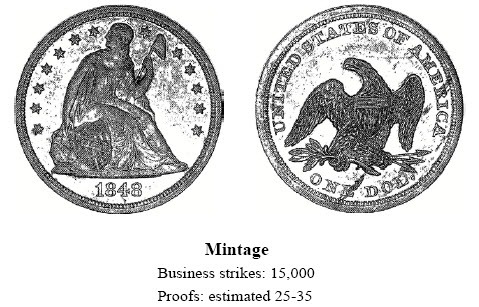
Coinage Context
Production small: The Philadelphia Mint produced only 15,000 silver dollars, the lowest production of the 1840-1850 decade.
Writing in The History of Currency 1252-1896, Second Edition, 1896, p. 259, W.A. Shaw told of the immediate benefits experienced by the Act of July 31, 1834, whereby gold coins began to circulate freely, but also noted this:
The panacea thus magnificently lauded soon proved itself worse than inefficient. The ratio was too high, and the silver dollars could not be maintained. They were unduly exported, especially between the years 1848 and 1851.
Whether or not silver dollars were exported in quantity during this period has not been ascertained with finality. If, indeed, dollars were exported in quantity during the period 1848-1851, it is not hard to envision a scenario in which undistributed dollars minted a few years earlier in 1841 were obtained from the Treasury and sent overseas to be melted, thus accounting for their rarity. Actually, the year 1848 given by Shaw is probably too early, for California gold was not plentiful on world markets until 1849, at which time an excess of the metal began to accumulate, precipitating a rise in the price of silver. Although gold was discovered on the American River in California in 1848, news was slow in spreading, and the following year, 1849, saw a rush to the gold fields.
Numismatic Information
Circulated grades: Because of its low mintage of just 15,000 pieces-the lowest of the 1840s the 1848 silver dollar has always been in strong demand. Coins figuratively walk out of dealers' catalogues. Circulated grades, while quite scarce, exist in sufficient quantities that they are usually easily available for a price.
Mint State grades: The 1848 is scarce but is not in the top echelon of rarity for the decade. The low mintage of the date has placed a premium on coins of all grades, and a Mint State 1848 will attract a lot of attention in a dealer's display or auction catalogue. Coins MS-64 or better are extreme rarities.
Proofs: The 1848 Proof dollar is a great rarity, but it may be slightly less rare than 1847. In this entire series we are dealing with the rarest of the rare, and, as noted, comments concerning exactly how rare such coins are can be highly conjectural. Different opinions abound. In general, owners and cataloguers opt for greater rarity, and objective analysts (which certainly Walter H. Breen has been and, hopefully, I have also been) tend to have a broader view.
The 1848 dollar is a highly desirable coin in any condition, due to the related low business strike mintage of just 15,000 pieces. Thus, an 1848 Proof dollar appearing on the market is apt to be attended with more fanfare than a rarer Proof 1847, a common date as a business strike ..
Varieties
Business strikes:
1. Normal Date: Breen-5439. Larger numerals than in other dates 1840-1850. On early impressions horizontal die polish lines are seen in the crook of Miss Liberty's elbow. No variations have been described for business strikes of this year.
Proofs:
1. Proof issue: "Badge" variety: Breen-5440. Die chips (suggesting badges, decorations, or an oversized semicolon.per Breen) on Miss Liberty's breast. Shield point over center of top of 1 of date, left base 0£"1 over right edge of border denticle. Reverse of 1840-1850 (described under 1840).