Silver Dollars & Trade Dollars of the United States - A Complete Encyclopedia
Q. David Bowers
1859-S Liberty Seated: Market Values
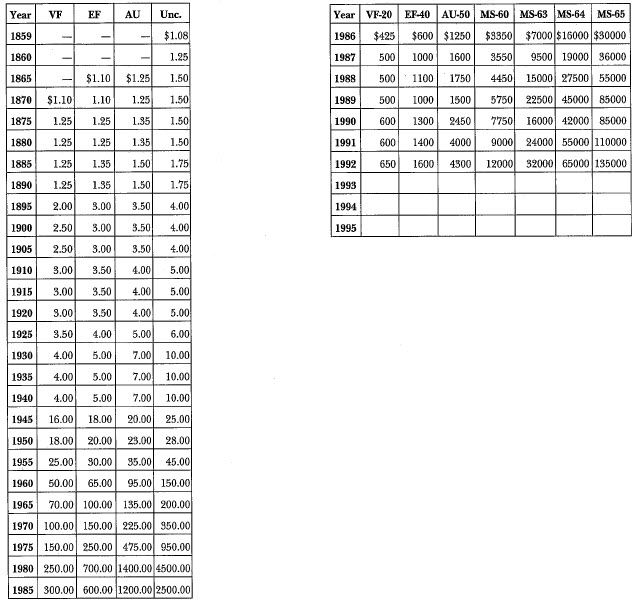
1859-S Seated: Summary of Characteristics
1859-S Liberty Seated: Summary of Characteristics
Business Strikes:
Enabling legislation: Act of January 18, 1837
Designer of obverse: Robert Ball Hughes (after Gobrecht)
Designer of reverse: Robert Ball Hughes (after Reich)
Weight and composition: 412.5 grains; .900 silver, .100 copper
Melt-down (silver value) in year minted: $1.052 Dies prepared: Obverse: 10; Reverse: 10 Business strike mintage: 20,000
Estimated quantity melted: Most of the mintage was exported to China; there melted
Approximate population MS-65 or better: 0 or 1 (URS-O)
Approximate population MS-64: 0 or 1 (URS-O)
Approximate population MS-63: 0 or 1 (URS-O)
Approximate population MS-60 to 62: 5 to 10 (URS- 4)
Approximate population VF-20 to AU-58: 750 to 1,250 (URS-11)
Characteristics of striking: Usually well struck Known hoards of Mint State coins: None
Proofs:
None
Commentary
First and largest coinage of Liberty Seated dollars in San Francisco. 1859-S silver dollars were coined expressly for export to China. The issue is a rarity in Mint State.
Additional Information
Mexican Coins to be Struck in the U.S.
To help ameliorate the shortage of heavyweight silver coins for export from San Francisco, a private firm, Duncan, Sherman & Company, of New York, proposed to set up a mint in San Francisco to produce silver pesos similar in design, weight, and fineness to those produced under government authorities in Mexico, this operation to be supervised by Mexican assayers, and with a seigniorage of 1% to be paid to the Mexican government for the first 14 years of the contract and 1-1/2% thereafter. Presumably most silver bullion would have come from Mexico. After due consideration and preparation of contracts, the idea was dropped.
Less than 20 years later, the Philadelphia Mint would begin making coins in quantity for foreign governments; three generations later, so would branch mints; more recently, private mints in the United States followed suit. In 1949, the San Francisco Mint restruck 2,000,000 1898-dated Mexican silver pesos, Mo mintmark, AM assayer 's initials, for export to Chiang Kai-Shek and the Republic of China, and the Mexico City Mint restruck 8,250,000 similar pieces (originals made in Mexico in 1898 have 139 beads around the reverse border; 1949 restrikes have 134).