Silver Dollars & Trade Dollars of the United States - A Complete Encyclopedia
Q. David Bowers
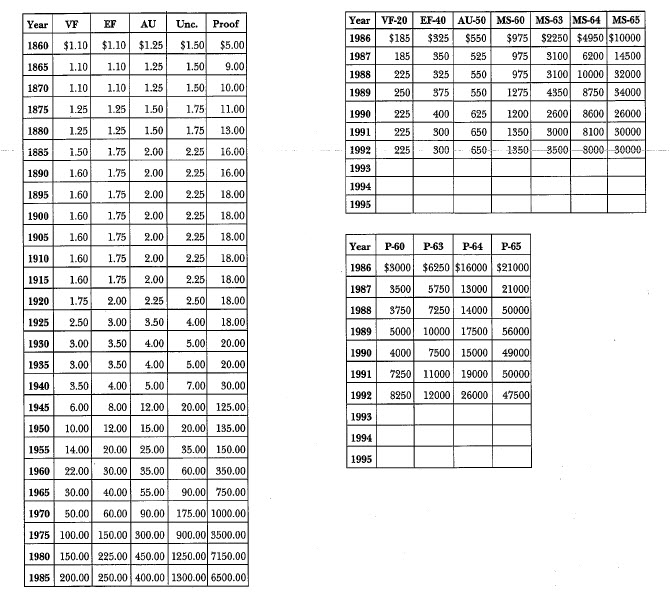
1841 Liberty Seated: Market Values
1841 Liberty Seated: Summary of Characteristics
Business Strikes:
Enabling legislation: Act of January 18, 1837 Designer of obverse: Robert Ball Hughes (after Gobrecht)
Designer of reverse: Robert Ball Hughes (after Reich)
Weight and composition: 412.5 grains; .900 silver, .100 copper
Melt-down (silver value) in year minted: $1.018 Dies prepared: Obverse: Unknown; Reverse: Unknown
Business strike mintage: 173,000; Delivery figures by day: March 31: 14,500; April 30: 23,000; May 31: 43,500; June 15: 14,000; June 30: 15,000;July 31: 33,000; August 31: 21,000; September 22: 8,000; December 31: 1,000.
Estimated quantity melted: Unknown
Approximate population MS-65 or better: 1 to 3 (URS-1)
Approximate population MS-64: 3 to 6 (URS-3)
Approximate population MS-63: 5 to 10 (URS-4)
Approximate population MS-60 to 62: 15 to 25 (URS-S)
Approximate population VF-20 to AU-58: 1,000+ to 1,500 (URS-12)
Characteristics of striking: Striking varies; some have flatness in areas, including stars and/or denticles.
Known hoards of Mint State coins: None
Proofs:
Dies prepared: Obverse: At least 1; Reverse: At least 1. (The reverse die, the so-called Reverse of 1840-1849, is believed to have been prepared in 1841 and used to coin originals of this date as well as restrikes of this and certain other dates. More study is needed before firm conclusions can be drawn. )
Proof mintage: 10-15 estimated
Approximate population Proof-64 or better: 2 or 3 known (URS-2)
Approximate population Proof-60 to 63: 3 to 6 known (URS-3)
Commentary
While 1841 is very common in worn grades, in Mint State or Proof it is a rarity.
Additional Information
The Year 1841 in History
Following the trend of the 1830s, the funds of the United States, as shown by a surplus in the Treasury, continued to build up. On January 1, 1841 the amount of excess funds stood at $13,500,000, up sharply from $5.2 million a year earlier. By January 1, 1842 the amount would increase to $20.6 million. These were the days of intended fiscal responsibility, a posture which over the coming decades would furnish great strength to the government and the American system of commerce and trade. While political campaigns of the 1840s were as free-swinging and irresponsible as they would be, for example, over a century later in the 1980s and 1990s, those in office sought responsibility in government financial matters.
Among the larger world cities, New York had an estimated 313,000 inhabitants, Berlin 300,000, Vienna 357,000, Paris 934,000, and London 2,240,000.
William Henry Harrison, elected president in 1840, caught cold on his inaugural day, and a month later, on April 4, 1841, died. His was the shortest tenure by far of any chief executive. Later, letters and documents signed while he was in office would be quickly recognized as prime rarities by collectors. Harrison, who was sick for his entire brief time in office, had no involvement with coinage. Taking his place in the White House was his vice-president, John Tyler, age 51.
On June 12 an act calling for a fiscal bank of the United States was introduced in the Senate and was passed by both houses, but was vetoed by President Tyler. Tyler's entire cabinet, with the exception of Secretary of State Daniel Webster, resigned in protest over the president's action.
In New York City on April 10, 1841, Horace Greeley, age 30, launched the New York Tribune with $1,000 in borrowed capital. Later, Greeley would espouse the opening up of the sunset territories; however, the saying, "Go west young man," often attributed to him by later writers, was borrowed from another (John Babsone Lane Soule in an article in the Terre Haute Express, 1851). Among other events in the publishing field was Charles MacKay'S Extraordinary Public Delusions and the Madness of Crowds (still in print in recent years); over a century later, American financier Bernard Baruch would mention it in his autobiography as a key item in the formulation of his eminently successful investment philosophy. The volume told of the Holland tulip bulb mania, the South Sea Bubble, and other schemes, some of which accounts are occasionally mentioned in rare coin investment newsletters (especially of the contrarian kind) today.
The Old Curiosity Shop, by Charles Dickens, and The Deerslayer, by James Fenimore Cooper, reached print, as did Edgar Allan Poe's A Descent Into the Maelstrom and The Murders in the Rue Morgue, the latter to achieve fame as "the world's first detective story" (however, the biblical story of Susanna had antedated it by two millennia).
The Philadelphia Mint, for unknown reasons, made only a few quarter eagles, not to be generally recognized as rarities until 1909. In the 1940s, dealer Abe Kosoff nicknamed the 1841 quarter eagle "Little Princess."