Silver Dollars & Trade Dollars of the United States - A Complete Encyclopedia
Q. David Bowers
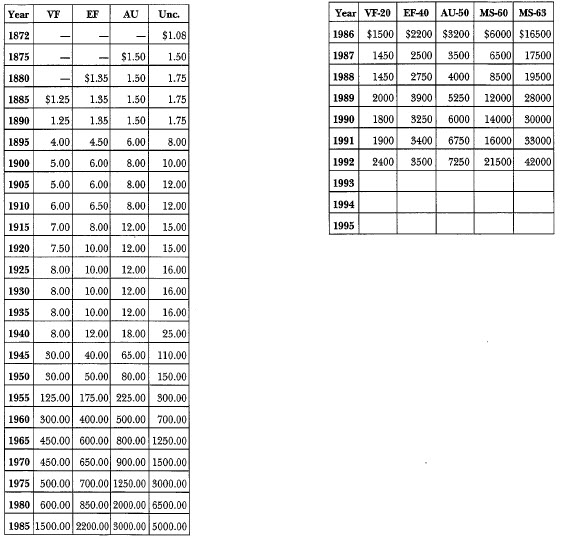
1872-CC Liberty< Seated: Market Values
1872-CC Liberty Seated: Summary of Characteristics
Business Strikes:
Enabling legislation: Act of January 18, 1837 (weight and fineness); Act of March 3, 1865 (motto)
Designer of obverse: Robert Ball Hughes (after Gobrecht)
Designer of reverse: J.B. Longacre (after Hughes and Reich)
Weight and composition: 412.5 grains;.900 silver, .100 copper
Melt-down (silver value) in year minted: $1.022
Dies prepared: Obverse: 2; Reverse: 1 (left over from 1870) (This die was used earlier to coin 1870-CC dollars and is Reverse C of that year. Two obverse dies were shipped from Philadelphia, but no reverses. Reverse C probably arrived at the Carson City Mint in October 1869.)
Business strike mintage: 3,150; Delivery figures by month: March: 2,150; July: 1,000.
Estimated quantity melted: Unknown; some believed to have been melted at the Carson City Mint in 1873.
Approximate population MS-65 or better: 0 or 1 (URS-0)
Approximate population MS-64: 0 or 1 (URS-0)
Approximate population MS-63: 1 or 2 (?) (URS-1)
Approximate population MS-60 to 62: 5 to 10 (URS-4)
Approximate population VF·20 to AU-58: 100 to 150 (URS-8)
Approximate population AG-3 to F-15: 40 to 60 (URS-7)
Characteristics of striking: Usually seen well struck on the reverse; average strike on the obverse. As is the case with other CC Mint Liberty Seated dollars, the word LIBERTY on the shield is not as prominent as on Philadelphia coins and tended to wear away especially quickly once the coins saw circulation.
Known hoards of Mint State coins: None
Proofs:
None
Commentary
The 1872-CC is elusive in all grades.