Silver Dollars & Trade Dollars of the United States - A Complete Encyclopedia
Q. David Bowers
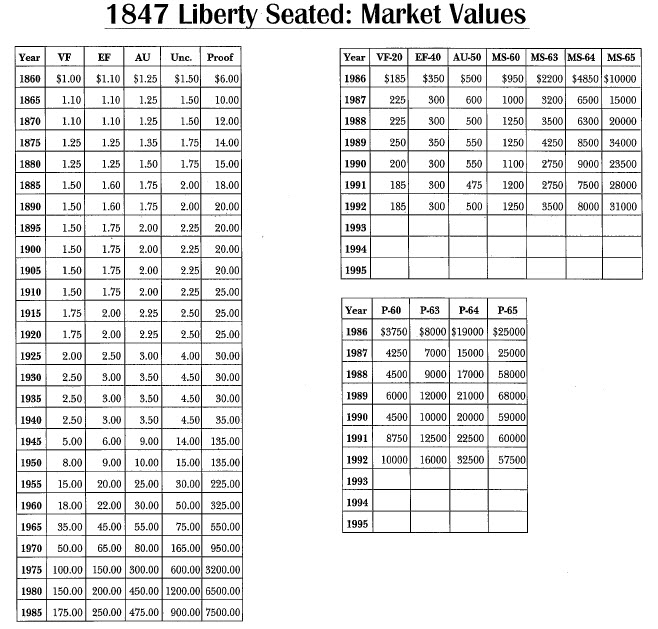
1847 Liberty Seated: Summary of Characteristics
Business Strikes:
Enabling legislation: Act of January 18, 1837 Designer of obverse: Robert Ball Hughes (after Gobrecht)
Designer of reverse: Robert Ball Hughes (after Reich)
Weight and composition: 412.5 grains; .900 silver, .100 copper
Melt-down (silver value) in year minted: $1.011 Dies prepared: Obverse: Unknown; Reverse: Unknown
Business strike mintage: 140,750; Delivery figures by month: June: 2,750; August: 75,500; September: 40,000; December: 22,500.
Estimated quantity melted: Unknown
Approximate population MS-65 or better: 4 to 8 (URS-3)
Approximate population MS-64: 15 to 25 (URS-5)
Approximate population MS-63: 25 to 50 (Population data from PCGS and NGC suggest that the 1847 is more available at the MS-63 level than in all grades MS-60 to 62 combined; the effect, if any, of resubmissions at the MS-63 level is unknown.) (URS-6)
Approximate population MS-60 to 62: 20 to 40 (URS-6)
Approximate population VF-20 to AU-58: 3,000 to 5,000 (URS-13)
Characteristics of striking: Usually well struck Known hoards of Mint State coins: None
Proofs:
Dies prepared: Obverse: At least 1; Reverse: At least 1.
Proof mintage: 20 to 30
Approximate population Proof-64 or better: 2 to 4 known (URS-2)
Approximate population Proof-60 to 63: 5 to 10 known (URS-4)
Commentary
The 1847 Liberty Seated dollar was made in large quantities and is common today in circulated grades.
Additional Information
The Year 1847 in History
Military engagements in the Mexican War concluded with a string of American victories at Vera Cruz, Cerro Gordo, Contreras, Churubusco, and Molina del Rey, capped by General Winfield Scott's triumph at Chapultepec on September 13th.
About 15,000 Mormons, who had fled persecution in a series of towns during their westward migration, reached the shores of the Great Salt Lake, where they found their land of refuge, although at the outset the district was anything but promising. Salt Lake City was founded by Mormon leader Brigham Young, who, with over 20 wives, was an ardent proponent of polygamy. Mormon wives were not always content with being one of many, and they often sought outside "entertainment," sometimes with U.S. troops passing through the area. Sylvester Mowry, a West Point graduate who visited Salt Lake City in 1854 with a military detachment, wrote this in a letter: (Copy furnished to the author by Henry H. Clifford; reprinted in the catalogue of the Henry Clifford Collection (Bowers and Ruddy Galleries, March 1982), description given prior to Lot 237.)
"We are here in the heart of the Mormon City, encamped in Union Square .... All you ever heard of polygamy here is true and a damned sight more. Brigham Young has a great number of wives or whores as you please. No one can tell how many; about fifty seems to be the general opinion. The other dignitaries in proportion. The Governor [Young] is as keen as the devil. He is an absolute dictator and is regarded as the direct delegate of God on earth .... Speaking of coming into the valley of the Great Salt Lake, [Heber C. Kimball, the second-ranked person in the Mormon Church] said we should be treated better than we ever were before, but we must keep our 'hands off the women .... The whole thing looked very much as if he and Brigham Young were afraid we were going to four way through town. Perhaps we shall." A later account stated: (Richardson, Beyond the Mississippi, p. 365.) "The majority of [Mormon] women will no longer accept one undivided half or sixth of a husband-when a full unit is available. They already show strong proclivities for running away with Gentiles. Many have married federal soldiers and prove excellent wives and mothers."