Silver Dollars & Trade Dollars of the United States - A Complete Encyclopedia
Q. David Bowers
1847 Liberty Seated Dollar
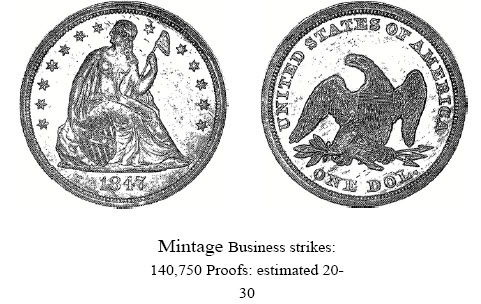
Coinage Context
Mint busy: The Philadelphia Mint was busy this year and turned out large numbers of silver coins of all denominations. Apparently, the silver supply problem had lessened somewhat. However, as is true of other years, silver dollars were only struck to the order of bullion depositors specifically requesting them.
Numismatic Information
Circulated grades: The 1847 is one of the most common of all Liberty Seated dollars of the 1840-1865 no-motto type. In 1963 when I was sorting through quantities of unattributed worn Liberty Seated dollars from the great Treasury release, I found more of this date than of any other early issue. However, in terms of appearances on the numismatic market, the 1842 and 1843 are more plentiful today.
Mint State grades: This issue is available in Mint State, and when seen is apt to be very frosty. From the beginning of the series to 1847, it is the date most often seen MS-60 or above. Still, it is scarcer in Mint State than the mintage figure suggests.
1847 Proofs: In my experience, the 1847 Proof dollar is exceedingly rare, although not quite in the class of 1841 or 1843, but slightly rarer than 1844. However, PCGS and NGC population data (as of December 1991) suggest that it may be more on a par with the "common" 1846, something which I cannot believe. It may be that the certification data represent the same coin(s) being resubmitted in hope of attaining a higher grade, or it may be one of those numismatic anomalies in which a great rarity appears on the market several times within a short period. (A particular instance of such an anomaly is represented by the great 1787 Brasher gold doubloon, of which just six or seven exist (plus several additional pieces of the earlier Lima style). After none had appeared on the market for many years, two pieces (the Robert Friedberg coin and the Garrett piece with hallmark on wing) came on the market within six months in 1979! Not too long thereafter, the high prices of these two specimens drew another coin out into the market, the Yale University Collection piece. In the same era, two more Garrett Collection Brasher doubloons were sold, one the 1787 with hallmark on the breast of the eagle and the other the Lima-style coin (which, according to John J. Ford, Jr. and Michael Hodder, is believed to have been made in 1786-per research since the publication of the Garrett catalogue).
Walter H. Breen writes of "many deceptive business strikes" masquerading as Proofs, (Walter Breen's Encyclopedia of U S. and Colonial Proof Coins, 1722-1989, p. 85. Breen gives the die characteristics of such prooflike pieces.) but in the present writer's view this does not affect the PCGS and NGC comment above. It does, however, affect the historical record as delineated in auction catalogues and price lists over the years. As an example of how price lists cannot be relied upon, A J. Fink, a Dayton, Ohio dealer in the years before about 1960, made many offerings of "Proof' Liberty Seated dollars of early dates, but virtually without exception these were polished coins or prooflike business strikes. Such price lists are not worth the paper they are printed on and have no value for numismatic research.
Varieties
Business strikes:
1-6. Normal Date: Breen-5438. Known with at least six obverse variations among pieces made for circulation, such varieties differing from one another by their date position in relation to the base of Liberty and the border denticles.
Proofs:
1. Proof issue: Obverse: Date about centered and not deeply impressed into the die. Left base of 1 over space between border denticles. Reverse of 1840-1850 (described under 1840). Walter H. Breen reports that in this use the reverse sometimes has a faint line from D in UNITED to eagle's wing tip to beak.