Silver Dollars & Trade Dollars of the United States - A Complete Encyclopedia
Q. David Bowers
Numismatic Information
Circulated grades: Although the 1862 silver dollar was minted in low quantities-just 11,540 business strikes were made-a fair number have survived to the present day. Although quite rare, the 1862 is not "impossible" and, in fact, is more easily obtained than the higher mintage 1861. Per Director Pollock's 1861 comment, quoted earlier, by 1862 there was a diminished demand for silver dollars for export to China. Probably, many remained stateside and were placed into circulation after the mid-1870s, by which time their bullion value had fallen to below face value. Alert bank tellers and others fished dozens of specimens out of circulation in the 1890s and the following decade.
Mint State grades: In Mint State the low-mintage 1862 is rare, and is especially so in MS-64 or better. High-grade coins typically have extensive die striae, as struck, on the obverse and reverse, making it appeal' to the uninitiated that such coins have been cleaned or brushed. On the obverse, the die striations are diagonal and are oriented in a line, more or less, with the top of Miss Liberty's lower left leg. On the reverse, the die striations are nearly vertical.
As is the case with other Liberty Seated dollars after 1858, the relative availability of Proofs takes much of the demand away from Mint State coins. Because of this Proof factor, the true rarity of Mint State Liberty Seated coins was not recognized in the literature until recent decades," Since the founding of the Liberty Seated Collectors Club in 1974 there has been a great interest in the subject. This and the availability of PCGS. and NGC population reports have made it possible to appreciate such coins today for the rarities that they truly are.
1862 Proofs: Proof dollars of 1862 are especially desired today due to the enticingly low business strike mintage of just 11,540 coins, the smallest of the era. However, Proofs, while rare, are more often seen than are those dated 1861 and are about on a par with those dated 1859 and 1860.
Some 550 copper-nickel: and silver Proof sets were delivered on January 27, 1862, and from then through February 1863, about 430 found buyers. Those that remained unsold were placed in a vault and not found until the mid-1870s, at which time they were sold. Beginning in January 1862 for new Proof sets, single silver or gold Proof coins were no longer sold to collectors. Buyers had to take entire sets or nothing.
Proofs difficult to order: After July 1862, ordering Proof coins from the Mint became a very difficult business, for silver coins rose significantly above face value (due to widespread hoarding by the public), and the Mint established two price schedules: one price (higher) for payment in greenbacks or bank drafts, and a lower price for payment in coin, like for like. Information concerning this is related in my book, The History of u.s.Coinage as Illustrated by the Garrett Collection. Neil Carothers, in Fractional Money, gives an excellent overview of the monetary situation in nineteenth century America and is particularly valuable for the understanding it imparts of the chaotic situation during the Civil War.
Varieties
Business strikes:
1.Normal Date: Breen-5468. One obverse and two reverse dies were prepared for business strike coinage. Mint State pieces have heavy die striations in the fields.
Proofs:
1. Proof issue: Breen-5468. Obverse: With date reasonably well centered and slightly slanting up-ward. Reverse: Two arrowheads touch; inner circle arc is seen at border denticles over UNITE.
Note: This reverse die was used to coin certain 1853 Proof restrike silver dollars.
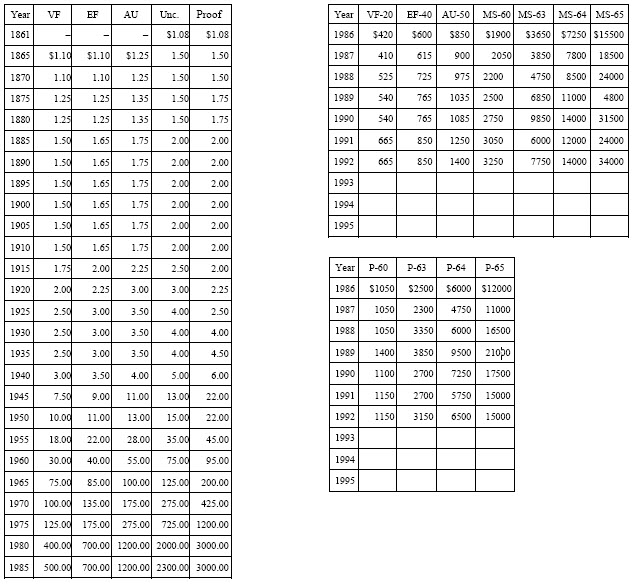
1862 Liberty Seated Dollar: Market Values