Silver Dollars & Trade Dollars of the United States - A Complete Encyclopedia
Q. David Bowers
1842 Liberty Seated Dollar
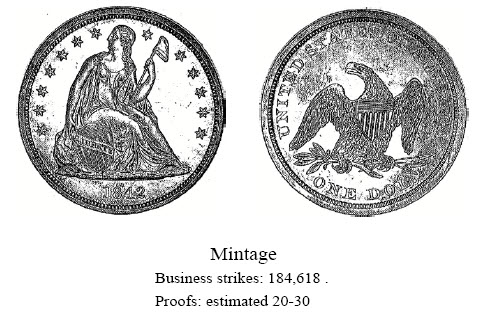
Coinage Context
Silver shortage continues: The supply of domestic silver remained small, and the production of silver coins 'was therefore smaller than it otherwise could have been. Unlike 1841 dollars, quantities of which are believed to have been exported in the early 1850s, most 1842 dollars were probably used within the borders of the United States.
The Assay Commission found that the fineness of silver coins (of all denominations as a class) minted at Philadelphia this year was .9009, or very close to .901, significantly (in terms of tolerances accepted at the time) above the legal standard of .900. (Information concerning the Assay Commission was given in the Annual Reports for most years.)
At the time the United States Mint was much more careful on such matters than were most mints of other countries. The finenesses of foreign gold and silver coins, as assayed at the Philadelphia Mint in the 1840s, were apt to vary widely.
Numismatic Information
Circulated grades: Here is one of those numismatic mysteries that make the collecting of Liberty Seated dollars such a fascinating pursuit: circulated 1842 dollars, a date with approximately the same mintage as 1841, are nevertheless nearly four times as commonly found on the market as are 1841s. Examples are plentiful in all grades from Very Fine to AU.
Mint State grades: Examples of the 1842 Liberty Seated dollar are occasionally available in grade levels of MS-60 to MS-63, but in higher grades the issue is a rarity. This is the first Liberty Seated dollar variety that has any claim to general availability in Mint State, but, even so, in absolute terms Mint State specimens are rare.
Proofs: Proofs were issued in sets (which also were notable for having contained the exceedingly rare 1842 Small Date quarter dollar) and possibly singly as well, Several complete 1842 copper and silver Proof sets have appeared in auctions or have been sold privately over the past century and a half, including one I purchased from Oscar G. Schilke in the 1950s; this set had been presented to the governor of Connecticut in 1842 and had been obtained from a descendant who found it in a bedroom bureau drawer.
Individual 1842 Proof dollars are seldom encountered, but they are more prevalent than 1841 and are possibly slightly more obtainable than those dated 1840.
Varieties
Business strikes:
1-2. Normal Date: Breen-5428. At least three obverse dies were used, making the positional varieties known today. One of these dies was used to coin Proofs (described below).
3. Blundered Date: With part of a numeral punched into the base of the rock above the 4 and 2 of date. 2 of date repunched at bottom. One reported specimen had rim cud breaks on the obverse rim. Discovered by David Rubin, 1988. (David Rubin's letter to the editor of The Gobrecht Journal, published July 1988. )
Proofs:
1. Proof issue: Obverse: Date about centrally positioned. Die file marks (in relief on the coin) slant down to the right near Miss Liberty's thumb at the shield and nearly vertically from the cap pole to the crook of her elbow (this die was also used to make business strikes; see above). Reverse of 1840-1850 (described under 1840).
