Silver Dollars & Trade Dollars of the United States - A Complete Encyclopedia
Q. David Bowers
1859 Liberty Seated: Market Values
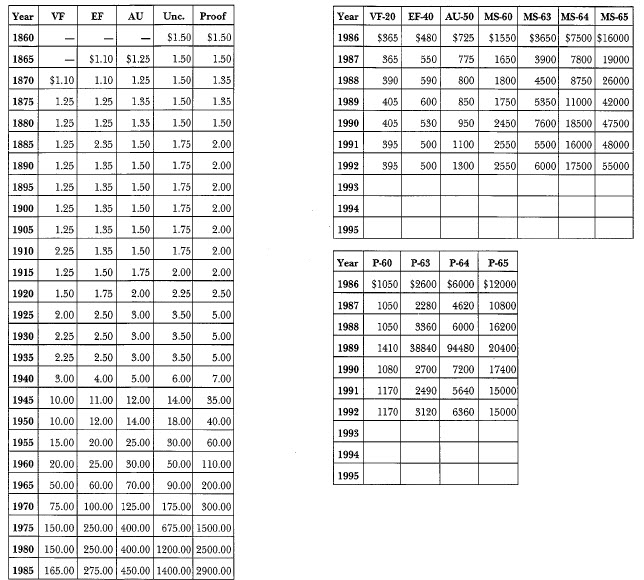
Business Strikes:
Enabling legislation: Act of January 18, 1837 Designer of obverse: Robert Ball Hughes (after Gobrecht)
Designer of reverse: Robert Ball Hughes (after Reich)
Weight and composition: 412.5 grains; .900 silver, .100 copper
Melt-down (silver value) in year minted: $1.052 Dies prepared: Obverse: 3; Reverse: 5
Business strike mintage: 256,500; Delivery figures by day: April 18: 33,000; April 19: 22,000; April 28: 2,500; June 27: 16,000; July 8: 13,000; July 21: 20,000; October 6: 22,000; October 13: 18,000; October 18: 17,000; October 24: 24,000; October 25: 16,000; November 21: 29,000; November 23: 22,000; December 10: 2,000.
Estimated quantity melted: Unknown
Approximate population MS-65 or better: 2 to 4 (URS-2)
Approximate population MS-64: 12 to 20 (URS-5)
Approximate population MS-63: 15 to 25 (URS-5)
Approximate population MS-60 to 62: 20 to 40 (URS-6)
Approximate population VF-20 to AU-58: 350 to 500 (URS-10)
Characteristics of striking: Many examples are weakly struck at one or both of these areas: stars (irregular weak striking, with stars 1 and 4 sharp and the others, especially 8 and 9, weak); head of Miss Liberty.
Known hoards of Mint State coins: None
Proofs:
Dies prepared: Obverse: 1; Reverse: 2 (including one used earlier).
Proof mintage: 800; net distribution c. 450 Quantity melted: 350 estimated
Approximate population Proof-65 or better: 24+/- (URS-6)
Approximate population Proof-64: 36+/- (URS-7)
Approximate population Proof-63: 47+/- (URS-7)
Approximate population Proof-60 to 62: 145+/- (URS-9)
Commentary
Most business strike 1859 silver dollars were exported to China.
Additional Information
The Dollar Coinage from 1859 Onward
The following is from R.W.Julian:(Specific contribution to this book, February 1992. R.W. Julian places less emphasis on the exportation of dollars during this period than did John M. Willem (in The United States Trade Dollar) or the present author (QDB). Source material is often conflicting.)
The heavy coinage of 1859-1860 arose from three reasons.
First of all, the Treasury had shut off Snowden's illegal high price purchases in 1858. Second, there was a heavy imbalance in the silver imports and exports in favor of the United States in 1858-59. The third reason was the sudden and heavy mining of silver beginning in 1859 at a time when the nation had no use for increased quantities of this metal; the economy was just coming out of a recession and the mints were buying very little, even at reduced rates, for subsidiary silver coinage. I do not think that the Oriental trade had any bearing on this problem, although clearly a few people in 1859 and 1860 thought that it did.
There is no doubt in my mind that silver dollars did indeed go to the Orient, but purely as bullion and only in very small quantities. If there had been a real demand for the American silver dollar, then there would have been no need for the Spanish or Mexican coin to be sent to the Far East. The minuscule coinage at San Francisco in 1859 (when there were ample supplies of silver to be had, either from the Comstock or as a by-product of gold mining in California) is a telling point against silver dollars being sent in quantity to the Orient. If American dollars could have been used, even as bullion, the premium on the Mexican would have dropped to bullion value. There is some doubt that those dollars that did stray to the Orient went to China; Pollock, on more than one occasion, referred to them being used in the East India trade, which seems to imply Indo-China or the Dutch East Indies rather than Canton.
There was very heavy melting of dollars in 1861 for use as bullion in the manufacture of subsidiary silver. In one case there were 40,000 silver dollars melted at Philadelphia. I suspect that a careful investigation of archival material would turn up meltings well in excess of that. (This may have been a contributory factor to the rarity of business strike silver dollars of the 1853-1859 span)
There is also the question of ingots. San Francisco and Philadelphia both made large quantities of silver ingots of varying quality, according to the needs of the depositor. (At times, in the early 1870s for example, Carson City made more in bars than it made in coins.) Ingots would have been much easier to send to the Orient and they were readily available. The whole point of the later trade dollar coinage was to introduce a coin to the Far East, which was considered a better way to dispose of our silver than mere ingots.
The following is from Harry Salyards:
Concerning the possibility of heavy import surcharges with silver as a cause of the large coinages of silver dollars of 1859-60, to me this is not convincing when one considers that there was a constant import surplus during 1854-57 of almost as great a magnitude, with no corresponding effect on dollar coinage; and there was actually an export surplus on silver in 1860, for the first time since 1853 (Hepburn, table p. 70, op cit.). Plus, as commented upon previously, while the Comstock discovery dates to 1859, the boom years in silver production came a good deal later. (Specific contribution to this book, November 1992.)