Silver Dollars & Trade Dollars of the United States - A Complete Encyclopedia
Q. David Bowers
1873 Liberty Seated Dollar
Coinage Context
Three different dollars: The year 1873 is especially interesting in the annals of American silver dollars for many reasons: (1) The Liberty Seated dollar was abolished with other denominations. (2) The trade dollar began. (3) This was the first year that the coinage system contained three different dollars made for circulation (the standard or Liberty Seated silver dollar, the new silver trade dollar of heavier weight, and the gold dollar; in the other years, 1878-1885, the Philadelphia Mint made trade dollars only as Proofs). (4) Beyond all these are the rarity of 1873-CC and the mystery of the vanished 1873-S.
By 1873, the melt-down value of the last Liberty Seated dollar issue minted was just a fraction over face value, not enough premium to warrant melting. This situation had not occurred for over two decades previously. Now, at last, Liberty Seated dollars in Treasury vaults and in private vaults of bullion dealers and banks (where many such pieces were held) were free to circulate once again when specie payments were resumed beginning in autumn 1876. That quantities of dollars were indeed held after 1873 is evidenced by a provision in the Act of July 14, 1875 which stated that United States bonds issued in 1870 were payable at the option of the government in standard silver dollars, 412.5 grains, or in gold coin.
The price of silver continued to drop, and in 1874 a Liberty Seated dollar was worth about 99¢ in melt-down value, dropping to 96¢ in 1875, 90¢ in 1876, and rising slightly to 92¢ in 1877. Liberty Seated dollars came out of the woodwork and were once again seen in circulation, particularly in the American West.
Treasury records are ambiguous on the official government attitude on silver dollars. Exactly how the Treasury came to own quantities of certain Liberty Seated dollars in Mint State is not known, in view of the practice at the time of paying out dollars to depositors of silver. Liberty Seated dollars were not minted for the government's own account.
Silver dollar coinage stopped: With the advent of the trade dollar in 1873, the Liberty Seated dollar, long the bane of various Mint directors, suddenly lost any further reason for continuance, and on March 29, 1873, production ended, following the Act of February 12, 1873 (popularly called "the Crime of '73" by its numerous detractors). Among other provisions, this legislation abolished the two cent piece, the silver three-cent piece, the half dime, and the silver dollar, and provided for the coinage of the trade dollar. Changes in weight were made for the dime, quarter, and half dollar. (See information concerning the act given below.)
The Philadelphia Evening Telegram on July 11, 1873 carried this notice on the front page: "The new law went into effect the first of April, and since that time none of the dollars coined prior to that date have been paid out." After July 10, 1873, many undistributed pieces still held at the Mint went to the melting pot. Included in the destruction was the large quantity of 2,258 unsold Proof dollars of 1873 and unspecified earlier years.
Commenting on the Act of April 12, 1873, W.A. Shaw in The History of Currency, 1252 to 1896, Second Edition, 1896, noted this: "The silver dollars previously coined (few of which were in existence) maintained their quality as legal tender. ... " This is still another indication that Liberty Seated dollars were rare in their own time.
Numismatic Information
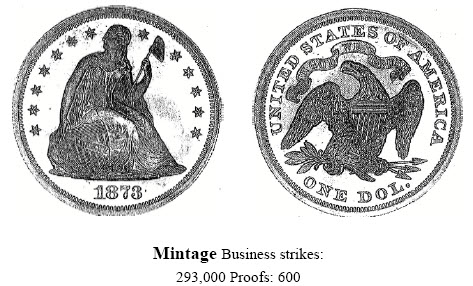
Closed 3 date numeral: All 1873 Liberty Seated dollars have the Closed 3 date logotype; knobs of 3 are large and close together. No Open 3 pieces were made. Some 293,000 business strikes came from several obverse dies distinguished from each other by minor differences in position.
1873 circulated grades: Many if not most 1873 Liberty Seated dollars went to the melting pot. Specimens of coins in circulated grades from Very Fine to AU are much rarer today than the mintage indicates.
Availability of Mint State grades: The 1873 is quite rare in Mint State, but not as rare as one might think. However, they are not significantly more elusive than are circulated pieces (which, as noted, are not easy to find). Mint State coins seen by me have been sharply struck and very frosty.
As early as 1977, which is "ancient history" in the annals of research on Liberty Seated dollars, Ron Severa, writing in The Gobrecht journal; noted that in Extremely Fine condition 1873 is not a common date and is "very undervalued." On the other hand, in July 1982 Donald Vettel did not hesitate to say that the 1873 was "uncommon" but "overpromoted."
Proofs: Only 600 Proof Liberty Seated dollars were struck this year, probably because by early in 1873 the standard silver dollar was considered to be an obsolete denomination.
Walter H. Breen suggests in his Proof coins Encyclopedia that "many" Proof 1873 silver dollars were undoubtedly among the 2,258 Proof silver dollars of various dates sent on July 10, 1873 to the melter and refiner at the Philadelphia Mint, who destroyed them. Because of this, the official mintage figures for various other years, particularly during the Linderman and Pollock administrations, do not reflect the actual distribution of these coins and are incorrect. On the other hand, if these Proofs were struck but never delivered by the coining department, then published mintage figures would not be affected, but undelivered pieces were never listed in annual reports.
Today, Proof 1873 Liberty Seated dollars are fairly scarce, but not so much that cataloguers take special notice of them.
Caveat emptor: In the early 1970s a number of cast counterfeits of the 1873 Liberty Seated dollar and the 1873 trade dollar appeared in numismatic circles. These are believed to have been made in Southeast Asia. Examples seen are very sharp and have a microscopically granular surface.
Varieties
Business strikes:
1.Normal Date: Breen-5494. Closed 3 in date. (All trade dollars of 1873 have open 3: knobs of 3 smaller, especially the upper one, and farther apart. Special credit is due Harry X Boosel, who over a period of years has studied the year 1873 intensively and has brought to light much information concerning numismatic issues of the time. See text.)
Knobs of 3 large, about equal in size, close together. Positional varieties exist among business strikes but have not been classified.
Proofs:
1. Proof issue: Breen-5494. Obverse: With closed 3 in date. Date about centered between rock base of Miss Liberty and the border denticles. Scattered rust marks are seen on Miss Liberty's breast and neck. Reverse: Die file marks at claw and stem. The same die used to coin Proof dollars in 1872.
2. Doubled Reverse Die: Reverse (also used in 1871 and 1872) with portions of motto sharply doubled through IN GOD WE, with IN GO particularly so. For example, the letter I has two sets of serifs at the top and bottom. Cf. Frank and Laurese Katen, Sale 50, June 1992, Lot 90; examined by the author.