Silver Dollars & Trade Dollars of the United States - A Complete Encyclopedia
Q. David Bowers
1849 Liberty Seated Dollar
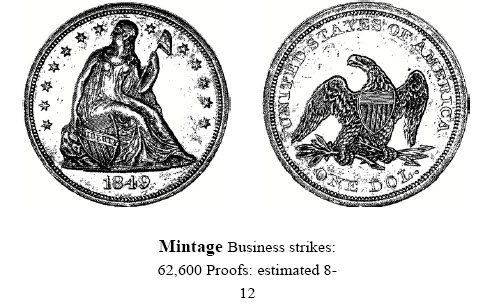
Coinage Context
Circulating issue: The year 1849 is the last in which Liberty Seated silver dollars were made in quantity at the Philadelphia Mint and also the last in which virtually the entire production was placed into circulation at the time. However, there are different opinions in the historical record, and it may be the case that large numbers of dollars of this date were exported (see citation on this subject under Coinage Context, 1848).
Gold vs. silver (once again): Gold! Gold! Gold! Newspapers of 1849 carried little other national news. As metal was extracted from placers (streams and loose soil) and mines, gold began to become common on world markets, and the ratio of the value of gold to silver began to slide from the statutory 16 to 1, to 15.45 to 1 early in 1851. As this trend continued, silver coins were withdrawn from circulation, hoarded and exported. Many were later melted as they were worth more than face value as bullion.
In 1849 Congress authorized the production of two new denominations, the $20 gold (officially, double eagle) and the diminutive gold dollar. Gold dollars were minted in quantity during the year, but no $20 pieces were made for circulation until 1850.
It was expected that gold dollars, made in large numbers, would help fill in when silver coins were in short supply (this demand dropped after 1853 when silver coins once more became available in the marketplace). From this point, the silver dollar became a whipping boy for certain Mint officials, who began to call for its discontinuation. It was not logical, they stated, to have two metal dollars, one (silver) worth more than the other (gold).
Numismatic Information
Circulated grades: Although this date has approximately the same mintage as the 1840, circulated examples are seen on the market more frequently.
Mint State grades: The 1849 silver dollar is quite elusive in Mint State. I have handled very few of this date over the years. I suspect that it may be somewhat rarer than the numbers I give below in the Summary of Characteristics, although the population data from certification services do not reflect this. At least one person who reviewed this manuscript considered the 1849 to be among the easier dates of the 1840s to find in Mint State grade. However, in 1982, Bruce Amspacher stated that he knew of only three specimens that could be called MS-65, a grade that today would be equal to MS-63 or so. One of these coins, appearing in February 1978 in the Bowers and Ruddy Galleries auction of the Fairfield Collection, was by June 1992 graded MS-66 by PCGS.(Article, "Liberty Seated Dollars," in the Monthly Summary, Coin Dealer Newsletter, July-August, 1982. Also, notes from Bruce Amspacher to the author, received in June 1992.)Chris Napolitano commented as follows:(Letter to the author, June 26, 1992.) "Very tough in MS-63 or better. This date is underpriced in Coin World 'Trends,' and Mint State coins are very difficult to locate."
Often several people describing a numismatic situation reminds one of the old verses about the six blind men describing an elephant. One felt the tail and said the elephant was like a rope. Another, who touched the trunk, said the beast was like a hose. Another, touching a leg, believed it Was like a tree, while still another blind man, feeling the elephant's side, thought the animal was like a wall. Similarly, opinions concerning the availability of a given coin, such as a Liberty Seated dollar in Mint State, are apt to vary from one person to another. Earlier, I cited a study which suggested that Mint State 1845 dollars were common, while I consider them to be rare, etc.
Proofs: Something happened to the issuance of Proof coins in 1849, and whatever it was, from this point through and including 1853 very few silver Proof sets were produced. The Proof Liberty Seated silver dollar of this date stands as the rarest of the 1840s, in my opinion, with the runner-up being 1841, and with 1843 coming close behind. As noted earlier, such comparisons are dangerous, for in the present instance it would take only a mini-hoard of three or four 1849 Proofs to be discovered to skew the rarity ratings.
By any measure, the 1849 Proof dollar is an extreme rarity today. Indeed, its rarity cannot be overestimated. In 40 years I have seen only three specimens.
Proof sets of the era: I know of no 1849 copper-silver Proof sets which have changed hands during the past half century. Walter H. Breen writes that no complete Proof sets (copper through gold) are known to exist, nor, apparently, is there any record of any having been made. (Walter Breen's Encyclopedia of u.s.and Colonial Proof Coins, 1722-1989, p. 91.)
From 1849 through 1853 the demand for Proofs apparently fell to a low point. The nadir was reached at the end of this short period. As is noted under the appropriate heading, few Proof dollars if any at all were coined in 1853. Certainly, there was no diminution of numismatic interest in America, at least not as reflected in any early accounts I have encountered. Neither was there any nationwide financial depression (as in 1837-1844 and 1857) to account for a dramatic fall-off in orders, nor were there any new Mint regulations against the issuance of silver coins. The explanation must await new information.
Varieties
Business strikes:
1. Normal Date: Breen-5441. Business strikes have not been studied in detail. Some early impressions have "chin whiskers," or die file marks extending below the chin, a feature also seen on certain other dates, notably 1853. A few have the reverse die rotated 15° to the right of normal alignment.
Proofs:
1. Proof issue: Obverse: With imperfection on 4 of date. Some marks in shallow relief (rust marks) near the border; see, for example, the denticles immediately below and to the left of the first digit of the date. Reverse of 1840-1850 (described under 1840).