Silver Dollars & Trade Dollars of the United States - A Complete Encyclopedia
Q. David Bowers
1863 Liberty Seated Dollar: Market Values
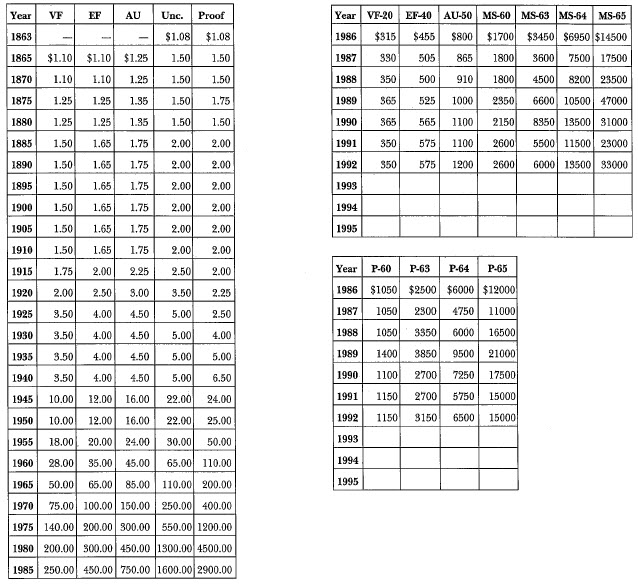
1863 Liberty Seated: Summary of Characteristics
Business Strikes:
Enabling legislation: Act of January 18, 1837
Designer of obverse: Robert Ball Hughes (after Gobrecht)
Designer of reverse: Robert Ball Hughes (after Reich)
Weight and composition: 412.5 grains; .900 silver, .100 copper
Melt-down (silver value) in year minted: $1.040
Dies prepared: Obverse: Unknown; Reverse: Unknown
Business strike mintage: 27,200; Delivery figures by day: March 9: 3,800; March 26: 1,400; April 10: 15,400; November 22: 6,600.
Estimated quantity melted: Unknown
Approximate population MS-65 or better: 8 to 12 (URS-4)
Approximate population MS-64: 10 to 15 (URS-5)
Approximate population MS-63: 15 to 25 (URS-5)
Approximate population MS-60 to 62: 20 to 40 (URS-6)
Approximate population VF-20 to AU-58: 275 to 400 (URS-10)
Characteristics of striking: Most are well struck
Known hoards of Mint State coins: None
Proofs:
Dies prepared: Obverse: 2; Reverse: 2 .
Proof mintage: 460; delivery dates from the coiner: March 5: 100 delivered; March 8: 160; May 26: 200.
Approximate population Proof-65 or better: 10+/- (URS-5)
Approximate population Proof-64: 56+/- (URS-7)
Approximate population Proof-63: 80+/- (URS-8)
Approximate population Proof-60 to 62: 210+/- (URS-9)
Commentary
In terms of specimens appearing on the market in auctions in recent years, Proofs outnumber business strikes by a considerable number.
Business Strikes:
Enabling legislation: Act of January 18, 1837
Designer of obverse: Robert Ball Hughes (after Gobrecht)
Designer of reverse: Robert Ball Hughes (after Reich)
Weight and composition: 412.5 grains; .900 silver, .100 copper
Melt-down (silver value) in year minted: $1.040
Dies prepared: Obverse: Unknown; Reverse: Unknown
Business strike mintage: 27,200; Delivery figures by day: March 9: 3,800; March 26: 1,400; April 10: 15,400; November 22: 6,600.
Estimated quantity melted: Unknown
Approximate population MS-65 or better: 8 to 12 (URS-4)
Approximate population MS-64: 10 to 15 (URS-5)
Approximate population MS-63: 15 to 25 (URS-5)
Approximate population MS-60 to 62: 20 to 40 (URS-6)
Approximate population VF-20 to AU-58: 275 to 400 (URS-l0)
Characteristics of striking: Most are well struck
Known hoards of Mint State coins: None
Proofs:
Dies prepared: Obverse: 2; Reverse: 2 .
Proof mintage: 460; delivery dates from the coiner:
March 5: 100 delivered; March 8: 160; May 26: 200.
Approximate population Proof-65 or better: 10+/- (URS-5)
Approximate population Proof-64: 56+/- (URS-7)
Approximate population Proof-63: 80+/- (URS-8)
Approximate population Proof-60 to 62: 210+/- (URS-9)
Commentary
In terms of specimens appearing on the market in auctions in recent years, Proofs outnumber business strikes by a considerable number.
Additional Information
Notes Concerning 1863-1864 Pattern $1
The following notes are from two specimens in silver of the 1863 and 1864 "pattern" Liberty Seated dollars with IN GOD WE TRUST on the reverse, Judd-345 and J-396 respectively; specimens appearing in the Van Arsdall and Antelope Valley Collections Sale, Bowers and Merena, January 1993. These observations are to aid in further study of the pieces, the exact time of striking of which is not known, but is believed to have been later than the dates on the coins:
The reverse of the 1864 dollar is from an earlier state of reverse used to coin the 1863.
The 1864 has numerous raised die finish lines, including one extending from the base of the final A in AMERICA about 40% of the way toward the back of the top arrowhead; diagonal lines from the upper left corner of R and I to denticles, diagonal lines from right side of base of upright of R into field; line adjacent to right side of ribbon of first A in AMERICA downward passing close to the end of the ribbon, and curving to near the top of the eagle's left (observer's right) wing; nearly horizontal line over middle and right side of T of UNITED and all of E; microscopic line from left bottom of N to eagle's wing, then discontinuous, then continuing again immediately under the eagle's dexter (observer's left) wing (this is the sole die finish line that is visible also on the 1863); and numerous die lines beneath and near the bottom two arrowheads. The spaces within the shield stripes are only partially polished, with the most polish at the leftmost space. Additional shield stripes appear somewhat curved, rather than flat, and have not been fully polished.
The 1863 die, from a later state, is more highly polished, obliterating most of the die lines just mentioned, adding more Proof surface within the shield stripes (although the rightmost shield stripe opening is still not polished, and the shield stripes toward the right are not polished at the base), adding Proof finish between the topmost claw and the branch, and traces of Proof finish in the ribbon folds under ST of TRUST.
The 1863 obverse die has an unfinished area under Miss Liberty's chin, with no Proof surface at all. The area of non-Proof surface extends in a curved line from the front of her chin to her shoulder. A raised die finish line extends from Miss Liberty's rightmost (observer's right) bottom curl upward to slightly above where the liberty cap meets the pole, with the line being not quite parallel to the pole, but coming toward it. A microscopic die finish line connects stars 4 and 5 near the centers between the points. Around the date are numerous die finish lines, including some curving down to the right below and at the bottom right of the 3. The digits 1 and 3 are L2 mm. from the base of Liberty. On the flat surface of the lower right of the digit 8 there is a semi-circular raised die defect. The digit 6 has some raised lumps at its lower left and a small raised area at the upper right of the lower curved area. The digit 3 has a tiny raised defect at the upper right.
The 1864 date has a tiny rough area between the right base of Liberty and the denticle, and is not fully polished. The area beneath Miss Liberty's chin is largely unfinished, but the unfinished area begins slightly in from the bottom of the chin. The top of the 1 in the date is slightly under 1.1 mm. below the base of Miss Liberty. The top of the 4 in the date is just about 1 mm. below the base of Liberty. The digits in the date have slightly rough surfaces. At the upper right of the lower curve of the 6, close to the inside, there is a small raised lump. In the upright of the 4 there is a small raised lump, roughly triangular in appearance, near the upper left. About 40% of the way down the upright of the 4, on the left side, are two small raised lumps.
Questions posed are these: (1) On what other date(s) of pattern and regular issue dollars was this reverse die used? (2) Was the 1863 obverse ever used to strike regular Proofs of that year (without motto on reverse)? (3) Was the 1864 obverse ever used to strike regular Proofs of that year?