Silver Dollars & Trade Dollars of the United States - A Complete Encyclopedia
Q. David Bowers
1853 Liberty Seated Dollar
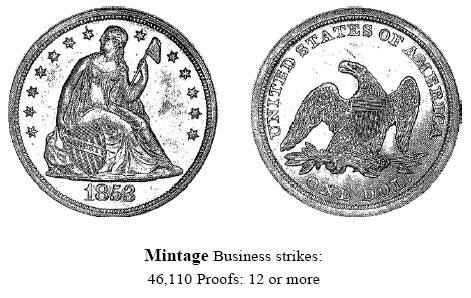
Coinage Context
The Act of 1853: By early 1853, the price of silver had risen on the international market to a point at which earlier Liberty Seated coins of various denominations, originally issued at face value, were being bought up by banks, bullion dealers, and brokers and melted down or exported. To continue to issue more such coins in quantity would have been an exercise in futility.
The Act of February 21, 1853 mandated a lowering of the weight of silver coins from the half dime through the half dollar but left the dollar untouched, a discrepancy frequently mentioned as an omission in various later annual Mint reports. The legislation was effective, and from 1853 until hoarding began in earnest in July 1862, large mintages plus the lack of a reason to melt coins combined to make issues from the three-cent piece to the half dollar very plentiful in commercial channels. By 1854 the silver coin crisis was over. However, as silver dollars were now worth more as bullion than as coins, they no longer circulated at par.
In his memoirs, Senator John Sherman observed: (John Sherman's Recollections of Forty Years in the House, Senate, and Cabinet, Vol. I, p. 46]) "No mention of the dollar was made in the Act of 1853. It had fallen into disuse and when coined was exported, being more valuable as bullion than coin."
The silver dollar mintage of 1853 was fairly generous for the period. As the first delivery was not until April 21, 1853, I assume that no dollars of this date circulated at par. Those minted in April and again in December (none was made in the meantime) apparently stayed within the borders of the United States, or at least the majority of them did, for dollars dated 1853 are more plentiful today than are those of the next several years.
Banks holding dollars: In April 1853, The Bankers' Magazine (p. 1004) noted the following: "The Mint will be abundantly supplied with silver for the creation of small coins contemplated by the late act of Congress. The Western banks have cut back their silver, awaiting the passage of the new Mint law. A shipment of $400,000 in silver was made by the several Louisville banks last week to the Philadelphia Mint. There are large sums, in dollars and half dollars, held by the banks of Indiana, Tennessee and other states, which will now be brought forward for recoinage."
This suggests that large numbers of Liberty Seated dollars were being held by banks as an investment, and were "brought forward" to be sold at a profit to the Mint, to be recoined into lighter weight coins (of the denominations from the half dime to the half dollar).
The entire situation of the utility of the silver dollar in the channels of American commerce during this time, indeed since the early 1840s, draws different interpretations and conclusions. However, as Senator Sherman, quoted above, and various Mint documents also relate, the Liberty Seated silver dollar was not seen in American circulation from spring 1853 until well into the 1870s. As noted earlier (under 1848), it is likely that beginning in 1848, many previously-minted coins were withdrawn from domestic use in commerce.
Neil Carothers stated that the silver dollar had never circulated generally and had been entirely unknown since 1806. (Fractional Money, footnote p. 120.)
Changes in 1853: R.W. Julian comments as follows: (Specific contribution to this book, February 1992.)
Beginning in 1853 the owner of silver bullion, who did not have a ready market for his goods, could either sell the silver to the mints to be used for subsidiary silver or have it made into dollars. There was a minor coining charge (.005 or 0.5%) for this service. The depositor could not get subsidiary silver for his bullion, although Director James Ross Snowden, to encourage sales of silver to the 'Philadelphia Mint, set an arbitrarily high price for such purchases and then paid off the depositor in subsidiary silver. This was illegal under the 1853 law and was not stopped by the Treasury until 1858.
The coinage of silver dollars after 1853 was almost totally on private account and reflected the amount of bullion deposited. There were some dollars coined on government account but the number was negligible because of accounting problems. Most of the dollars sold to visitors and collectors were Proof dollars, which cost $1.08 -in silver or gold until 1859 and then $1.60 during 1860-1861; after 1861 only Uncirculated pieces were available at the usual $1.08 in coin. No silver dollars were coined for circulation in 1858 because no one had any need for them.
At no time did merchants or banks purchase silver dollars for $1.08 each. unless they needed a mere handful for some special purpose. Heavy coinages were always made with silver bullion deposits. Some of this bullion was purchased on the open market, but most came through bullion dealers and mine owners.