Silver Dollars & Trade Dollars of the United States - A Complete Encyclopedia
Q. David Bowers
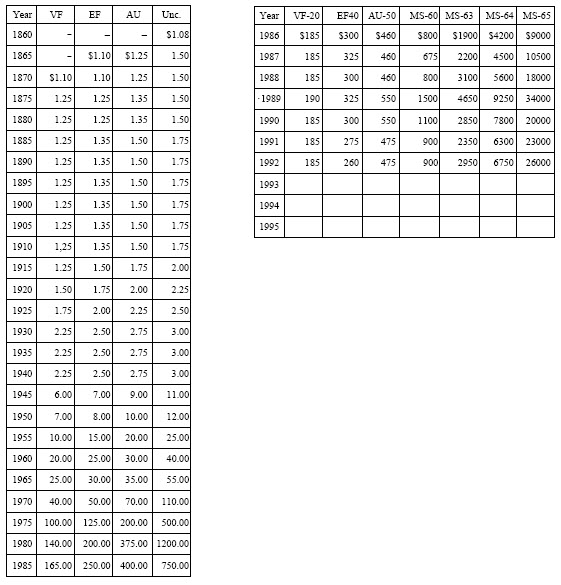
1860-O Liberty Seated: Market Values
1860-O Liberty Seated: Summary of Characterics
Business Strikes:
Enabling legislation: Act of January 18, 1837
Designer of obverse: Robert Ball Hughes (after Gobrecht)
Designer of reverse: Robert Ball Hughes (after Reich)
Weight and composition: 412.5 grains; .900 silver, .100 copper
Melt-down (silver value) in year minted: $1.045
Dies prepared: Obverse: Unknown; Reverse: Unknown
Business strike mintage: 515,000
Estimated quantity melted: Unknown
Approximate population MS-65 or better: 3 to 6 (URS-3)
Approximate population MS-64: 15 to 20 (URS-5)
Approximate population MS-63: 60 to 120+ (URS-7)
Approximate population MS-60 to 62: 5,250 to 5,750; most are in the MS-60 category and heavily bagmarked. (URS-14)
Approximate population VF-20 to AU-58: 2,500 to 4,500+ (URS-13)
Characteristics of striking: Usually fairly well struck. Satiny rather than deeply frosty lustre; fields usually prooflike, especially on non-hoard coins.
Known hoards of Mint State coins: An estimated 6,000 Mint State coins plus an unknown quantity of worn coins were in the Treasury release of 1962-1964; nearly all of the Mint State pieces are heavily bagmarked.
Proofs:
None
Commentary
The 1860-O is the most plentiful Liberty Seated dollar in Mint State, due to the availability of hoard coins.
Additional Information
Mint Sources of Silver
A retrospective commentary in the Annual Report of the Director of the Mint, 1867 (sic), noted, that the fiscal year ended June 30, 1860 represented the first time that Nevada silver had been deposited in any of the United States mints, during which year $102,540.57 worth was paid in. Much must have come from the Comstock Lode.
Prior to this, the main source of domestic silver had been in parting the metal from gold, rather than from specific silver deposits. It was not until fiscal year 1858 that silver deposits on their own came from elsewhere, during which year $15,623 was deposited in the mints from the Lake Superior district, followed in 1859 by $30,122.13 from the same source. 1859 also saw the first deposits of silver from North Carolina, amounting to $23,398.
1860, the first year of the Nevada silver deposit, was also the first year of deposit of silver from Arizona, ($135,357) and New Mexico ($1,200). This does not include silver parted from gold in any of these regions.