Silver Dollars & Trade Dollars of the United States - A Complete Encyclopedia
Q. David Bowers
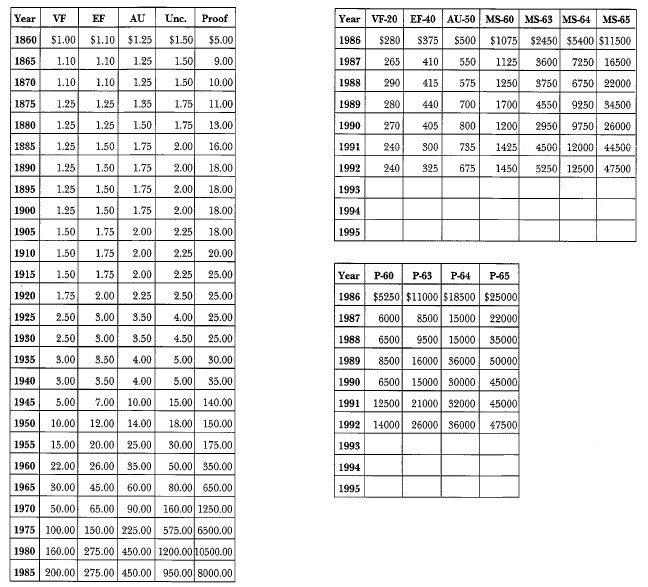
1849 Liberty Seated: Market Values
1849 Liberty Seated: Summary of Characteristics
Business Strikes:
Enabling legislation: Act of January 18, 1837 Designer of obverse: Robert Ball Hughes (after Gobrecht)
Designer of reverse: Robert Ball Hughes (after Reich)
Weight and composition: 412.5 grains; .900 silver, .100 copper
Melt-down (silver value) in year minted: $1.013
Dies prepared: Obverse: Unknown; Reverse: Unknown
Business strike mintage: 62,600; Delivery figures by month: January: 17,000; March: 14,000; May: 11,000; August: 2,000; October: 9,000; December: 9,600.
Estimated quantity melted: Unknown
Approximate population MS-65 or better: 1 or 2 (URS-1)
Approximate population MS-64: 2 to 4 (URS-2)
Approximate population MS-63: 10 to 20 (URS-5)
Approximate population MS-60 to 62: 30 to 60 (URS-6)
Approximate population VF-20 to AU-58: 1,400 to 2,000 (URS-12)
Characteristics of striking: Striking varies; some are well struck and others show local weakness (particularly at the eagle's neck immediately above the shield and at the eagle's dexter leg and/or at the stars on the right obverse). Some business strikes, even those with areas of light striking, have knife-rims, partial on the obverse, nearly full on the reverse, and prooflike surface on both sides.
Known hoards of Mint State coins: None
Proofs:
Dies prepared: Obverse: At least 1; Reverse: At least 1. Proof mintage: 8-12 estimated
Approximate population Proof-64 or better: 2 or 3 known (URS-2)
Approximate population Proof-60 to 63: 3 to 5 known (URS-3)
Commentary
Although this issue is readily available in worn grades, in Mint State it is very rare.
Additional Information
The Mint in 1849
At the Mint in 1849, the usual speed of striking coins was as follows: for silver dollars and half dollars, 60 pieces per minute; 75 per minute for the quarter dollar; 90 for the dime and half dime. (Information from The Bankers' Magazine, collected volume June 1848 through June 1849, p. 556.)
The Mint had about 50 employees. It was calculated that if the Mint were to operate at its maximum capacity and to coin 12 million dollars annually, half in gold and half in silver, with a standard proportion of distribution throughout the denominations, then it cost the government $106,000 to do this. More employees would be needed, however.
The Year 1849 in History
The Gold Rush was in full force in California, and each tale of riches reaching the East seemed to be more fantastic than the one before it. Imagination knew no bounds! Reality was somewhat different, and most of those who did go to the gold fields found it took a lot of hard work to make a day's pay. The first Easterners to arrive in San Francisco docked in February aboard the S.S. California, pride of the Pacific.Mail Steamship Company. In the meantime, tens of thousands of gold seekers were massing in Missouri, awaiting the chance to head westward as soon as spring conditions permitted travel.
In 1849 through and including September, $2,397,264.46 worth of gold had been deposited from California at the Philadelphia Mint and $260,561.42 at the New Orleans Mint. During the previous year, 1848, deposits from California totaled $44,177.00. (Data from The Bankers' Magazine, November 1849.)
Edgar Allan Poe, master of the macabre, died in Baltimore on October 7, 1849, not long after his mystical-sentimental poem, "Annabel Lee," Was published.
Popular tradition holds that on March 4, 1849, Senator David Rice Atchison was president of the United States-for just one day. Polk's term had expired on Sunday, and incoming President Zachary Taylor opted to be inaugurated on Monday. Atchison, who was president pro tempore of the Senate and thus next in succession to the presidency, filled the interregnum. What did he do during his term? Tired from his work, he stayed in bed!
However, John Kroon says this: (Letter to the author, March 17, 1992.) "As an amateur historian I have always objected to this statement. The Constitution is very clear in that the oath of office must be administered before anyone can be considered president. The wording is explicit. David Rice Atchison never took the oath of office. How can he be considered as having been president? The answer is that he should not be. In fact, during that 24-hour period, Taylor had a more legitimate claim to office, having been elected. This is one of these myths of U.S. history which just does not fit the facts."
At the New Orleans Mint it was a year for silver rarities, as few half dimes, dimes, and quarter dollars were coined. The Philadelphia Mint had its hands full with Chief Engraver Longacre's trials and tribulations with the new $20 denomination, and by year's end none had been coined for circulation. Just one is located today, a Proof pattern which is the pride of the National Coin Collection at the Smithsonian Institution. A second, made for Treasury Secretary William M. Meredith, passed from the Meredith estate to Stephen K. Nagy to an unlocated private collection. Nagy mentioned it to Walter H. Breen and was astonished when Breen identified it as Meredith's. (Letter from Walter Breen to the author, April 11, 1992.)
This year saw the first gold dollars, from all four mints. The public saved many Philadelphia Mint dollars as the first of their kind, including dozens of the limited mintage (Type I) issue without Longacre's initial L on the neck truncation. Later, the Mint struck half cents for circulation, the first since 1835. Experiments with a couple of non-standard alloys, meant for a proposed three-cent piece, resulted in striking patterns with a half dime obverse and two reverses having 3 or III in a plain field. Later, someone muled the two reverses; W. Elliot Woodward called the 3/111 combination "one of the rarest of U.S. coins and certainly the ugliest," provoking a remonstrance from the Mint's spokesman William E. DuBois.
Private mints operated by bankers, assayers, and others sprang up in San Francisco, and soon coins appeared bearing such names as Moffat & Co., Miners Bank, Pacific Company, N.G.N., and Cincinnati Mining & Trading Co. Meanwhile, to the north in the Oregon Territory, after a new governor ruled that state coinage would violate the Constitution, businessmen minted 6,000 $5 pieces and 2,850 $10 coins on their own. In Salt Lake City the Mormons operated their own mint and made coins of values from $2.50 to $20, using gold brought from California. In Philadelphia, Jacob R. Eckfeldt and William E. DuBois, who superintended the formation of the Mint Cabinet, eagerly studied gold coins privately minted in California and elsewhere, as they began arriving for assay, evaluation, and deposit. They saved particularly nice examples from the melting pot, and (except for two pieces stolen in 1858) the collection went to the Smithsonian Institution, where millions have viewed these historic relics.