Silver Dollars & Trade Dollars of the United States - A Complete Encyclopedia
Q. David Bowers
1859 Liberty Seated Dollar
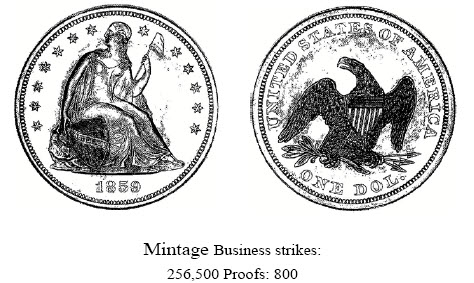
Coinage Context
Still another export issue: John M. Willem, in The United States Trade Dollar (p, 46), noted that the silver dollar coinages of 1859 and 1860, from all three mints, were made primarily for export to China. Most of these went to northern ports in China where the pieces were melted down and converted to bullion.
The Comstock Lode: New supplies of domestically mined silver remained scarce in the United States. However, this would change in the years to come, for in 1859 two prospectors, Patrick McLaughlin and Peter O'Reilly, discovered a deposit of ore on Mt. Davidson, in Washoe, Nevada, on property to which Henry Tompkins Paige Comstock, age 39, claimed rights. Comstock sold his interest, but his name remained behind in the Comstock Lode. The ore proved to yield metal in the ratio of about 75% silver and 25% gold and assayed about $4,700 per ton (as in typical ores, only a fraction of the ore consisted of valuable metal, but in this case the fraction was unusually valuable).
Although estimates have varied widely over the years, one modern source states that the Comstock during the next 11 years and $397 million by 1882. (Trager, The People's Chronology, p. 497.)
Silver from Arizona: New discoveries of silver in Arizona were exploited in 1859, and shipments of the metal began to reach the East, mostly by way of EI Paso, Texas. As of October 6, 1859 there were nearly two tons of silver bullion awaiting shipment from that point. Transportation was by mail coach, and was of uncertain safety.
(Cf. The Bankers' Magazine, November 1859, pp. 404-405.)
Numismatic Information
Circulated grades: As noted, the vast majority of the mintage of over a quarter million 1859 Liberty Seated dollars went to the Orient, where they were soon melted. Examples of this high-mintage date are scarce today in all grades.
Mint State grades: Very few Uncirculated specimens exist. Dealers' memories are not always precise on this, for the availability in quantity of Mint State 1859-O sometimes causes confusion, but mint markless coins are rarities. In 1992, dealer specialist Chris Napolitano told me that he had never had a Mint State 1859 in stock, in the course of handling several collections and many rarities. (Conversation at the Central States Numismatic Society Convention, Minneapolis, April 30, 1992.) In this grade the 1859 may be influenced by the resubmission of the same coins.
Proofs: Apparently, many Proofs were made this year in the hope that the public, which was becoming increasingly interested in numismatics, would buy them. Following R.W. Julian, the 45th edition of A Guide Book of U.S. Coins states that 800 Proofs were struck. However, today the issue is quite rare, and it is likely that 450 or fewer were actually distributed. Even that figure may be on the high side. There were hardly 450 numismatists in 1859 interested in buying Proof dollars from the Mint. However, enough coins survive today to indicate that 450 is a reasonable estimate of distribution.
Varieties
Business strikes:
1. Normal Date: Breen-5457. Three obverse and five reverse dies were made for this date, but it is believed that not all were employed.
Proofs:
1. Proof issue: Breen-5457.0bverse: With base of 1 repunched. Reverse: No.2 of 1858, now somewhat worn and repolished, but not with the rust seen when it was combined with 1875 and 1876 pattern silver coin obverses. (Judd, United States Pattern, Experimental and Trial Pieces, pp. 158-90-1420 to Judd-1422 pattern dollars of 1875), p. 1640-1470 and Judd-1471 pattern dollars of 1876).
2. Proof issue: Breen-5457. Obverse: As preceding. Reverse: Different from above. No description on hand.