Silver Dollars & Trade Dollars of the United States - A Complete Encyclopedia
Q. David Bowers
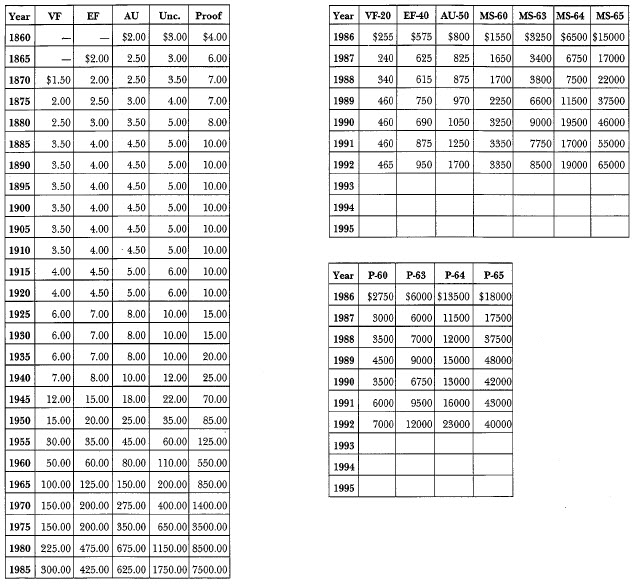
1856 Liberty Seated: Market Values
1856 Liberty Seated: Summary of Characteristics
Business Strikes:
Enabling legislation: Act of January 18, 1837 Designer of obverse: Robert Ball Hughes (after Gobrecht)
Designer of reverse: Robert Ball Hughes (after Reich)
Weight and composition: 412.5 grains; .900 silver, .100 copper
Melt-down (silver value) in year minted: $1.039 Dies prepared: Obverse: Unknown; Reverse: Unknown
Business strike mintage: 63,500; Delivery figures by day: January 30: 10,000; January 31: 18,000; February 4: 17,000; February 9: 18,500.
Estimated quantity melted: Unknown
Approximate population MS-65 or better: 0 or 1 (URS-O)
Approximate population MS-64: 2 or 3 (URS-2)
Approximate population MS-63: 2 or 3 (URS-2)
Approximate population MS-60 to 62: 8 to 12 (URS4)
Approximate population VF-20 to AU-58: 200 to 350 (URS-9)
Characteristics of striking: Usually weakly struck, typically with Miss Liberty's head and stars 8 through 10 flat. On the reverse, the eagle's dexter leg is often weak.
Known hoards of Mint State coins: None
Proofs:
Dies prepared: Obverse: At least 1; Reverse: At least 1.
Proof mintage: 60 to 125 estimated
Approximate population Proof-64 or better: 7 to 15 (URS-4)
Approximate population Proof-60 to 63: 25 to 45 (URS-6)
Commentary
Most 1856 business strike dollars were exported.
Examples are rare today in all grades.
Additional Information
General Silver Coinage
The Annual Report of the Director of the Mint, 1856, advised that since the passage of the Act of March 3, 1853, authorizing a reduction in the weight of silver coins, silver coins were circulating effectively. The director of the Mint felt, however, that the nation would never "fully realize the benefit of a sound specie circulation until all bank notes, at least below the denomination of $20, shall be excluded from circulation." However, this statement did not apply to silver dollars, which did not circulate in the United States.
Most private bank notes stopped circulating before the end of the Civil War, thanks to new laws. Evidently, after 1861 the Treasury wanted a monopoly, partly because many banks failed and left their creditors with worthless paper money, and partly to help finance the Civil War. Nevertheless, the United States did not enjoy a sound specie circulation until mid-December 1878, when for the first time in American history, federal silver coins, gold coins, and paper money were all on a par with each other.
The Year 1856 in History
In the presidential election James Buchanan, a Democrat from Pennsylvania, scored over his Republican opponent, John C. Fremont, the famous explorer, becoming America's only bachelor president. On May 22, one of the ugliest situations ever to take place in the chambers of the United States Senate occurred when South Carolina Congressman Preston Brooks, a nephew of Senator Andrew P. Butler, took umbrage at a verbal diatribe levied against Butler by Charles Sumner, senator from Massachusetts. Sumner had condemned Butler's defense of slavery. Brooks beat Sumner severely with a heavy cane, nearly causing his death. Several years passed before Sumner could resume his activities, and even then he was impaired. Georgia senators who watched the attack laughed, and before long Congressman Brooks was swamped with countless canes sent by pro-slavery Southerners who suggested that the canes could be used with effectiveness on other abolitionists as well.
The Western Union Company, a consolidation of smaller telegraph firms, received its charter. In 1856, Rudolph Wurlitzer who had come to Cincinnati from Germany in 1853, began a music retailing and manufacturing empire, which in the early twentieth century would make the' Wurlitzer Hope Jones Unit Orchestra (theatre pipe organ), a magnificent musical device of which over 2,000 were sold.
On May 14, 1856, James King of William, local do-gooder and proprietor of the San Francisco Daily Evening Bulletin, was
gunned down by a competitor, who was subsequently arrested. At the time, there was widespread dissatisfaction with the state of law enforcement in San Francisco, and a group styling themselves as vigilantes took the prisoner from the sheriff and held their own court proceedings, tried and convicted the murderer, and hanged him. Vigilante groups were formed in several areas of California.
William Walker, a soldier of fortune from the United States, led his followers in an invasion of Granada, the capital of Nicaragua, and in July set himself up as president of the Central American country. His regime, which gained diplomatic recognition by the United States, lasted less than a year.
John Greenleaf Whittier's poem, "Maud Muller," published in March 1856, became one of his best-known works. Whittier (1802-1892) was born to Quaker parents in Haverhill, Massachusetts, and grew up on a farm. Supporting himself through his school days, he attended a local academy. Inspired by the poetry of Robert Burns, Whittier soon became a prolific writer and editor of numerous periodicals. He was the secretary of the American Anti-Slavery Society, a position which brought him attacks for his views. Whittier's poems expressed his sincerity and nobility and have been popular ever since their initial publication. "Maud Muller" tells of a sweet, innocent country maiden who becomes enamored of a judge who stops by her farm to water his horse. The attraction is mutual, and as he rides away he wistfully contemplates her beauty and charm. As memory of her lingers, he realizes that his world of society and wealth is too different from hers to be reconciled with it. He weds a lady of fashion and power, and Maud takes a poor, unlearned man for a husband. As the years go by, Maud and the judge separately contemplate: "For of all sad words of tongue or pen, the saddest are these: 'It might have been.' "
Darling Nellie Gray, a song written by Benjamin Russell Hanby, a student at Otterbein College in Ohio, told of a slave who lived by "the old Kentucky shore," presumably across the Ohio River from freedom. It helped arouse anti-slavery sentiments, as did the still-popular Uncle Tom's Cabin which was researched in the 1840s when Harriet Beecher Stowe visited slaves in Kentucky. In 1856, a healthy male slave able to work hard in the fields had a market price in the $1,500 range.
At the Philadelphia Mint, the first Type III gold dollars were struck. Over 600 small-diameter pattern cents with a flying eagle motif were made for distribution to congressmen, newspaper editors, and others of influence. This set the stage to discontinue the large copper cent, minted since 1793, which had become expensive to manufacture and was widely viewed as being cumbersome to handle. At the same time, coin collecting was growing rapidly, and hundreds of citizens became interested in the hobby. Within two or three years an 1856 Flying Eagle cent became worth $1, then $2. The Mint began making restrikes, and over the next several years a nice trade was developed in these. In 1856, the San Francisco Mint struck its first dimes and its only Type II gold dollars.