Silver Dollars & Trade Dollars of the United States - A Complete Encyclopedia
Q. David Bowers
1851 Original, Liberty Seated Dollar
Coinage Context
Record exports: In 1851 the excess of silver exports (including bullion, U.S. coins, and coins from other countries) over imports jumped to $23 million, up dramatically from just $2 million the year before according to Neil Carothers in Fractional Money (Carothers, Fractional Money, pp. 108-112, was the source of much of this information.) Coinage Laws of the United States reports an export figure of $6,635,839, much lower than Carother's figure but still showing a significant increase over the year before. (See Additional Information at the end of this 1851 section) In the years 1850 and 1851 the excess exports of silver were more than the entire face value of silver coinage for the preceding two decades. Much of this exportation was in the form of earlier-minted coins, including silver dollars, which tended to be of higher weight and better acceptability than foreign silver coins in domestic circulation. It is likely that large numbers of Liberty Seated dollars minted 1840- 1850 saw destruction in this manner. New silver coins were made in very small amounts in 1851, and none was put into circulation at the time. The relatively new gold dollar denomination helped fill the gap, and production soared to a record 3,658,820 pieces, over seven times the quantity minted the previous year.
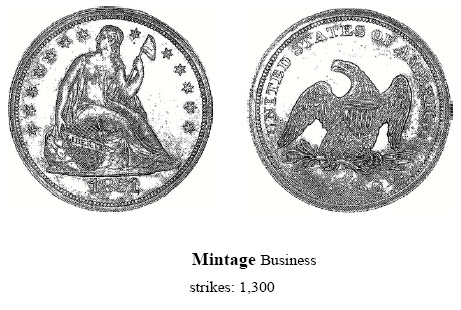
Low silver dollar mintage: The Philadelphia Mint restricted its issuance of silver dollars this year and in the year following. Only a few silver dollars, 1,300 in all, were made in 185l. (It is unknown if these were coined for depositors or on government account. R.W. Julian, letter to the author March 10, 1992.) Carothers writes that none was placed into circulation at the time; otherwise, they would have been exported or melted. In the year 1851 gold dollars were produced at the Philadelphia Mint in the staggering and unprecedented quantity of 3,317,671 pieces, a number higher than the entire combined Liberty Seated silver dollar coinage from its inception in 1840 up to this point in time (1851). The Liberty Seated dollar had become a second-rate coin in American commerce, and from about this point onward little notice would be made of it.
What to do?: It became evident as the silver dollar became worth over $1.03 in meltdown value that the only way to have silver coins circulate was to select a ratio of silver unfavorable to gold. Another alternative was to make all silver coinage fiduciary-meaning that its face value would exceed its meltdown value. Congress had received proposals for such in 1800, 1816, 1819, 1832 and 1850. The subsidiary three-cent piece adopted in 1851 was doing quite well, yielding a profit, and demonstrating the value of fiduciary coinage. However, the members of the Congress Were not sufficiently versed in currency matters to understand the system. (Then, as has also been true in the 20th century, congressional testimony demonstrated vividly that the average elected official had very little knowledge of coinage, finance, and related matters. As modern-day readers of relevant articles in Coin World, Numismatic News, and other periodicals know well, trying to educate congressmen on tile fine points of coinage, designs, etc., is usually an exercise in futility.) Congress believed in general that silver was better as a standard than gold. Likewise, to a majority of Americans gold was still unfamiliar as a common medium. Only one country in the world (England) had adopted gold as its sole standard.
The eventual answer would be the Act of 1853, lowering the weights of all silver coins except the dollar and three-cent piece such in 1800, 1816, 1819, 1832 and 1850. The subsidiary three-cent piece adopted in 1851 was doing quite well, yielding a profit, and demonstrating the value of fiduciary coinage. However, the members of the Congress were not sufficiently versed in currency matters to understand the system. Congress believed in general that silver was better as a standard than gold. Likewise, to a majority of Americans gold was still unfamiliar as a common medium. Only one country in the world (England) had adopted gold as its sole standard. The eventual answer would be the Act of 1853, lowering the weights of all silver coins except the dollar and three-cent piece.