Commemorative Coins of the United States
Q. David Bowers
1935 Old Spanish Trail Half Dollar
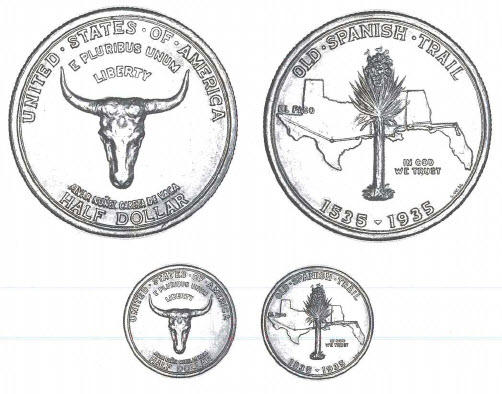
A Cozy Arrangement
The 1935 Old Spanish Trail half dollar represents another instance of an issue primarily designed for the exploitation of coin collectors. L.W. Hoffecker, who was to keep his fences mended by investigating later abuses of commemorative half dollars on behalf of the American Numismatic Association and to serve as president of the ANA 1939-1941, was the originator of this promotion. Throughout the 1930s Hoffecker was extremely successful in diverting attention away from himself, so that criticisms directed toward the Hudson half dollar, the Boone pieces, and others did not fall on his shoulders as well. However, the situation can also be considered in the light that in 1935 collectors were fair game and that Hoffecker was simply trying to make a profit, the desire of many businessmen.
There is no particular reason why he or anyone else should have sold commemoratives for purely altruistic reasons. While Wayte Raymond, Stack's, B. Max Mehl, and others acted as distributors and thus were not the focal point of many complaints, Hoffecker dreamed up the scheme, much as C. Frank Dunn did for the Boones, and the fact that he was not chastised by the numismatic community is a testimonial to his adroit sense of politicking and public relations. Apart from his involvement with commemorative coins, Hoffecker earned his living in the mortgage and loan business and as a rare coin dealer (trading as Watkins Coin Company, Box 553, El Paso, through the early 1950s).
In his book, United States Commemorative Coins, Arlie Slabaugh viewed the Old Spanish Trail half dollar situation quite charitably: "This is one commemorative half dollar that was 'made' by a collector for collectors. Not only was Mr. Hoffecker, the designer, a collector (some years later he was president of the American Numismatic Association), he also was chairman of the El Paso Museum Coin Committee which distributed the coins, the proceeds from which went to further the work of the Museum. Although he was closely connected with the issue from start to finish, there were no wild cries of favoritism from collectors about the handling of the coin; in fact, Mr. Hoffecker was highly commended for his efforts toward a wide and equitable distribution."
In 1929 Hoffecker had set himself up as chairman of the Gadsden Purchase Commission in El Paso, essentially a one-man organization, and had sought to have a commemorative half dollar issue of 10,000 coins to be sold for $1.50 each. Despite approval of the bill in Congress, President Herbert Hoover vetoed the Gadsden Purchase proposal. Undaunted, Hoffecker tried again, this time with the Old Spanish Trail half dollar in 1935. The second time around, Hoffecker visited Washington several times, became friends with congressmen, and even had a five-minute visit with President Franklin D. Roosevelt ("that saved us"). (Per a letter from Hoffecker to Trygve Rovelstad, September 26, 1935.)
In a form letter to collectors dated June 12, 1936, Hoffecker noted in part: "I have been selected by our Museum to handle the distribution of the coins; to have a free hand and not be dictated to by anyone. I promised to take all our coins from one mint and all of one date. I spent considerable time in Washington and met with much opposition on account of the 'racket' some of the committees are making of these commemoratives, and I made the above guarantees voluntarily and am prepared to live up to my promises." Lest recipients of the letter doubt his credentials, Hoffecker noted that he was American Numismatic Association member No. 2610, and that references could be supplied by Farran Zerbe, Howland Wood, and W.A. Philpott, Jr. (Farran Zerbe was a past president of the ANA and the distributor of several commemorative issues; Howland Wood was a highly regarded numismatist associated with the American Numismatic Society; William A. Philpott, Jr. was secretary of the Texas Bankers Association (Dallas, Texas) and was well known as a collector of currency and choice coins'.)