Commemorative Coins of the United States
Q. David Bowers
1927 Vermont Sesquicentennial Half Dollar
(1927 Vermont-Bennington Half Dollar)
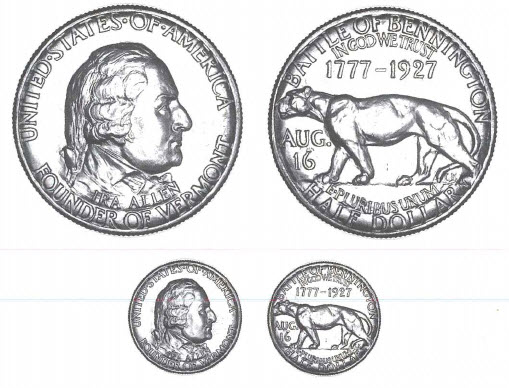
The Battle of Bennington Commemorated
The 150th anniversary of the independence of Vermont and the Battle of Bennington was commemorated by half dollars not to exceed 40,000 in quantity, authorized by Congress two years in advance of the celebration, on February 24, 1925, as part of the enabling legislation that also provided for the California Diamond Jubilee and Fort Vancouver half dollars. In its original form the congressional bill (submitted on January 9, 1925) called for commemorative gold dollars and silver half dollars, but the provision for gold dollars was later dropped. It is perhaps a reflection of the conservative nature of Vermonters that the two senators from that state, Dale and Greene, requested that just 40,000 half dollars be struck in an era in which this was a very small authorization. Undoubtedly, had they asked for 100,000 half dollars, this request would have been granted. The Vermont Sesquicentennial Commission intended that funds derived would benefit the study of history.
Although Vermont had been explored by French and British trappers and others in the 1600s, it was not until 1724 that the first permanent fort was erected in the area, a settlement by the British. Fifteen years later Governor Benning Wentworth of New Hampshire asserted that the limits of his state extended to about 20 miles east of the general line described by the north-ward course of the Hudson River including Vermont. Governor George Clinton of New York took immediate exception to what he considered to be a brazen claim and insisted that Vermont belonged to his state. Later British authorities resolved the dispute by awarding the land to New York.
Settlers in Vermont, most of whom felt greater allegiance to New Hampshire or believed that Vermont should be an independent area, resisted New York's claim. Ethan Allen (1739-1789) and Ira, his younger brother (1751-1814), formed a group of insurgents known as the Green Mountain Boys, "Vermont" being the French language equivalent of "green mountain." Soon thereafter the Revolutionary War erupted, and the Green Mountain Boys captured Fort Ticonderoga from the British. The boundary dispute with New York was set aside.
On January 15, 1777, at a meeting held in Windsor, a town in the eastern section of Vermont just across the Connecticut River from New Hampshire, Vermont declared its independence. During the following summer the Green Mountain Boys, by that time led by Captain John Stark and Colonel Seth Warner (Warner was a cousin of the Allens), together with New Hampshire militia and local citizens, overwhelmed and defeated a contingent of British forces (augmented by hired Hessian soldiers) at the Battle of Bennington on August 16th. Vermont sought to become a state of the Union, but Congress did not approve. At one time negotiations were held with the British, and the possibility that Vermont might become a part of Canada was explored. However, Vermont remained an independent state until it finally joined the Union in 1791. In the meantime it issued its own copper coinage dated 1785-1788.
Ira Allen, who was a member of the Green Mountain Boys and later was active in government, was influential in drafting Vermont's declaration as an independent state in 1777. Allen served in the General Assembly and was state treasurer 1778-1786. His gift of $4,000 established the University of Vermont. Despite his recognition as the founder of Vermont, his life ended ignominiously. Following a purchase of arms from France for the State of Vermont in 1795, he sought to return with them to America. On the way back Allen was captured by the British, who accused him of supplying munitions to Ireland. Finally in 1801 he returned to Vermont, where he found himself penniless and in danger of being thrown into debtors' prison because of tax deficiencies. Leaving the state which he founded, Ira Allen fled to Philadelphia. His death occurred in January 1814, by which time he was virtually penniless. His estate was valued at only $70.
Design, Minting, and Distribution Sherry Fry, a New York sculptor whose work included a statue of Ira Allen on the campus of the University of Vermont and who had exhibited at the 1915 Panama-Pacific International Exposition (among many other places), was selected by the Vermont Sesquicentennial Commission to prepare designs for the new half dollar. Fry submitted a portrait of Ira Allen for the obverse and a representation of the Bennington Monument obelisk for the reverse. Fry's efforts were rejected.
French-born sculptor Theodore Spicer-Simson was contacted in an effort to enlist another artist, but nothing came of the correspondence. (Among other commissions, Spicer-Simson (1871-1959) sculpted for the American Numismatic Society. Although the artist was born in France and died there, he did much of his work in the United States. His wife, the former Margaret Schmidt, was known as a painter of miniatures.) Subsequently, Charles Keck, who earlier designed the gold dollar for the Panama-Pacific International Exposition, was named as Fry's replacement. Keck suggested a different portrait of Ira Allen for the obverse and a depiction of the Catamount Tavern, a 1777 gathering spot, on the reverse. Operated by Stephen Fay and his sons Joseph and Jonas, the Catamount Tavern was a small wooden building located on the crest of a small hill north of Bennington. A stuffed catamount displayed on top of a 20-foot pole in front gave the tavern its name. (This information is from Michael K. Garofalo's article, "A Vermont Diary," in The Commemorative Trail, Fall 1986, pp. 23-26.)
The Commission of Fine Arts felt that a building would not be appropriate for the reverse design, nor would the Bennington obelisk. The suggestion was made to John Spargo, chairman of the Vermont Sesquicentennial Commission, that an actual catamount (the Canada lynx, a large cat related to the puma and mountain lion) or a motif depicting the trophies of battle (flags, arms, and regalia) would be more appropriate. Keck drew two sketches with catamounts and one with the implements of war. One of the catamount motifs was accepted.