Commemorative Coins of the United States
Q. David Bowers
1936 Norfolk Bicentennial Half Dollar
An Obscure Anniversary
An obscure event in American history was the change of Norfolk, Virginia, a village founded in 1682, to the borough form of government in 1736. In 1936 the city fathers thought that the 200th anniversary of the town's borough status should be brought to national attention by issuing Norfolk Bicentennial commemorative half dollars. The same year, 1936, was also the 300th anniversary of the 1636 land grant on which Norfolk was founded.
The Norfolk Advertising Board, Inc. tried its best to have a commemorative coin bill passed but had to settle for a medal instead. Numismatic interest in the medal would have been nil (for collectors of the era preferred legal-tender coins), the committee recognized this, and medals were not struck. Undaunted, the Norfolk Advertising Board made another attempt and pointed out to Congress that, for example, San Francisco had already had two commemorative half dollars (1915-S Panama-Pacific International Exposition and 1936-S San Francisco-Oakland Bay Bridge), whereas Norfolk had none. On June 28, 1937 representatives of Norfolk succeeded in having Congress authorize the production of a quantity not to exceed 25,000 silver Nor-folk Bicentennial half dollars to be struck of a single design and at a single mint; never mind that the anniversary to be celebrated had already passed.
A Cluttered Design
William Marks Simpson, a Baltimore sculptor, and his wife Marjorie Emery Simpson were named to prepare the designs. Mr. Simpson did the work for the 1937 Roanoke and Antietam issues as well.
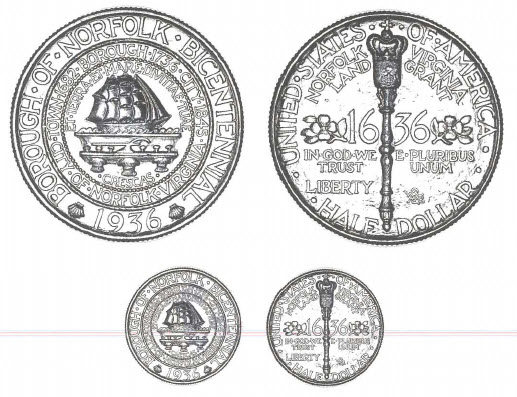
The obverse of the 1936-dated Norfolk Bicentennial half dollar stands as the most cluttered commemorative design ever produced, and contains inscriptions in three concentric circles, enclosing a three-masted ship at the center, below which are a plow and three sheaves of wheat, taken from the seal of the city. The reverse has enough lettering for two coins, at the center of which is the Royal Mace of Norfolk.
The design of this half dollar attracted the attention of Cornelius Vermeule, who commented in 1971: (Numismatic Art in America, p. 202.) "A low point in coin design.... Skill in spacing the letters, in casting the surfaces, and in modeling the high relief saves much of the composition. Still, the commemoration of Norfolk's various anniversaries is a document of epigraphy rather than figural art. A small ship, a plow, and three sheaves of wheat making up the city seal and providing a full repertory in themselves, are surrounded by too much inscription. To all this has been added the primary designation of commemoration. On the reverse is another special inscription giving more commemorative statistics, plus all three required words and mottoes. The Royal Mace of Norfolk forms the vertical accent and the statutory inscriptions are packed in to the lower left and right of its handle. It took a family team, like the Frasers to produce this coin, both W.M. Simpson and his wife, M.E. Simpson, signing the reverse. The coin gives ample evidence that two heads need not be better than one."
Sales Methods
25,013 coins were produced in 1937 (13 for assay) and were subsequently offered for $1.65 each by the Norfolk Advertising Board, which gave a slight discount for orders of multiple coins, up to a limit of 20. This limit was later dropped in order to permit quantity sales to dealers. The Board advised that distribution would begin by August 15, 1937, and informed collectors as follows: "Indications are that owing to the popularity of the Norfolk half dollar the issue will be over-subscribed, and view of this numismatists who have not placed orders are urged to act quickly.
F.E. Turin, manager of the Norfolk Advertising Board, Inc., aggressively promoted Norfolk Bicentennial half dollars in an innovative manner. In an effort to stimulate sales and to answer the complaint that the British royal crown should not have been put on a United States coin because our country is a democratic nation and the British Empire is a monarchy, this answer was given in a full-page advertisement in The Numismatist: "The crown appears because it is part of Norfolk' s historic mace which is reproduced on the half dollar. Norfolk is the only city in the United Stateswith a mace with such an historic back-ground. It was presented in 1653 by the then Lieutenant Governor of Virginia , Robert Dinwiddie .... "
Another answer in the same advertisement addressed the complaint of the coin being minted in 1937 but dated 1936, by stating that "we tried to secure passage of the bill when Congress was in session in 1936, but owing to the coin-medal mixup were unsuccessful. Numismatists who followed the project know all about this and how President Roosevelt promised to correct the mistake of Congress. This he did and the bill passed provided that the coins were to bear the date 1936 regardless of when they were minted."
The same notice suggested that "the Norfolk half dollar should be extremely valuable to a collector, especially now in view of the above, and rather than be criticized we should be complimented for having minted a coin with such an unusually attractive and unique design. We have approximately 9,000 pieces still on hand and will sell them on a first-come first served basis as long as they last-the price as originally advertised being $1.65 for the first coin on the order and $1.55 for each additional piece up to the limit of 20 to one person."