Commemorative Coins of the United States
Q. David Bowers
1988 Olympic Silver Dollars
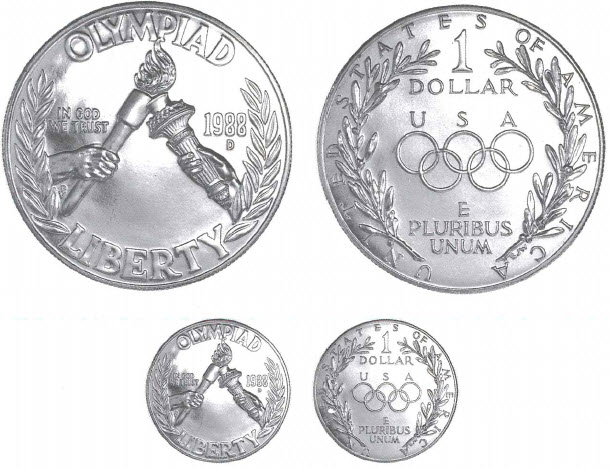
The 1988 Olympic Games in Seoul
The Summer Olympic Games held in Seoul, South Korea in 1988 furnished the opportunity for the United States government to create an issue of commemorative coins.
Some observers suggested that, as the event was not held in the United States, it was not an appropriate subject for American coinage. Professional numismatist Luis Vigdor commented: "I think American coins should celebrate American events. And the same holds true for other countries' coinage as well. No country has the right to celebrate on its coins an event which is occurring on the other side of the ocean. Some of the smaller countries, some of the smaller mints, have been doing this for years-commemorating all kinds of events just for commercialization. And I think that's wrong, no matter who is doing it." (As quoted in "Coins For the '88 Olympics," by Ed Reiter, Coinage, November 1987, p. 98.)
Rep. Frank Annunzio, who by this time had shepherded through Congress most of the successful commemorative proposals of the decade, introduced a bill, subsequently modified and signed as Public Law 100-141 on October 28, 1987, providing for not more than 10 million silver dollars and not more than one million gold $5 pieces, the dollars to be offered at a price to include a $7 surcharge and the half eagles to bear a surcharge of $ 35. Coinage standards specified were similar to those used on other commemorative silver and gold coins of the decade. Profits from the coins were earmarked for the United States Olympic Committee.
The Design
The Treasury Department invited 10 private sculptors and seven Mint employees to compete to design the two coins. (These artists from the Mint were invited to participate in the competition: Elizabeth Jones, Sheri Joseph Winter, Michael Iacocca, Edgar Z. Steever IV, James C. Licaretz, John Mercanti, and Chester Y. Martin. The private artists invited were: Alex Shagin, Patricia Lewis Verani, Karen Worth, John Cook, Domenico Facci Mark Rhea, Marcel Jovine, Eugene Daub (in 1991 he would be named recipient of the Saltus Award given by the American Numismatic Society), and Mico Kaufman. Robert Weinman (son of noted sculptor Adolph Weinman) was given the opportunity but declined to compete. Years earlier Weinman had been the chief judge in the selection of the 1776-1976 Bicentennial designs for regular coinage.) Each artist from the private sector received $1,000 as a compensation, whether or not his or her designs were chosen.
At its meeting on January 21, 1988, the Commission of Fine Arts reviewed 60 outside designs and 24 from Mint artists. Those in attendance were asked to vote on the sketches presented, which for purposes of anonymity were marked not with artists' names but with designations such as A-4, H-4, J-1, etc. Member Diane Wolf noted that this was a historic moment in commemorative coinage, for it represented only the second time that designs had been selected by competition and the first time that the Commission participated in the choices. It was noted that the Secretary of the Treasury James A. Baker III would review the Commission's ideas and make the final decisions. (Minutes of the Commission meeting, January 21, 1988, p.2.)
The silver dollar obverse design chosen was a sketch by Patricia Lewis Verani, labeled H-1, which was not the obverse design recommended by the Commission (which chose J-2 instead).
A Mint news release described Mrs. Verani's work: "The obverse of the silver Olympic coin displays Lady Liberty's torch and the Olympic torch merging into a single symbolic flame. Olive branches, emblems of peace, encircle the torches." The artist came to the Mint and worked with the staff in the production of models.
The design for the reverse by U.S. Mint sculptor-engraver Sheri J. Winter (labeled as L-2; the motif recommended by the Commission) featured "the five-ring logo of the U.S. Olympic Committee, framed by a pair of olive branches," the same news release noted.
Sherl J. Winter Comments
Sherl J. Winter commented on working conditions at the Mint while he was de-signing the reverse of the 1988 Olympic dollar. "When I created the design, I was happy with it, even though the problem with this and other work was that it always had to be done under duress. Then there was too much of the situation of other people telling you what to do, changing your designs, and that sort of thing. When we at the Mint submitted designs and sent them to Washington, then they changed them. You expect some of this, but in recent times they did it so much that it created problems at the Mint in getting the work done on time. By the time I left the Mint, it was really getting difficult to work there, to say the least. I don't know if it was committees down there or it was the director of the Mint or who. I never really knew who was making things difficult, but I am sure it was a lot of different people. The way they were handling it- you know, instead of letting the Mint art department handle the artwork, they would have thing sent down there, then committees and lots of different people would have their in put into it until things were changed so much that it sort of took the fun out of it.