Commemorative Coins of the United States
Q. David Bowers
1936 York County Tercentenary Half Dollar
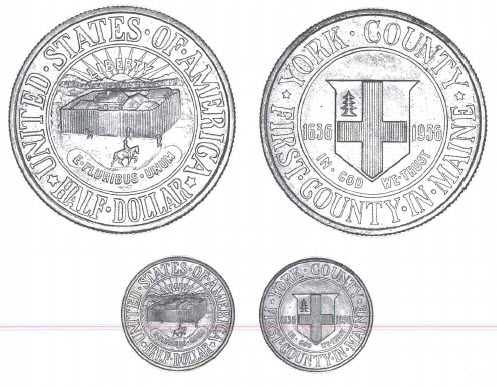
Still Another Obscure Celebration The world will little remember the 300th anniversary of the founding of York County, Maine, but it furnished the occasion for the issuance of a half dollar authorized by Congress on June 26, 1936. The legislation provided that not more than 30,000 pieces were to be struck at a single mint and of a single design.
The Committee for the Commemoration of the Founding of York County was in charge of arrangements and tapped Portland artist Walter H. Rich to create the designs. These were translated into models (apparently made of brass rather than the usual plaster or clay) by the G.S. Pacetti Company of Boston, from which the Medallic Art Company made dies.
The obverse design depicted a stockade representing Brown's Garrison (the original settlement in York County; later the site of the York National Bank in Saco) with a rising sun in the background and a horse and rider in the foreground, a motif taken from a sketch printed in The Proprietors of Saco, a 1931 work by Frank C. Deering. The reverse illustrated the seal of York County, consisting of a cross within a shield, with a pine tree at the upper left.
In his monograph on commemorative half dollars printed in 1937, B. Max Mehl gave his opinion of the motifs: "The design reminds one more of a medal than a coin and in my humble opinion would hardly win a beauty prize." On the other hand, Stuart Mosher, writing in 1940, considered the obverse design "splendid."
Distribution
Distribution was handled through the committee, which variously styled itself in printed literature as the York County Commemorative Coin Commission, the York County Tercentenary Commemorative Coin Commission, and, as stated on the enabling legislation, the Committee for the Commemoration of the Founding of York County.
Walter P. Nichols, an ardent numismatist and later a member of the American Numismatic Association Board of Governors (elected for two years in 1939), personally supervised all aspects of the release of the pieces and was careful to do everything in a proper manner. His actions be-came a model for other groups who intended to issue half dollars, and he corresponded with many of them to share his experiences and give advice. Much of this is recounted in the present author's compilation, An lnside View of the Coin Hobby in the 1930s: The Walter P. Nichols File, and in letters to Nichols quoted in the present text.
At the outset 10,000 pieces were reserved for residents of Maine, and 15,000 were earmarked for sale out of state. At the original issue price of $1.50, apparently more than half went to Mainers, whereas those ordering from out of state paid $1.65 per coin and accounted for thousands more. After the initial burst of enthusiasm about 6,000 remained unsold and continued to be distributed through the 1950s, well after Nichols' death (August 8, 1941). Historian Arlie Slabaugh relates the Association sold pieces in the 1950s for $15.50 per group of 10, at which time the remainders were quickly liquidated.
When the present writer's firm auctioned coins from the Nichols estate in 1984, a few York County half dollars were included, so technically it can be said that complete distribution was not concluded until that late time.
Collecting York County Half Dollars
York County half dollars seem to have been struck and handled with particular care, far more so than the typical commemorative issue of its year. At the time they left the Philadelphia Mint, specimens were relatively free of abrasions, bagmarks, and other evidences of contact. Today York County halves are readily available on the market. Most examples are in the middle Mint State range, with MS-63 and MS-64 being about average, although MS-65 coins are not difficult to locate. The York County half dollar was popular at the time of issue and remains so at the present day.
GRADING SUMMARY: As noted, this issue was well handled at the Mint and in distribution, and most examples are in higher grades and are relatively free of marks. Obverse points to check for friction include the horse and rider and the stockade. On the reverse the top of the shield is a key point. Some coins have been brushed and have a myriad of fine hairlines; these can be detected by examining the coin at various angles to the light.