Commemorative Coins of the United States
Q. David Bowers
1918 Illinois Centennial Half Dollar
(Lincoln-Illinois Half-Dollar)
A Commemorative Is Created
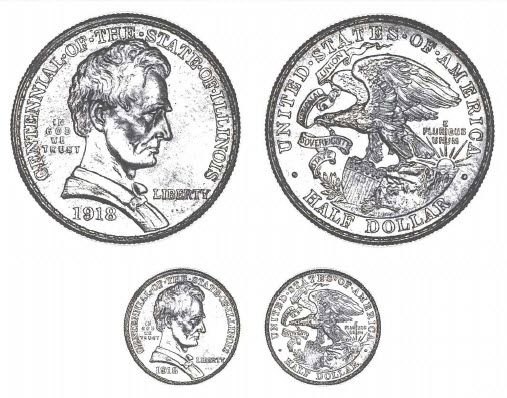
The next commemorative ha1f dollar produced was the issue struck in 1918 to celebrate the centennial of the admission of the state of Illinois into the Union, a coin which set the precedent for numerous other state and local anniversaries to be observed on commemorative coinage during the next several decades.
The name of Illinois is from the French adaptation of Iliniwek, a consortium of Algonquin Indian tribes. Early explorers of the region, the French set up various settlements and outposts. Although France ceded Illinois and adjacent areas to England under terms of the Treaty of Paris in 1763, it was not until two years later that the transfer took place. Under the British flag numerous pioneers attracted by the availability of land came to Illinois from Virginia and other eastern colonies. Illinois was captured from British forces during the American Revolution. In 1800 it became part of the Indiana Territory; then on February 9, 1809 (coincidentally, three days before Lincoln's birth), Illinois was established as a separate territory in its own right, later becoming a state in the Union on December 3, 1818.
Abraham Lincoln, shown on the obverse of the Illinois Centennial half dollar, was born in Kentucky on February 12, 1809, and in 1830 relocated with his family in Illinois, where he practiced law, served in the state legislature (1834-1841), and was elected as a delegate to Congress (1847-1849). Following recognition gained by his participation in debates with Stephen A. Douglas in 1858, Lincoln was nominated in 1860 as the Republican candidate for president. Elected to the office, he served with honor and distinction throughout the Civil War period. The Emancipation Proclamation and Gettysburg Address of 1863 were among his many accomplishments. Lincoln's death occurred on Apri115, 1865, after he was shot by actor John Wilkes Booth in Ford's Theatre in Washington, D.C.
The enabling legislation for the commemorative coin issue, approved on June 1, 1918, well into the centennial year, provided that 100,000 half dollars of standard weight, composition, and other requirements be struck to observe the Illinois state centennial. The expenses of die preparation and other necessities leading to the coinage were to be borne by the centennial commission, a typical arrangement.
Sinnock's reverse motif is adapted from the Illinois State seal and is in the present writer's opinion the finest work he ever did for a legal tender coin. Years later Sinnock, who was to become chief engraver in 1925 following the death of George T. Morgan, produced the Roosevelt dime and Franklin half dollar among other things, but none of his later coins or medals seem to have the appeal of the 1918 Lincoln commemorative half dollar reverse. The border of the obverse and reverse consists of beads and pellets, an attractive substitute for denticles.
Striking and Distribution
All 100,000 authorized Illinois Centennial half dollars were struck, plus an additional 58 pieces for assay. Offered for sale at $1 each through the Springfield Chamber of Commerce and other outlets, the Illinois half dollars met with a popular reception, and most were sold, including several thousand to B. Max Mehl, at a price of just slightly more than face value.
A Springfield bank retained about 30,000 pieces until the "Bank Holiday" of March 1933, after which most went to dealers for a slight premium over face value, (According to B. Max Mehl in The Commemorative Coins of the United States, 1937, p. 8.) and a small number may have been released into circulation. Large quantities remained on the market until early 1936, at which time the numismatic demand for commemoratives of all kinds was such that the surplus was readily absorbed by the market.
As nearly all known specimens are in one degree of Mint State or another, and as the author has never seen a well worn piece, it can be presumed that any pieces released into circulation remained there for but a short time before they were extracted as souvenirs, and in any event such circulating quantities must have been small.
Collecting Illinois Half Dollars
In the intervening years since its issue, the Illinois Centennial half dollar, also known as the Lincoln-Illinois half dollar, has been a favorite with collectors. In 1938 David M. Bullowa, writing in The Commemorative Coinage of the United States, stated: "This coin is excellent in execution and design and has been generally praised. " In 1975 Arlie Slabaugh in United States Commemorative Coinage noted: "This design is generally considered as being one of the best of the 'state' issues." These sentiments have been repeated by many numismatists since.
Most known specimens are in Mint State and have lustrous, frosty surfaces, typically with contact marks on the portrait of Lincoln and in the obverse field. The relief and rather complicated design of the reverse serve to protect the reverse field from such marks, with the result that it is not unusual to see a coin graded, for example, MS-60 on the obverse and MS-63 on the reverse. This situation has many counterparts elsewhere in numismatics (most familiarly on the Morgan silver dollars of 1878-1921 and $ 20 gold coins of 1850-1907 in which the obverse portrait is susceptible to marking, whereas the more elaborate design of the reverse protects the reverse field).
Most Illinois Centennial half dollars have technical grades from MS-60 to MS-63 and are designated by the obverse grade only. Thus a coin with an MS-60 obverse and an MS-63 reverse is typically sold as MS-60, a coin with an MS-63 obverse and an MS-65 reverse is usually designated as MS-63, etc., although some careful cataloguers will grade the sides separately, as MS-60/63 or MS-63/65. Higher level Mint State coins are elusive.
GRADING SUMMARY: Examples were struck with deep, frosty finishes, giving Mint State pieces an unusually attractive appearance today. On the obverse the typical coin shows contact marks or friction on Lincoln's cheek and onother high parts of his portrait. The field typically shows contact marks. The reverse is usually from one to three points higher due to the protective nature of its complicated design. Most examples are lustrous and frosty, although some are seen with partially prooflike fields.