Commemorative Coins of the United States
Q. David Bowers
1934-1938 Boone Bicentennial Half Dollars
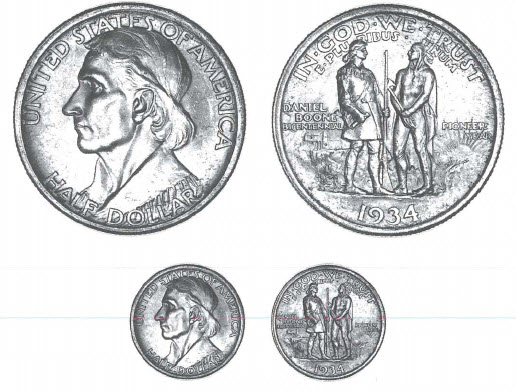
Origin of the Boone Half Dollars
The 200th anniversary of the birth of Daniel Boone, famous frontiersman, trapper, and explorer, furnished the occasion for the most flagrant abuse of commemorative coins seen in the series. The Daniel Boone Bicentennial Commission, located in Lexington, Kentucky, ostensibly desired to raise money in coordination with a group known as the American Order of Pioneers, Inc., with the approval of Boone's descendants, to restore several historical sites pertaining to the famous frontiersman. Legislation passed on May 26, 1934, provided for the coinage of 600,000 silver half dollars.
The subject being commemorated, Daniel Boone, was born in 1734 near Reading, Pennsylvania and by 1752 had moved to North Carolina. He became an explorer and hunter on the frontier. In the late 1760s Boone explored Kentucky, and in March 1775 he and 30 others cut the Wilderness Road from the eastern region of Tennessee to the Kentucky River, at which point the settlement of Boonesborough was established. During the Revolutionary War Boone was captured by Indians and turned over to the British authorities in Detroit. Released back into the custody of the Indians, Boone was adopted as a son of Shawnee Chief Black Fish and was given the name of Big Turtle. While thus engaged, Boone learned of a strategy between the British and Indians, who intended to seize Boonesborough. Boone escaped in time to travel 160 miles by foot and warn the Boonesborough settlers, thus allowing them to prepare for the attack. After a series of incidents Chief Black Fish came to believe that Boone had supernatural powers and opted for peace. In later years Boone moved several times and served in several sessions of the Virginia legislature. Boone's skirmishes with Indians and his activities in the Revolution, discussed only briefly here, made him an American folk hero.
The Design
Augustus Lukeman, the New York sculptor who had taken the place of Gutzon Borglumin the carving of the epic memorial on Stone Mountain in Georgia in 1925, was selected to prepare the models for the Boone half dollar. Depicted on the obverse was the bust of a young man said to represent Boone, an artist's conception, for no original portrait is known to exist of the pioneer (another depiction of Boone is found on the 1921 Missouri half dollar). The reverse showed Shawnee Chief Black Fish standing with Daniel Boone, who held in one hand a peace treaty and in the other a musket.
Correspondence preserved in the National Archives reveals that Lukeman's de-signs sparked a bitter debate between the artist and C. Frank Dunn, secretary of the Boone Bicentennial Commission, who had examined the models and stated them to be "historically impossible." Supporting Dunn was the Boone Family Association, which requested that the Commission of Fine Arts fire Lukeman and select another artist. This the Commission refused to do, and over a period of time the Boone faction and Lukeman worked out a few compromises-not to the complete satisfaction of anyone. The controversies surrounding the design were soon forgotten and indeed were never prominent in the numismatic press.
Writing in 1971, Cornelius Vermeule in Numismatic Art in America paid the design and the artist a high compliment: "Because of its broad, bold concept of figures, this coin ranks as one of America's best artistic endeavors. Lukeman should have pursued his career as a designer of dies."
Distribution Begins
Although the legislation provided that 600,000 Boone Bicentennial half dollars! be struck, it was somewhat curious that in October 1934 the entire first issue amounted to just 10,007 pieces, obviously a portent of the future. The pieces were shipped to Kentucky, where C. Frank Dunn, operating from an office on the second floor of the Phoenix Hotel in Lexington, dutifully set about selling as many as he could for the issue price of $1.60 each. Those not sold were Simply kept on hand. There was no particular stir about them made in the numismatic community.
In 1935 the exploitation of collectors began, seemingly in an innocent way, when 10,010 pieces were struck in Philadelphia in March and 5,005 each at the Denver and San Francisco mints in May. These were dated 1935 on the reverse of the coin, representing the issue date. Philadelphia coins were offered for $1.10 each, and $1.50 was charged for each Denver and San Francisco coin. A 1935 Boone set of three coins cost a total of $4.10. So far the only problem was that it was no longer the bicentennial of Boone's birthday, and there was no reason to continue celebrating a 1934 anniversary in 1935. Of course, in some peoples' minds this was reason enough to mount the charge of exploitation. However, more was to come....