Commemorative Coins of the United States
Q. David Bowers
1936 Wisconsin Territorial Centennial Half Dollar
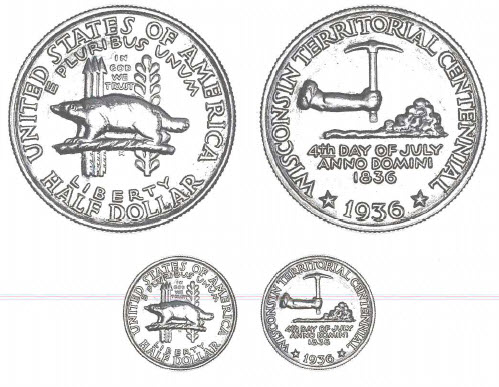
Another Obscure Anniversary
The year 1936 marked the 100th anniversary of the establishment of the territorial government in Wisconsin, and it was deemed appropriate to observe the occasion with a commemorative half dollar issue. Wisconsin did not join the Union until 12 years after 1836, so the centennial is not of statehood but is, as noted, of the establishment of the territorial government, a rather obscure event to observe with a nationally-distributed coin.
On May 15, 1936, a congressional bill was approved that provided for no fewer than 25,000 coins to be struck of a single design and at a single mint, in connection with the event commemorated. It is worth noting that on May 15, 1936, Congress also approved half dollars pertaining to Bridgeport, Connecticut and to Delaware, and that, although a minimum amount of 25,000 was specified, there was no upper limit. Presumably, the issuing commissions could have ordered any higher number desired.
The Design
The Coinage Committee of the Wisconsin Centennial Celebration selected David Goode Parsons, an art student at the University of Wisconsin, to prepare the designs. The Committee stated that the territorial seal should be used on one side and a badger on the other. The Mint found Parsons' models to be poorly executed and rejected them, after which the Committee suggested that the Treasury Department name a suitable artist. The Commission of Fine Arts recommended New York sculptor Benjamin Hawkins, who took up the work and vastly revised it, so that the finished product bore little resemblance to what Parsons originally created.
The obverse showed a stout badger facing to the viewer's left, standing on a small log, with three vertical arrows and a stiff olive branch behind, representing hostilities with native Indians and eventual peace. According to Mint records this side is the obverse, although a number of writers in the commemorative field have felt differently.
In its final form the reverse depicted the simple design used on the Wisconsin Territorial seal, consisting of a forearm holding a pickaxe above a small mound of earth and rock clumps, said to represent lead ore. Below appears the inscription 4TH DAY OF JULY / ANNO DOMINI / 1836, referring to the date when the first territorial governor, Henry Dodge, took office.
Stuart Mosher, in United States Commemorative Coins, 1940, discussed the motif: "Though Wisconsin is known as the 'Badger State' and the badger is shown on the state's arms, it is not indigenous to that territory. It probably originated as a nick-name for lead miners who came from the East and who lived in dug-outs like the hillside burrows of the badger. Eventually the name 'badger' was applied to anyone living in the state, and finally 'Badger State' became a familiar expression."
Cornelius Vermeule, writing in 1971, was no admirer of the coin: (Numismatic Art in America, p. 194.) "Like the Old Spanish Trail, the coin of 1936 that marks the hundredth anniversary of Wisconsin's formation as a territory smacks of amateurism. The models were the work of an art student at the University of Wisconsin .... This half dollar of the United States is, as a work of art, little more than a high school medal of the dullest variety. As a visual experience, it ranks with some of the worst local-society or small-occasion medals which have a timelessness if only in the mediocre level of their art."
Distribution
In July 1936, 25,015 Wisconsin Territorial Centennial half dollars were struck at the Philadelphia Mint. They were subsequently offered for sale at $1.50 each. Initial orders were handled by the Wisconsin Centennial Coin Committee, John Callahan, chairman. Shortly thereafter Rev. Fred W. Harris, a Wisconsin numismatist and director of the distribution committee, shared the work of handling orders and inquiries. Correspondence sent to a collector informed the recipient that distribution was to begin about June 1st and that "we anticipate a shortage, so you better send in your order soon."
In addition to those dispersed elsewhere, many coins found buyers at the Wisconsin Centennial celebration in Madison, held from June 27 to July 5, 1936. Large quantities remained unsold, and a decade later pieces could be ordered in groups of 10 for $1.25 each from the State Historical Society. By January 2, 1952, the Society had raised its price to $3 per coin (plus postage of 7¢ for the first coin and 1¢ for each additional piece). (Per a letter of that date to numismatist James N. Phillips.)
Collecting Wisconsin Half Dollars The design was not a favorite with collectors, and relatively little enthusiasm was ever shown for it. Instead, the issue was considered to be just one of many entries in the 1936 commemorative half dollar sweepstakes.
Today examples are readily available, with most being in lower Mint State levels such as MS-60 to MS-63.
GRADING SUMMARY: The flank of the badger is an obvious spot to check for friction, and it is nearly always present if you look closely enough. The miner's hand is another checkpoint. Most Wisconsin halves are very lustrous and frosty, except for the higher areas of the design (which often have a slightly polished appearance).