Commemorative Coins of the United States
Q. David Bowers
1989 Congress Bicentennial Half Dollars
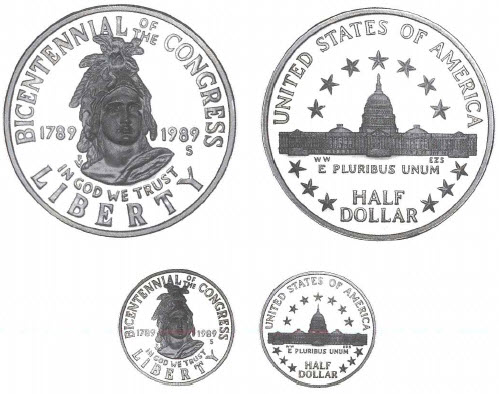
Anniversary of Congress Commemorated
In 1787 the Constitution of the United States mandated the creation of a new United States Congress consisting of two representative bodies, the Senate and the House of Representatives. This two-house or bicameral system was intended to be a compromise between the conflicting interests of large and small states and was an important step in the development of democratic government. With the addition of the executive branch (the president), an effective check and balance system was implemented.
The first United States Congress to meet under the Constitution convened early in 1789 in New York City, then the capital of the United States. The initial group consisted of 22 senators and 59 representatives from a population of about four million people. Vice President Adams presided over the Senate and Frederick Muhlenberg of Pennsylvania was selected as the first speaker of the House of Representatives. In 1800 Congress moved to the Capitol building, then unfinished, in the Federal City, later named Washington, D.C. By 1989, when the Congress Bicentennial was observed, the 101st Congress of the United States consisted of 5 35 members comprised of 100 senators and 435 representatives from a population of about 245 million.
A descriptive brochure issued by the Mint noted: "When our Congress first met on March 4, 1789, we were a struggling young nation of 13 individual states. To bring us together as one, the new Constitution mandated the creation of a new Congress. Unlike other lawmaking bodies of the time, Congress truly reflected the diversity of the people it governed-farmers and merchants, soldiers and politicians, commoners and aristocrats. Other countries believed this idea of the people making their own laws was certain to fail. Soon, from the Atlantic to the Pacific, America grew as Congress planted the seeds of expansion. And from around the world, people came to reap the rewards of a truly free democracy. For 200 years Congress has been a tribute to the American people and our capacity for self-government. Today it is only appropriate that we offer a distinguished tribute to this historic bicentennial"
The 200th anniversary of Congress operating under the U.S. Constitution saw the production of three denominations of commemorative coins. The original enabling legislation (public Law 100-673 approved by President Ronald Reagan on November 17, 1988) provided that "the one dollar and half dollar coins minted under this Act may be issued in Uncirculated and Proof qualities, except that not more than one facility of the United States Mint may be used to strike any particular combination of denomination and quality. The Secretary may issue the coins minted under this act beginning January 1, 1989. Coins may not be minted under this Act after June 30, 1990."
The legislation authorized mintage of up to four million clad (92% copper and 8% nickel) half dollars, three million silver dollars, and one million gold $5 pieces.(The original bill (August 1, 1988), before emendation, provided for 10,000,000 half dollars, 10,000,000 silver dollars, and 1,000,000 $5 gold coins.) Profits were to be used to help reduce the national debt. In keeping with recent policies, the congressional bill also provided that: "The Secretary shall make any bulk sales of the coins minted under this Act at a reasonable discount to reflect the lower cost of such sales."
Further: "50% of the first $40,000,000 in surcharges that are received by the Secretary from the sale of coins minted under this Act shall be deposited in the Capitol Preservation Fund .... The balance of the surcharges received by the Secretary shall be deposited in the General Fund of the Treasury for the sole purpose of reducing the national debt."
Surcharges amounted to $1 for each half dollar, $7 for each silver dollar, and $35 for each $5 gold coin sold. The legislation was later revised to provide that all surcharges should become part of the Capitol Preservation Fund. The first two Capitol-related projects for which funds were to be used from the coins were the renovation and preservation of the Statue of Freedom, which was installed on the dome of the Capitol on December 2, 1863, and which by 1989 was said to need "extensive renovation and preservation work."
Another intended use of the profits was to finance the installation of fountains at the Capitol, which had been purchased years earlier as part of Lady Bird Johnson's beautification program. Funds for the two white marble fountains to be placed on the east plaza of the Capitol were privately donated, but funding for the installation was cut from the National Park Service's budget, and the fountains were placed in storage.