Commemorative Coins of the United States
Q. David Bowers
1934 Maryland Tercentenary Half Dollar
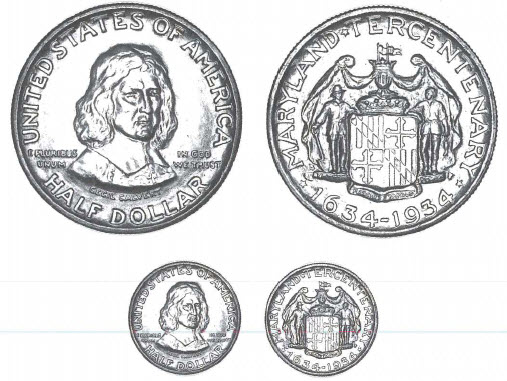
The Founding of Maryland Commemorated
The 300th anniversary of the arrival in Maryland in 1634 of colonist followers of Cecil Calvert, second Lord Baltimore, furnished the occasion for legislation approved on May 9, 1934, which made possible the coinage of 25,000 silver half dollars of appropriate design. Calvert sponsored the departure of about 200 would-be colonists from England to America on the Ark and the Dove in 1633, who formed the first settlement in Maryland at St. Mary's in 1634. Cecil Calvert never came to America.
John Work Garrett, distinguished American diplomat and well-known numismatist, was among the citizens of Maryland who endorsed the commemorative half dollar proposal on behalf of the Maryland Tercentenary Commission of Baltimore.
Design and Distribution
Hans Schuler, director of the Maryland Institute, designed the coins. Die work was done by the Medallic Art Company. The obverse featured the portrait of Cecil Calvert, whereas the reverse was a representation of the arms of the state of Mary ... land including the motto FATTl MASCHII PAROLE FEMINE, which, translated from the Italian, means "deeds are manly, words womanly."
In July 1934 the Philadelphia Mint struck the entire authorized issue, amounting to 25,000 pieces for distribution and 15 for assay. By the end of 1934 the Commission had sold nearly 15,000 coins for $1 each through banks and other outlets primarily to Maryland citizens. During the next year the price was cut, but still about 5,000 unsold pieces remained on hand and were offered in bulk: for 75 cents each. Those that attracted no buyers at this level were discounted even further to 65 cents.
On May 24, 1935, the Maryland Tercentenary Commission advised rare coin dealer L.W. Hoffecker as follows: (Letter in the Bowers and Merena Galleries Reference Collection. Hoffecker, a rare coin dealer (among other business activities), was the distributor of his own issue of commemorative half dollars in 1935.) "Our supply of Maryland Tercentenary half dollar coins has been exhausted." He was referred to Edward W. Cockey, of Baltimore, "who still has a very few coins for sale at $1.25 each including postage."
Hoffecker wrote to ask for details of the distribution, and on June 6, 1935, the Commission replied: "As you probably know we were granted an issue of 25,000 Maryland Tercentenary commemorative half dollars. They were all dated 1934 and all minted at the Mint in Philadelphia. The first 15,000 we sold at $1.00 plus postage straight, regardless of the amount ordered, but as sales slowed up somewhat and we were anxious to close the office, we made a special price of 85 cents each plus postage in lots of 200 or more up to 1,000, and 75 cents each plus postage in lots of 1,000 or more. Our first coins were received on July 10, 1934, and we disposed of the last one about the latter part of April 1935. Probably 15,000 of the issue were sold in small quantities-one to say 100, and they were scattered all over the United States.
"In the beginning 5,000 were purchased for Maryland banks, and just how the banks disposed of them we cannot say, but the 20,000 sold through the office went mostly to individual collectors, except the probable 8,000 sold at a discount to dealers."
In testimony before the Senate Committee on Banking and Currency, March 11, 1936, Hoffecker, acting in the capacity of chairman of the Legislative Committee of the American Numismatic Association, mentioned the Maryland Tercentenary half dollar. (From Coinage of Commemorative 50-Cent Pieces, the transcript of the hearing, published in 1936.) "The Maryland commemorative coin was sold out, 15,000 of them, at a dollar apiece. Of that 15,000 [sic] coined, 5,000 were sold to banks in order to help the cause along. A dealer in the Southwest told me he bought 1,000 at a dollar apiece. (This was B. Max Mehl of Fort Worth, Texas.) I was over there the other day, and I was trying to locate a lady who handled the order, and the elevator man told me that he got 500 coins to layaway."
The Maryland issuers were conservative for the time, created no special varieties for extra profit, and did their best to distribute the coinage in a proper manner. Relatively little commentary concerning Maryland half dollars appeared in the numismatic press.
Collecting Maryland Half Dollars The field of the Maryland half dollar has an unusual "rippled" appearance making it similar to a sculptured plaque. Thus nicks and other marks that would be visible on a coin with flat fields are not as readily noticed on this issue.
As most 1934 Maryland half dollars were distributed to the general public rather than to collectors, specimens are considerably scarcer today than the relatively large mintage of 25,015 would indicate. Today most examples in collections are in the grade range of MS-60 to MS-63. MS-64 pieces, strictly graded, are quite elusive. Specimens exist struck from a reverse die broken from the right side of the shield to a point opposite the upper right of the 4 in the historical date 1634.
GRADING SUMMARY: Nearly all specimens show flat striking and/or friction on the nose of Cecil Calvert. Friction is often seen on other areas of the portrait as well and on the reverse, on the high parts of the central motif. This issue was not handled with care at the time of mintage and distribution, and nearly all show scattered contact marks.