Commemorative Coins of the United States
Q. David Bowers
1991 Korean War Silver Dollars
Honoring Korean War Veterans
In 1991 a commemorative silver dollar was produced to observe the 38th anniversary of the Korean War (originally called the Korean Conflict) and to honor those who served there. Coins were struck in Uncirculated and Proof finishes. Public Law 101-495 approved on October 31, 1990, provided for the mintage of not more than one million coins, all to be struck during the calendar year 1991. As part of the sale price of each coin a $7 surcharge was intended "to establish and erect the Korean War Veterans Memorial in the nation's capital to honor those who served .... "
The Design
The enabling act provided the following: "The design of the coins minted ... shall be symbolic of the Korean War veterans' heroic service. Each coin shall bear a designation of the value of the coin, an inscription of the years '1953-1991,' and the inscriptions of the words 'Liberty,' 'In God We Trust,' 'United States of America,' and 'E Pluribus Unum.' The design for the coins authorized by this act shall be selected by the secretary [of the Treasury] after consultation with the Korean War Veterans Memorial Advisory Board and the American Battle Monuments Commission."
As time was of the essence in creating motifs for the new coin, designs were solicited only from employees of the Engraving Department of the United States Mint. Outside artists were not considered. Final designs were approved (with reluctance on the part of some members; see following) by the Commission of Fine Arts on January 17, 1991. Later the motifs were to be approved by Secretary of the Treasury Nicholas F. Brady.
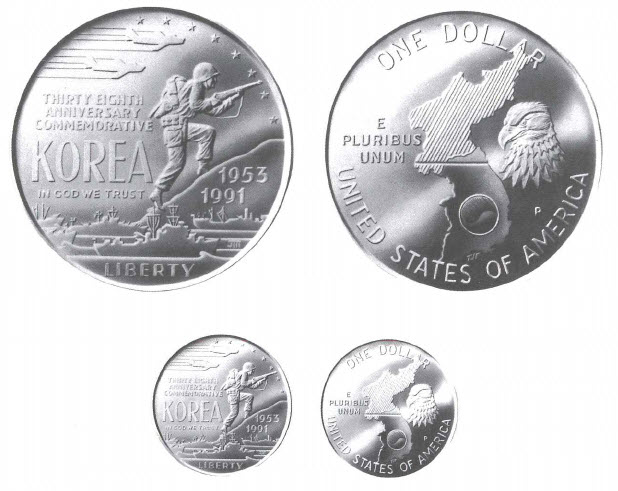
The obverse of the Korean War commemorative dollar by John Mercanti featured two F-86 Sabre jet fighter aircraft flying to the right, a helmeted soldier carrying a backpack climbing a hill, and the inscriptions: THIRTY EIGHTH / ANNIVERSARY / COMMEMORATIVE / KOREA / IN GOD WE TRUST /1953/1991. At the bottom of the coin appeared five Navy ships above the word LIBERTY. An observer of the Korean coin design in 1991 could not help but wonder how much more artistic the coin could have been if the designer had been freed from the necessity of including so many inscriptions including one which reminded the viewer that the coin was a "COMMEMORATIVE" (presumably helpful in case someone thought it was a regular issue silver dollar).
The reverse of the Korean War anniversary silver dollar, the work of T. James Ferrell, depicted an outline map of North and South Korea, divided. An eagle's head (representing the United States) was depicted to the right. Near the bottom was the symbol of Korea. Inscriptions included E / PLURIBUS / UNUM (in three lines), ONE DOLLAR, and UNITED STATES OF AMERICA. The designer's original sketch also showed the seal of the United Nations and the inscription 38th / PARALLEL, both of which were omitted from the final model.
Edward F. Fisher, a former Marine, commented as follows in a letter to Coin World. "As far as I am concerned, anything commemorating the Korean War is long over-due. Maybe it will spark young minds into reading about the 'Forgotten War.'... I have informed scores of Korean veterans about the coin, and they requested the Mint's address and for me to keep them updated because they are non-collectors, at least right now.... I am going to buy as many as I can afford to pass on to future generations. Part of the proceeds from the sale of the coins will be given to erect a memorial to honor those who served, especially the approximately 54,000 who never made it home .... I don't personally like the coin design, but I love what it stands for."
Commission Criticizes Designs
A front-page article by Paul Gilkes in Coin World, titled "Commission Criticizes Coin Designs," January 30, 1991, noted in part: "Deputy Mint Director Eugene Essner said the Korean War dollar designs were reviewed by the Korean War Veterans Memorial Advisory Board and American Battle Monuments Commission, and some minor modifications to meet technical considerations were made along with some recommended historically-correct modifications. Essner said the soldier on the coin's obverse in the submitted design had leggings like those worn by Marines, and the leggings were removed to more reflect the garb of Army personnel which made up the bulk of the military forces in the Korean War. The jet fighters were also redesigned to conform to those used in the conflict, Essner said. The Korean War dollar designs were aimed at capturing the themes of air, land and sea forces, Essner said.
"J. Carter Brown, chairman of the Commission of Fine Arts, said the lettering on the obverse and reverse of each of the silver dollars should conform to each respective side. The obverse is 'approvable,' Brown said, and the busy look of the re-οbverse can be addressed by 'liberating the coastline of South Korea.' Commission member Adele Chatfield-Taylor said she believed the reverse of the Korean War coin was too cluttered. There was discussion suggesting removal of the Korean symbol on the reverse along with the inscription 38th PARALLEL. Commission member Robert Peck said he felt the Korean War designs were 'overkill,' noting South Korea is lost with the eagle 'impinging' the map. Peck also noted that people who do not know the history of the war will not know what the significance of the 38th Parallel is, and those who do know do not need it spelled out. Concluded Commission member George Hartman: 'It's a collection of unrelated things in search of a unifying idea.' Hartman said the designs 'should be rethought because they're not as good as they ought to be.'