Commemorative Coins of the United States
Q. David Bowers
1936 Rhode Island Tercentenary Half Dollars
(Providence Tercentenary Half Dollars)
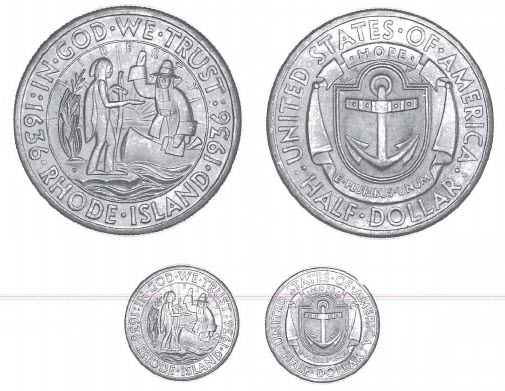
A Set of Three Coins
The 300th anniversary of the landing of Roger Williams in Rhode Island on June 24, 1636, and the subsequent establishment of the Providence Plantations furnished the occasion for issuing 1936-dated commemorative half dollars. Curiously, no reference to the city of Providence appeared on the coins. Roger Williams, depicted on the coins, was born in England and came to America in 1631. In Massachusetts he quarreled with religious and colony leaders and had the audacity to suggest that settlers should compensate the native Indians for land taken. Williams was commanded to leave, and an effort was made to send him back to England. He escaped with four companions and in early 1636 settled on the shore of Narragansett Bay and established a settlement named Providence in gratitude for God's help when he was in distress. He negotiated with the Indians and, true to his principles, purchased the land for the new colony. The community grew under a government which permitted freedom of religious expression and the separation of church and state. In 1644 several towns in the area were combined under a charter incorporating the Providence Plantations.
Providence Tercentenary half dollars, commonly called Rhode Island Tercentenary half dollars, were authorized by Congress in an act approved on May 2, 1935, as part of a bill that also provided for Hudson commemoratives. The issue of Providence coins was set at 50,000 silver ha1f dollars. Eventually the coins were produced at three mints. Correspondence from the issuing commission was signed Rhode Island and Providence Plantations Tercentenary Committee in some instances and Rhode Island Tercentenary Jubilee Committee in others. Apparently, the committee name was not standardized. The committee had been formed several years earlier in 1931.
Design and Production
The Providence Plantations Tercentenary Committee selected John Howard Benson, an instructor at the Rhode Island School of Design, and his friend, silver-smith Arthur Graham Carey, to create the motifs. The obverse motif depicted Roger Williams kneeling in a canoe, his right hand raised in greeting and his left hand holding a Bible, while an Indian standing on a rock extends his hands, ostensibly in greeting, but said to have been a welcoming indication, "good," in sign language. In the distance is the "sun of religious liberty" with resplendent rays. The reverse illustrated an anchor with HOPE above and other lettering below and surrounding. The scene represented Roger Williams arriving in his canoe at Slate Rock.
The entire design is in rather shallow relief, but distinctly defined. This style was inspired by shallow carvings on gravestones in Concord, Massachusetts and elsewhere. (Per an unattributed newspaper article, "Benson and Carey Do Much Research Designing Rhode Island Half Dollar: January 7, 1936, furnished to the author by Steve Innarelli.) After appropriate reduction of the models and preparation of master dies by the MedallicArt Company, 20,013 pieces were struck at the Philadelphia Mint in January 1936, followed by 15,010 in Denver and 15,011 in San Francisco in February.
Phony Distribution
A publicity blitz ensued, and news releases, advertisements, and other messages called nationwide attention to the distribution, which was set to take place on March 5, 1936.2 The Rhode Island Hospital National Bank was the focal point of the activity and distributed allotments to 30 banking outlets. In addition, nearly 7,000 coins were assigned to Horace M. Grant, a well-known numismatist who owned Grant's Hobby Shop in Providence. It was intended that Grant would take care of national distribution to interested collectors.
The lesson of the 1935 Boone half dollars with "small 1934" was well known to Grant and probably to others, for a secret scheme was devised whereby phony announcements were made to the effect that the entire issue was sold out within six hours of the time it was placed on sale on March 5th. In advertisements in hobby publications this supposed fact was trumpeted in Grant's headlines.
It soon developed that additional coins were indeed available, but for a higher price, from favored insiders including Grant. A royal mess ensued, and although few were willing to confront Grant directly with allegations, the Rhode Island distribution fiasco became the talk of the numismatic fraternity and was often cited as an example of how not to do things.