Commemorative Coins of the United States
Q. David Bowers
1989 Congress Bicentennial Silver Dollars
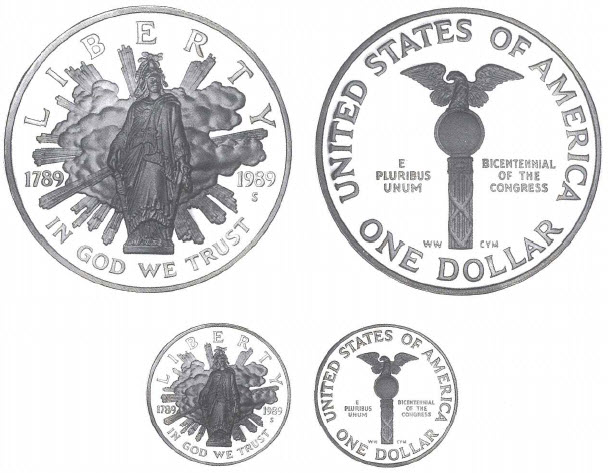
The Congress Bicentennial Dollar Authorized
The 200th anniversary of Congress operating under the U.S. Constitution saw the production of three styles of commemorative coins including a silver dollar authorized to the extent of three million pieces to be made of .900 silver. General information concerning the Congress Bicentennial coinage is given under the pre-ceding listing for the 1989 Congress Bicentennial half dollar.
The Design
The 1989 Congress Bicentennial silver dollar was designed by William Woodward. Models were prepared by Chester Y. Martin of the Mint staff. Depicted on the obverse was a view from the pedestal level, looking upward, of Thomas Crawford's Statue of Freedom (original name: Armed Liberty) on the U.S. Capitol dome, with clouds and rays in the background.
The reverse of the design depicted the ceremonial mace of the House of Representatives, consisting of an eagle perched on a globe mounted on the top of a fasces. The mace is displayed in the chamber of the House of Representatives in the Capitol when the House is in session.
The Commission of Fine Arts suggested that the design could be improved by "shortening the mace and enlarging the eagle and globe." (Letter from Commission Chairman]. Carter Brown to Mint Director Donna Pope, March 6, 1989. Subsequent commentary is from minutes of the Commission meeting, April 20, 1989, p.2.) At the Commission's meeting on April 20, 1989, the subject was discussed in detail, and this time the obverse was called into question. Eugene Essner, spokesman for the Mint, said that the clouds and rays behind the figure of Freedom had caused technical difficulties, and he was considering eliminating them.
Elizabeth Jones recalled the situation (In an interview with the author, February 11, 1991.) "When Chester Martin modeled Wood-ward's design, he included the rays as the artist intended. Dr. Andrew Cosgarea of the Washington Headquarters staff saw the model and requested that, even if technically feasible, the rays be removed, for he felt that they were incorrect. I explained to him that rays emanating from clouds had been used in art in sculpture for many hundreds of years, but he persisted that they were not correct as part of the dollar design. Chester Martin then made another model, without rays, and all of us who saw it agreed that it did not look right. We had quite a discussion about this at the Mint. Finally, Dr. Cosgarea agreed that the rays did belong as part of the design, and they were used." (All dies for the 1989 Congress Bicentennial coins were made at the Philadelphia Mint. Fiscal year 1989 (ended September 30, 1989) saw the production of combined $1 and $5 dies amounting to a quantity of 6,751.)
Purchase Options
Several purchase options were given as enumerated earlier in the present text under the 1989 Congress Bicentennial half dollar. Using the same numbering system, the following options included dollars:
(2) Proof 1989-S silver dollar. $25 pre-issue price (through July 17, 1989); $29 regular price. Each coin was mounted in a plastic capsule placed on a brown felt tray within a brown velvet presentation case with hinged lid on which was mounted a plaque of a heraldic eagle. The case was in a brown cardboard box imprinted with the Great Seal and "United States Congressional Coins." A brown slipcover, Similarly imprinted, protected the box. Sales amounted to 145,798 coins through this option.
(3) Two-coin set containing the 1989-S Proof half dollar and 1989-S Proof silver dollar. Pre-issue price (through July 17, 1989) $31.50, regular issue price, $34. Coins in plastic capsules were housed in a brown velvet presentation case with hinged lid on which was a plaque of a heraldic eagle. The case was contained in a brown cardboard box imprinted with the Great Seal and "United States Congressional Coins." A brown slipcover, similarly imprinted, protected the case. Sales amounted to 269,550 sets through this option.
(5) Three-coin Proof set containing the 1989-S half dollar, 1989-S silver dollar, and 1989-W $5 gold. Pre-issue price (through July 17, 1989) $220, regular price $245. Coins in plastic capsules were housed in a brown velvet presentation case with a hinged lid and a plaque of the Great Seal on the lid. The case was enclosed in a brown cardboard box imprinted on the lid with the Great Seal and "United States Congressional Coins." The box was placed within a brown slipcover Similarly imprinted. Sales amounted to 110,796 sets through this option.
(7) Uncirculated 1989-D silver dollar. Pre-issue price (through July 17, 1989) $23, regular price $26. Each coin was mounted in a plastic capsule and housed in a velvet-lined dark blue box. Sales amounted to 37,242 coins through this option.
(8) Two-coin Uncirculated set containing the 1989-D half dollar and 1989-D silver dollar. Pre-issue price (through July 17, 1989) $27, regular issue price $29.50. Coins in plastic capsules were set on a brown felt tray with a plaque of a heraldic eagle, the entire being contained in a brown cardboard box imprinted with the Great Seal and "United States Congressional Coins." Sales amounted to 57,054 sets through this option.