Commemorative Coins of the United States
Q. David Bowers
1946-1951 Booker T. Washington Half Dollars
A Series of Sets
The commemorative bandwagon began to roll again in 1946, and while the Iowa issue received little or no criticism due to the obvious purpose of its issue and the fact that the coins were distributed by the state, the same cannot be said for the other new issue of 1946, a special series of commemorative half dollars sold through the Booker T. Washington Birthplace Memorial Commission.
Marketed under the direction of Commission member Dr. S.J. Phillips, these half dollars were ostensibly produced to honor one of America's best known black educators. Phillips, according to an account, (The Numismatist, July 1946, p. 769; a news note submitted by Edward L. Weikert, Jr.) was "the public relations representative of 500,000 colored Elks and 4.5 million colored Baptists who will participate in the sale of these commemoratives." Further from the same account: "Mr. Phillips and Booker T. Washington's only surviving child, Mrs. Portia Washington Pittman, visited the office of the chairman of the Coinage, Weights and Measures Committee on their return trip from the dedication [of Washington's bust in the Hall of Fame]. in New York and outlined a plan. They are anxious that every Negro boy shall have one of these commemorative coins in his possession, as an inspiration to emulate the ideals and teachings of Booker T. Washington, who through a life of constructive efforts on behalf of his people rose from a boyhood of slavery to the Hall of Fame .... In view of the above mentioned objectives the chairman of the Coinage, Weights and Measures Committee feels this bill has unusually meritorious objectives and, furthermore, from the standpoint of the Treasury, rather than increasing the amount of money in circulation it would actually withdraw five millions of dollars from circulation, while the Treasury would be making a profit of one and one-quarter million dollars. (The item concerning increasing the amount of money in circulation reflected a national concern during the postwar era that inflation would get out of control and that inflation was caused by more money in the channels of commerce.) Congressional legislation was approved on August 7, 1946, concurrent with the bill authorizing Iowa half dollars.
The act provided that Booker T. Washington commemorative coins could be produced by plural mints of the United States for a period not to exceed five years after passage and up to the quantity of 5 million pieces, sowing the seeds for precisely the same sort of abuse which characterized the long-lived Arkansas, Boone, Oregon Trail, and Texas issues of a decade earlier. The target was, obviously, the coin collecting fraternity-now considered to be ripe for further exploitation. An even broader market was envisioned for the sale of single pieces to the general public, for it was felt that just about everyone, especially black citizens, would want to own a specimen of the new issue.
To be featured on the coin was Booker T. Washington, who was born into slavery circa 1858 in Franklin County, Virginia. As a young adult after the Civil War, he received a formal education unlike the majority of his black brethren. By 1879 Washington was an instructor at the Hampton Industrial Institute in Virginia, which he had attended earlier. In 1881 he headed a facility for the education of blacks in Alabama, the Tuskegee Institute, which in time achieved nationwide fame. Later in his life he received honorary degrees from Dartmouth and Harvard and wrote an autobiography, Up From Slavery. His death occurred in Tuskegee on November 14, 1915, by which time he was widely recognized as America's foremost black educator.
The Design
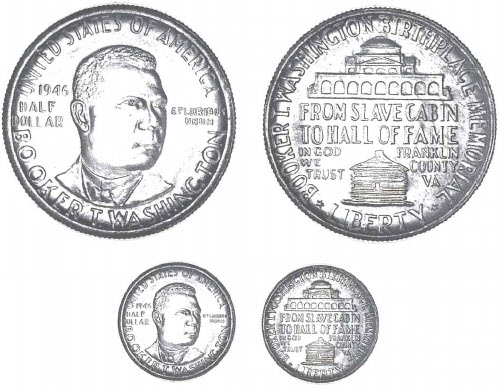
Charles Keck, who had produced the models for the 1915-S Panama-Pacific gold dollar, the 1927 Vermont half dollar, and the 1936 Lynchburg half dollar, was asked to design the Booker T. Washington issue, following motifs suggested by Dr. S.J. Phillips. Keck's models of the new design were accepted both by Phillips and the Mint. Around this time black artist Isaac Scott Hathaway entered the scene and offered to prepare his own models for the half dollar, at no charge, employing for the obverse a motif said to have been taken from the only life mask of Booker T. Washington in existence (made years earlier by Hathaway). The Commission of Fine Arts considered both the Keck and Hathaway portraits of Booker T. Washington for the obverse, and recommended Hathaway's depiction, much to the anger of Keck.
The reverse design was adapted by Hathaway from a sketch provided by an unnamed member of the Commission of Fine Arts and depicted the Hall of Fame at New York University, where a bust of Booker T. Washington was enshrined. At the bottom of the coin a rustic log cabin appeared, with the inscription FROM SLAVE CABIN TO HALL OF FAME separating it from the Hall of Fame above.