Commemorative Coins of the United States
Q. David Bowers
1935 Hudson Half Dollar
An Obscure Event Commemorated
Hudson, New York, a small community located 28 miles south of Albany on the banks of the Hudson River, was first called Claverack Landing when it was settled by Rensselaer family interests as a trading spot with two storehouses and two wharves in 1662. The little town expanded in 1783 and 1784 when former residents of Rhode Island, Martha's Vineyard, and Nantucket moved there and engaged in commerce, and renamed the village Hudson. In the following year it was incorporated.
The town name and that of the Hudson River were taken from Henry Hudson, famous for his four voyages of exploration in the New World during the 17th century. In 1608 he and a small crew set sail under Dutch charter in the Half Moon, owned by the United East India Company, and sought to find a shorter passage to China than those known. After seeking a route in the northern areas of America he sailed south. In 1609 Hudson found New York Bay and the large river that ultimately bore his name. On an ensuing voyage in the Discovery he entered another body of water, which later became known as Hudson's Bay, where he was set adrift with his young son John by his mutinous crew.
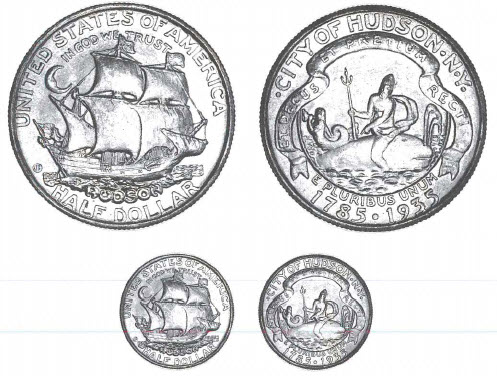
Charles W. Foster in his 1936 study, Historical Arrangement of United States Commemorative Coins, described the vessel shown on the Hudson half dollar:
"The Half Moon was the name of the ship in which Hendrick [sic] Hudson undertook his voyage in search of the Northwest Passage to the Indies, but in which he skirted the New England coast and sailed up the Hudson River. The ship, though a small merchant ship, was beautiful with its rich colors, its fine carvings and its silk flags. It exhibited the familiar lines of the late 16th century ships: a steep, sheer fore and aft; a narrow high stem transom on which appeared the crescent moon from which the ship took its name. On the fore part of the ship were displayed the two shields displaying the lion of the United Provinces and the arms of the Dutch West [sic] India Company."
Relatively unknown to the outside world at large, Hudson, New York, a town of 14,000 residents in the 1930s, was to take on national importance on the numismatic scene in 1935 when its 150th anniversary was celebrated. President Roosevelt approved on May 2, 1935 congressional legislation that provided for 10,000 silver half dollars (increased from the original proposal for 6,000) to be coined for Hudson and to be delivered to the "committee, person or persons duly authorized by said mayor of Hudson" and at the same time for 50,000 silver half dollars to be produced to help celebrate the 300th anniversary of the founding of Providence, Rhode Island. As it turned out, the Hudson issue wou1d be distributed in 1935, but the Rhode Island coins wou1d not be struck or go on sale until the year following.
The Design
On the same day that the coinage act was approved, Representative Philip A. Goodwin of New York wrote Charles Moore, chairman of the Fine Arts Commission, and asked for artists qualified to prepare designs for the forthcoming Hudson half dollar. Moore recommended Laura Gardin Fraser, who, it was stated, "stands in the very first rank of medalists" and who had been involved with several earlier commemoratives. Alternate recommendations included John Sinnock, Chester Beach, Francis H. Packer, and Paul Manship. In the meantime Hudson Mayor Frank Wise expressed a preference for John Flanagan, known at the time for his recent (1932) work on the Washington quarter dollar. After due consideration the work was given to Beach, an old hand at designing commemoratives.
Mayor Frank Wise, whose office was mentioned in the legislation, polled leaders in the city who agreed that the obverse should display the bust of Henry Hudson, whereas the seal of the City of Hudson would be ideal as a motif for the reverse. As historian Don Taxay later wrote: "The seal, a rather whimsical composition, depicts Neptune riding backwards on a whale, heralded by a mermaid blowing a conch shell."
Chester Beach prepared sketches as directed, as well as an alternate proposal of a design showing Henry Hudson's flagship, the Half Moon, and suggested to the city fathers that the ship would be preferable to a portrait. This proposal was duly adopted. The result was a coin which presented a puzzling appearance to many viewers. Nautical scenes were on both sides-a ship on the obverse and a caricature of Neptune on the reverse. At the upper left of the ship a fancifully-styled quarter moon (with a bump on the inside of the crescent for the nose of the Man in the Moon) apparently was intended to indicate the otherwise unstated name of the ship, Half Moon.
The date of the 1935 Hudson half dollar appeared on the reverse, a departure from the usual obverse position. Confusion was nothing new to the commemorative series, and, if logic had been a requirement for the issuance of the design and the issuance of commemorative half dollars during the first part of this century, we would have had far fewer varieties.