Commemorative Coins of the United States
Q. David Bowers
1936 Columbia Sesquicentennial Half Dollars
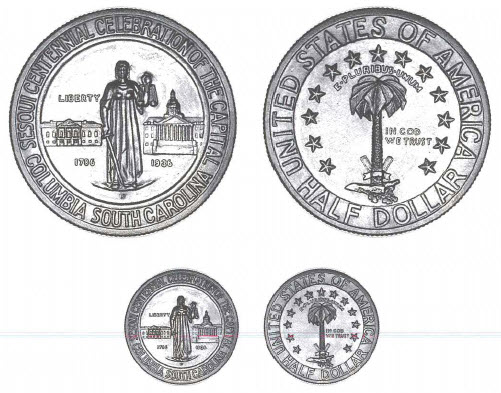
Another Set of Three Half Dollars
The city of Columbia, South Carolina was established as the capital of the state in 1786, although the General Assembly did not meet in its new capitol building there until 1790. Earlier the capital was Charleston.
To celebrate the 150th anniversary of the 1786 resolution to change the capital city, Columbia proposed to sell a set of commemorative half dollars containing one coin from each of the Philadelphia, Denver, and San Francisco mints. Subsequently, the Act of March 18, 1936, was passed by Congress allowing 25,000 half dollars to be coined at the various mints.
Design and Distribution
The Columbia Sesqui-Centennial (sic) Commission named A. Wolfe Davidson, a 32-year-old sculptor at Clemson College, to design the work, a choice which was viewed with disdain by the Commission of Fine Arts, which stated that "the models lack artistic merit and are unsatisfactory for translation into a memorial coin," a typical Commission of Fine Arts commentary on a design proposed by an amateur. At the time a promotional brochure noted:
"The sculptor whose selection has been approved by the Treasury Department and the Fine Arts Commission is A. Wolfe Davidson, of Clemson College, S.C. Mr. Davidson is an outstanding sculptor of the state and is, at present, engaged in sculptoring [sic] the bust of Thomas Clemson, the founder of the State Agricultural & Mechanical College."
The obverse depicted the goddess of Justice standing with the Capitol building of 1786 at the left and that of 1936 to the right. The reverse represented a palmetto tree (the state emblem) surrounded by stars. The half dollar was attractive in its simplicity, and few numismatists-who certainly are inclined to voice opinions if they don't like things-felt moved to be critical.
In Columbia there were festivities from March 22 to 29, 1936, marking the sesquicentennial, but the coins had not been minted yet (indeed, the congressional enabling act had just passed a few days earlier). The production of the coins was completed by the end of September 1936 and consisted of 9,007 pieces produced at Philadelphia, 8,009 at Denver, and 8,007 at San Francisco. Orders were taken at $2.15 per single coin or $6.45 for a set of three. By October 19, 1936, orders received by the issuing commission were said to have been for 15,000 coins more than were minted, despite a lacklustre market for commemoratives. Apparently, most of the 15,000 extra coins ordered represented quantities desired by dealers.
In an undated flyer sent to his mailing list circa December 1, 1936, dealer Horace M. Grant stated the following: "I have made two special trips to Columbia and regardless of all of the time and money spent, do not know what it is all about. The coins have been in Columbia for the past five or six weeks and no one outside of the Committee seems to know why delivery has not started, and they won't tell. Between sixty and seventy thousand dollars has been received by the Committee from collectors and dealers. The entire issue of twenty-five thousand at two dollars each, is but fifty thousand dollars, and the cost of the issue but twenty-five thousand dollars. How long will the collectors put up with the kind of treatment handed out to them by the Rhode Island, the Kentucky [Boone], and the Columbia commissions? Members of the ANA, won't you write to President [T. James] Clarke, urging him to request the ANA Legislative Committee to present a new bill at the next session of Congress, making it necessary for any commission desiring half dollars to have fifty thousand coins issued at one time and all from one mint. Further, that no issue can be carried over to another year. We love our hobby, but it will not live if a few grasping speculators are to continue the hardships of 1936." (Horace M. Grant. 109 Empire Street. Providence. Rhode Island. had been widely criticized for false statements he made in connection with the distribution of 1936-dated Rhode Island Tercentenary half dollars (to which refer). In the commentary quoted here he sought to mend his fences with collectors by taking the offensive and criticizing the practices of certain issuing commissions, including the Rhode Island commission with whom he had conspired earlier in the year!)
Grant wasn't the only one who was impatient concerning the delivery of the coins, and a number of other adverse comments reached print. The January 1937 issue of the Numismatic Scrapbook noted: "Well, well, the Columbia ... half dollar finally made its long awaited appearance. That is, it appeared for some of us shortly before Christmas. Evidently orders for single sets were filled first, orders for two sets next, and so on. Perhaps the delay is due to careful check of the orders; thereby distributing the coins as widely as possible. Anyway, let us hope that is the case."
At long last the Columbia sets were distributed to buyers from December 8th through the 19th. Most if not all single orders placed for sets were filled. In an advertising circular the Columbia Sesqui-Centennial Commission stated: "Residents of the City of Columbia will be given the privilege of making their purchases during the first 24 hours after the coins are placed on sale. Mail orders will then be filled. It is the desire of the Commission that the coin be sold to private collectors rather than dealers."
There were never any unsold remainders. Six sets of Columbia half dollars were sealed in a time capsule. (These were opened in Columbia nearly 50 years later on March 22, 1986. A two-page letter from the secretary of the Columbia Sesqui-Centennial Commission, William Lykes, Jr., addressed to his 1986 successor, was read, and the sets were subsequently marketed for several thousand dollars each. (Per information submitted by John Flitter to The Commemorative Trail and published in the Spring 1986 issue, p. 31.)) On February 15, 1937, a set was given to President Franklin Delano Roosevelt.
Writing in 1938, David M. Bullowa commented."The distribution was made by the commission on a very fair basis, and few persons were able to secure these coins in quantity. It made every endeavor to treat the collector fairly and to prevent the speculator from manipulating the prices of the sets in the open market, as had been done with many previous commemorative issues."
Collecting Columbia Half Dollars The supply of Columbia Sesquicentennial half dollars was widely distributed at the time of issue, and examples are readily obtainable today. Most are in the lower ranges of Mint State, such as MS-60 to MS-63.
GRADING SUMMARY: Handled with care at the mints, most coins show lustrous surfaces with very few handling marks. However, nearly all show friction on the bosom of Justice and, to a lesser extent, on the high areas of the palmetto tree foliage on the reverse.