Commemorative Coins of the United States
Q. David Bowers
1934-1938 Texas Centennial Half Dollars
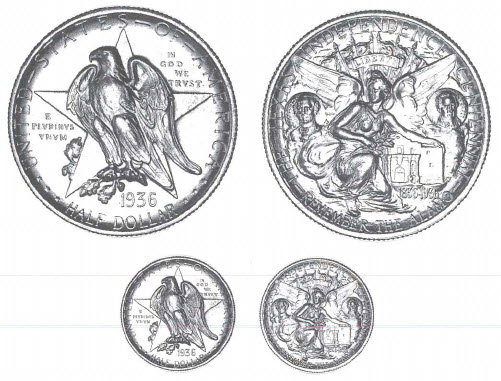
Texas History Commemorated
Early in the administration of President Franklin Delano Roosevelt, on June 15, 1933, Congress passed an act to authorize the coinage of silver half dollars" in commemoration of the one hundredth anniversary in 1936 of the independence of Texas, and of the noble and heroic sacrifices of her pioneers, whose revered memory has been an inspiration to her sons and daughters during the past century." This was the first of over two dozen commemorative bills that would become reality during Roosevelt's tenure. The legislation provided that no more than one and a half million pieces be created on behalf of the American Legion Texas Centennial Committee, located in Austin in that state.
The history of the state of Texas is rich and colorful. The year 1836 was especially important, as the siege of the Alamo in San Antonio took place in that year, followed by General Sam Houston's trapping of the hostile forces of Santa Anna at the Battle of San Jacinto on April 21, 1836. A few months later Texas became an independent republic.
A Complicated Design
Pompeo Coppini, a Texas sculptor who had maintained a studio in New York City since 1922, was selected to prepare designs for the new coins. Coppini's obverse depicted a large eagle perched on a branch, displayed against a five-pointed star in the background, with inscriptions surrounding-a departure from standard practice, for the eagle motif was traditionally reserved for the reverse of American coinage.
The reverse of the Texas Centennial half dollar was one of the most ornate created for a commemorative coin of this period. Within the confined space available several highly detailed elements were presented including the goddess Victory, winged and draped, kneeling slightly to the observer's right, an olive branch in her right hand, and her left hand resting on a representation of the Alamo, the most famous shrine in Texas history. Above is the word LIBERTY on a scroll, behind which are six flags. Beneath the wingtips of Victory are two medallions depicting Texas heroes General Sam Houston and Stephen Austin.
Correspondence between Charles Moore of the Commission of Fine Arts and L.W. Robert of the Treasury Department indicates that in 1933 Moore disapproved of commemoratives in general and the proposed design of the Texas half dollar in particular. Addressing Robert, Moore stated:
"Can you do anything to stop the deluge of 50-cent pieces for all sorts of commemorative purposes? We have now before the Commission a Texas half dollar. The design shows the whole history of Texas and all its leading personages in a perfect hodge-podge. The heads are so small that they will disappear on a 50-cent piece, and yet it is just this conglomeration in which the Texas people are relying to sell 25 cents worth of silver done into a 50-cent piece at the price of a dollar in order to make money to build some building. It seems to me very undignified for the United States government to lend itself to such schemes. I told the representative that if he succeeded in making money out of his 50-cent piece he will do more than any of the other people have done with theirs. The coinage may use up a certain amount of silver, but otherwise I see no advantage therein."
Moore's comment that the design was a "perfect hodgepodge" was seconded years later by historians of the commemorative series. Arlie Slabaugh suggested that "on the relatively small surface of a half dollar the design appears overcrowded and indistinct" and might have been better suited for a frieze or plaque, whereas Anthony Swiatek and Walter Breen called the reverse motif a "jumble" and stated that it might have made more sense if it had been translated into a heroic sculpture, perhaps 30 feet in diameter, meant to be viewed from several hundred feet away.
Writing in Numismatic Art in America in 1971, Cornelius Vermeule gave a contrasting view of the Texas motif: "Coppini's commemorative half dollar is the classic triumph of how much can be successfully crowded on a coin. The eagle is imaginative and majestic against the Lone Star. Victory, wearing the conventional cap of liberty and crouching with the Alamo amid inscribed tondo busts of Sam Houston and Stephen Austin, is a tour de force of mot ion, drapery, and attributes worthy of the masterful silver denarii of the last decades of the Roman Republic. The modeling, spacing, and lettering are clear and lively, while maintaining all the minute precision necessary to fit everything onto the field. This coin has one of the greatest of the designs in the commemorative series, by an artist not otherwise widely associated with coins or even medals."
Mehl Aids the Committee
Writing in 1937 B. Max Mehl, who had lived in Texas for nearly all his life, told how he had aided the issuing committee: (In his monograph, Commemorative Coins of the United States, p. 26.)"Of course, those of us who know a little about Texas history know that Texas in-dependence was won at the Battle of San Jacinto on March 2, 1836, and not 1834. But the idea of the commemorative coins was advanced by the Texas division of the American Legion. The idea was to raise funds from the sale of these coins to build a memorial building. The bill authorized 1,500,000. In 1934, according to mint re-ports, 250,000 [sic;actually 205,113] coins were coined. The Texas issue is also one of 'high finance,' and I am not entirely free from guilt that so many different issues of these coins were issued. The committee called on me and I gave them my idea as to how to sell more of the coins."