Commemorative Coins of the United States
Q. David Bowers
1936 Long Island Tercentenary Half Dollar
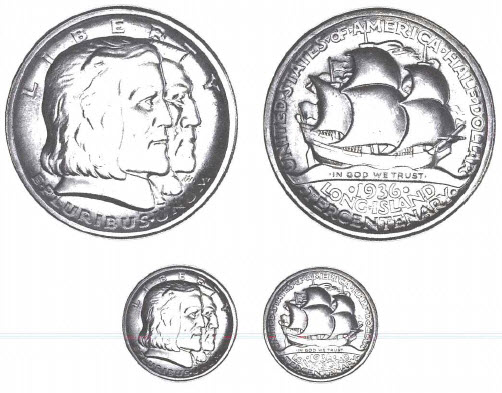
Long Island Memorialized
In the year 1636 the first white settlement was established on Long Island at Jamaica Bay, an event which was memorialized 300 years later by the Tercentenary celebration. The Long Island Tercentenary Committee helped formulate a congressional resolution which was signed into law on April 13, 1936, and which provided for up to 100,000 silver half dollars of a "single design" to be coined at "a mint," thus prohibiting a multiplicity of exploitative variations. Congress was becoming wise!
The Design
Well in advance of the passage of the bill, the Long Island Tercentenary Committee approached Howard Kenneth Weinman, son of famous sculptor Adolph A. Weinman (who designed the 1916 "Mercury" dime and Liberty Walking half dollar), to prepare sketches for the pro-posed commemorative half dollar. Weinman created a motif depicting on the obverse the conjoined heads of a Dutch settler and a male Algonquin Indian. The reverse design was a representation of a Dutch sailing ship of the period, quite similar to the Half Moon pictured on the reverse of the 1935 Hudson half dollar. Although the Commission of Fine Arts approved the model, some minor changes were made. Weinman had the proper name, and complaints that probably would have been voiced concerning the work of just about anyone else were notably absent in correspondence involving the Long Island coin.
Obviously, this design was not a favorite of B. Max Mehl, who commented: (In his monograph, Commemorative Coins of the United States, 1937, p. 43.) "The obverse bears conjoined portraits of two rather tough looking gentlemen, but so far have been unable to ascertain just who they are or who they are supposed to represent. The reverse is supposed to be a sailing vessel and was apparently modeled from one of the usual toy ship models. However, since it is a legal coin authorized by the United States Congress, we accept it with more or less grace as a member of the fast growing family of commemorative halves."
Coinage and Distribution
Coinage of the entire authorized issue of 100,000 pieces, plus 53 additional coins for assay, took place in Philadelphia in August 1936, too late to be sold during the May 1936 Long Island Tercentenary celebrations. The coins were shipped to Long Island, where they were distributed through banks for $1 each.
A newspaper account of the time? related that 100,000 coins were transported by armored truck from Philadelphia and shipped to the National City Bank branch on Montague Street in Brooklyn, to be called for by DeWitt A. Forward, bank vice-president for Long Island and treasurer of the Tercentenary Committee. Receiving them at the bank was Louis C. Wills, chairman of the Committee, and John W. Smith, secretary.
To distribute the 100,000 pieces, each section of Long Island was allotted a certain percentage according to its population with about 50,000 coins earmarked for Brooklyn, of which 19,000 had been sold in advance, with 31,000 remaining at $1 each. These were offered for sale at the offices of the Brooklyn Eagle on Johnson Street, at the offices of the Committee treasurer, and at banks and department stores throughout Brooklyn.3 25,000 coins were allotted to Queens, 10,000 to Suffolk County, and 15,000 to Nassau County. Sales continued through the first several months of 1937, after which 18,227 unsold coins were re-turned to Philadelphia and melted.
Distribution of the Long Island half dollars was widespread, and enough were coined that anyone who desired an example could buy one. No profiteering took place, and no criticisms were voiced concerning the method of distribution. Although collectors undoubtedly accounted for the sale of tens of thousands of pieces, citizens of Long Island were enthusiastic buyers as well. Over 80,000 were marketed, a creditable piece of work by any standard.
A Bank Teller's Good Fortune
In an interview with the author, John J. Ford, Jr. told of a hoard which surfaced in the 1950s: (Interview conducted February 20,1991.)
"Of my experiences with commemoratives one of the most memorable occurred sometime in 1953 or 1954. I was at the office one day and was feeling a bit ill, when I received a telephone call from a guy who inquired, 'Is this the Scott Stamp & Coin Company?' I said 'Yes,' because I didn't feel up to explaining to him that the office was no longer Scott's, but was now New Netherlands' and that my name wasn't Scott.
"He said, 'I have a half dollar here, and it's a funny half dollar as it's got two men's heads on the front.' I thought at the time that this could have been one of any number of commemorative half dollars. I then asked, 'What does it have on the back?' He said there was a ship. Immediately I knew that it was probably a 1936 Long Island Tercentenary half dollar. I went on to say that if it was in brand-new condition, absolutely brand new, I probably could pay two dollars for it.