Commemorative Coins of the United States
Q. David Bowers
1983 Olympic Silver Dollars
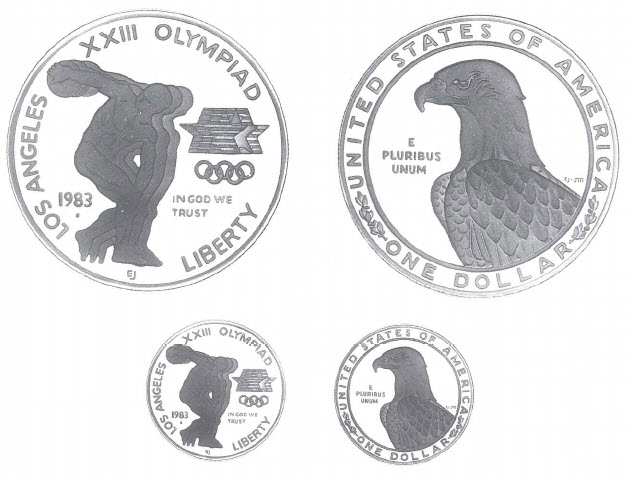
A Commemorative Silver Dollar
The 1984 Summer Olympic Games scheduled to be held at the Los Angeles Coliseum furnished the opportunity to issue several varieties of silver and gold coins for fund-raising purposes including the first commemorative silver dollar since the 1900 Lafayette issue.
In the beginning the issue became a political football when Lazard Freres, the international banking firm, sought to combine its interests with the Occidental Petroleum Corporation (whose chairman, Armand Hammer, was well connected in political circles) and persuaded certain legislators including Senator Alan Cranston of California to back a bill for 29 different coins to be sold through Occidental Petroleum (which, presumably, would set up a numismatic department).
The stage was being prepared for private profit, reminiscent of the commemorative distribution situation of the 1930s. On May 10, 1981, Cranston's bill called for a 29-piece set consisting of four different $100 gold pieces, four different $50 gold pieces, 16 different $10 silver pieces, and five different copper-nickel dollars. The silver and gold pieces were to be made in both Uncirculated and Proof finishes, whereas the copper-nickel pieces were to be made in Uncirculated finish only, yielding a total combination possibility of 53 different coin varieties! This made anything that the Oregon Trail or Boone Bicentennial coin people did in the 1930s seem tame by comparison!
A Battle on Capitol Hill
As might be expected, this attempt at profiteering caused an unfavorable reaction with coin collectors, the numismatic press, and the Board of Governors of the American Numismatic Association. Steps were taken immediately to cut short what was seen as a flagrant exploitation of collectors. ANA President Adna Wilde went to Washington to testify before Congress, as did the present author and numerous others including spokespeople from the numismatic press.
Burnett Anderson observed the Olympic coin debate on Capitol Hill and filed the following report with Coins Magazine on May 28, 1982. More than any other legislative event in the history of commemorative coins, this 1982 controversy gained national attention: (Transcript of original manuscript sent by Burnett Anderson, the Washington correspondent for Krause Publications, Inc.)
"The year-old battle over commemorative coins for the 1984 Los Angeles Olympic Games reached an unprecedented and dramatic climax in the House of Representatives when a scheme for 33 coins to be sold by a private monopoly was rejected by 302 votes to 84. The 4 to 1 margin was interpreted as a smashing victory for U.S. coin collectors and dealers, nearly all of whom had opposed both the large number of coin designs and issues and the high markups on the coins under private distributorship. The decisive vote nonetheless left the ultimate fate of Olympic coins in some doubt, although a number of informed congressional observers were satisfied that whatever the specifications and numbers of the coins 'private marketing is as dead as the one-half cent coin.' The last one-half cent piece was minted in 1857.
"The resounding vote in the House-upsetting every prediction up to the very day of the vote on May 20-was widely reported as a new version of the biblical David and Goliath. The role of David was played by Rep. Frank Annunzio CD-Ill.), chairman of the House Subcommittee on Consumer Affairs and Coinage, who almost singlehandedly among members of Congress has tenaciously fought against a flood of commemorative coins and their distribution by middlemen for profit since the legislation was introduced more than a year ago. Goliath was represented by a giant consisting of a multiple of powerful elements: Occidental Petroleum Corporation and the international banking house of Lazard Freres, who wanted the marketing monopoly; several powerful congressmen led in the House by Rep. Fernand St. Germain, chairman of the influential Banking Committee; a number of expensive lobbyists including three of the most prestigious public relations and legal firms in the nation's capital; Deputy Secretary of the Treasury Tim McNamara and other highly placed members of the Reagan administration, each armed with a letter of endorsement from the president himself; and the Los Angeles Olympic Organizing Committee (LAOOC) and the U.S. Olym-pic Committee (USOC).
"To be sure, Annunzio had the support of virtually every coin collector and dealer heard from during the long drawn-out legislative maneuvering and hearings in both houses, as well as the American Numismatic Association, but these were largely scattered voices without well-heeled political action committees to reinforce their positions with campaign contributions. (Later Rep. Annunzio was given a special award by the American Numismatic Association for his contributions to the hobby of coin collecting.) The result of the vote was to return the bill to the Senate, which in December of last year adopted a 49-coin, private marketing measure. Now the Senate Banking committee must deal with a bill for six coins, in only three designs, and with the Mint to conduct all sales directly to the buyer. However, bulk sales to dealers at a small discount for resale at retail would also be authorized ....