Commemorative Coins of the United States
Q. David Bowers
1921 Missouri Centennial Half Dollars
Celebrating a Centennial
Although Spanish explorers had visited Missouri in the 1540s, it remained for the French to settle the area. St. Louis, founded by the French in 1764, became a center for fur trading and commerce on the Mississippi River. The Territory of Missouri was established in 1812. Following the Missouri Compromise of 1820, a piece of legislation developed by Henry Clay, Missouri was admitted into the Union as a slaveholding state in exchange for the 1820 admission of Maine as a free state.
Missouri was admitted to the Union on August 10, 1821. A century later Congress, on March 4, 1921, authorized 250,000 silver 50-cent pieces to be struck in commemoration of the event. Pieces were in-tended for distribution at the Missouri Centennial Exposition and State Fair held in Sedalia, the first capital of Missouri, from August 8 to 20, 1921. (In another field, that of ragtime music, Sedalia is well known as the site In the 1890s of the Maple Leaf Club, which Inspired Scott Joplin's composition, The Maple Leaf Rag.)
The Design
Robert Aitken, a recognized medalist and sculptor best remembered in numismatic circles for the $50 Panama-Pacific gold coins, was named by the Commission of Fine Arts to prepare models, following ideas forwarded by a committee of the Missouri Centennial Exposition.
The idea of adding a special "2 4" notation in the field apparently was the brain-child of James Montgomery, chairman of the Exposition, who wrote the following in a letter to Charles Moore, chairman of the Commission of Fine Arts:
"I desire also to make the following suggestion, that the star with the figures '24' be shown on five thousand of the coins. To do this, the star and figures would have to be raised on the die and after five thousand coins were struck, the star and figures could be cut off and the balance of the coins would be without the star and figures. This would enable us to sell the 5,000 for a sufficient profit to pay the expense of model and die, which you price at $1,750."
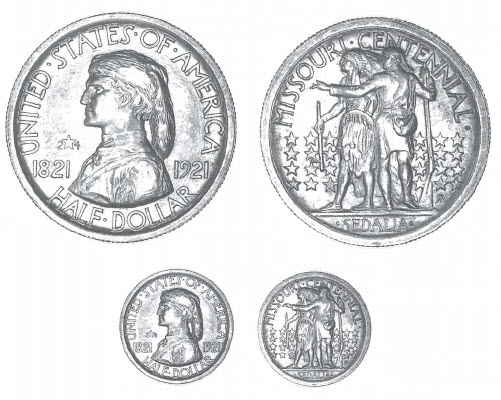
Robert Aitken created a design featuring on the obverse the portrait of Daniel Boone. On the reverse were shown standing figures of Boone and an Indian, set against a starry background, with SEDALIA incused below, representing the location of the exposition for which the pieces were created. (Taxay, p. 57: "The motifs on Aitken's [Missouri] coin are so similar to those on the later Boone Bicentennial issue as to invite comparison." Both designs feature Boone on the obverse and the standing figures of Boone and an Indian on the reverse.) Much of the die work was accomplished by the Medallic Art Company in New York City, in order to expedite manufacture.
In his 1971 book, Numismatic Art in America, Cornelius Vermeule analyzed the motifs: "The reverse [is reminiscent of] an Indian and a frontiersman standing like Roman soldiers in an Antonine relief on the arch of Constantine or Renaissance condottieri in a large fresco of court ceremonials. The relief is deep and well modeled, on a concave field with a plain, heavy edge. The lettering on the obverse follows the forms and system of Pisanello, and the coin as a whole is a work of art rather than just another way to market a silver 50-cent piece, because all three of the mottos that usually burden and constrict America's attempts at numismatic art are omitted. A final pleasing touch: the name of the Missouri town where the coins were first issued, SEDALIA, is incused in the exergue, a masterful detail."
The Missouri Centennial Committee branch of the Sedalia Chamber of Commerce was made custodian of the entire issue and appointed the Sedalia Trust Company as distributor. The first coins offered, the "plain" pieces without the 24 notation in the field, were marketed during the first week of August in 1921 at the Missouri Centennial Exposition and State Fair. The specimens with 24, although produced first, were offered later. Coins of both varieties were sold for $1 each.
Disputed Mintage Figures
David M. Bullowa stated that 50,028 half dollars were struck at the Philadelphia Mint in July 1921, of which the first 10,000 bore on the obverse the designation 24, signifying Missouri's status as the 24th state of the Union, with the balance of 40,028 being without the star, a variety collectors would later designate as "plain."
However, many later historians, Anthony Swiatek and Walter Breen among them, have suggested that only 5,000 pieces were coined with the 24 notation on the obverse and that 45,028 half dollars were made without this feature. Contemporary advertisements specifically listed the 24 variety as having a mintage of 5,000.