Commemorative Coins of the United States
Q. David Bowers
1936-S San Francisco-Oakland Bay Bridge Half Dollar
(Bay Bridge Half Dollar)
A Bridge Opening Commemorated
The San Francisco-Oakland Bay Bridge was opened to the public in November 1936, furnishing the occasion for a commemorative half dollar and its distribution. The coin had been approved months earlier on June 26th in a congressional bill authorizing a quantity not to exceed 200,000 half dollars to be made of a single design and struck at a single mint. Almost immediately the issuing commission announced its intention to have fewer made: "The present plans of this Committee include issuance of 100,000 one-half dollars." (Undated letter, circa July 1936, offering coins to collectors. Bowers and Merena Galleries Reference Collection.)
Work on the bridge was begun on July 9, 1933. Spanning four and a half miles over water and connecting in the middle of the bay with Yerba Buena Island, upon completion the bridge was eight and one-half miles long and linked San Francisco and Oakland, rendering obsolete the ferry which had been used since 1851. Some 200,000 tons of steel, 70,815 miles of cable, and one million cubic yards of concrete were used in its construction, which cost $77 million. It has always been a point of interest to Bay area tourists that maintenance painting of the bridge is continuous.
This bridge was often confused with the better-known Golden Gate Bridge crossing the entrance of San Francisco Bay, the construction of which was also begun in 1933. The original bill (H.R. 12397) authorized "the coinage of 50-cent pieces in commemoration of the completion of the bridges [sic] in the San Francisco Bay Area." The bill (S. 4464) finally approved on June 26, 1936, mentioned only the San Francisco-Oakland Bay Bridge.
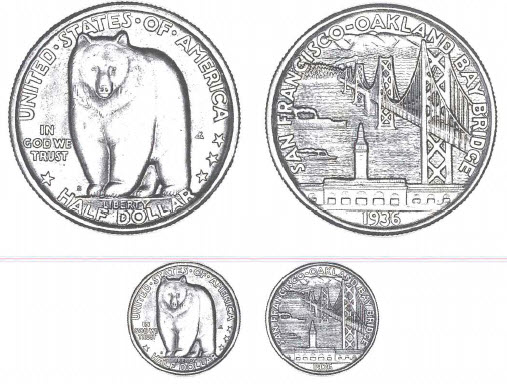
Jacques Schnier, a young Romanian sculptor who made his home in San Francisco and whose works were well known in California, prepared the designs for the coin. The obverse depicted a grizzly bear, whereas the reverse showed the Ferry Building and the San Francisco end of the bridge in question, with a view toward Yerba Buena Island and Oakland. The en-tire coin was executed in a modernistic style. The reverse was extremely detailed and had no completely smooth or "field" surface. Models were reduced to die form by the Medallic Art Company of New York, which prepared the master dies for other issues of the era as well.
Stuart Mosher, in United States Commemorative Coins, 1940, commented: "In choosing the obverse design for this half dollar the artist used the same idea as is on the reverse of the issue in 1925 for the California Diamond Jubilee. While the choice was of secondary importance compared to the bridge design, it aroused considerable criticism at the time of issue. The grizzly bear is the emblem of the state of California, but in this instance the artist used as his model a bear known as Monarch II that had spent the 26 years of its life in a cage as a public exhibit at the Golden Gate Park. It is customary for all United States coins to depict liberty in some form or another so perhaps the critics were justified in their wrathful outbursts." In actuality, the bear was a composite of different animals observed by Schnier at the San Francisco and Oakland zoos. (Carter. Mike. "Jacques Schnier and the San Francisco-Oakland Bay Bridge Commemorative Half Dollar," article in The Commemorative Trail, Winter-Spring. 1987. pp. 22-26.)
Concerning the reverse motif Cornelius Vermeule commented as follows in his 1971 book. (Numismatic Art in America. p. 199.)"The temptation to show comprehensive views of harbors on coins has existed ever since Nero adorned a sestertius with Rome's basin at Ostia or Trajan portrayed the inner port of the same complex. Schnier's grand view from San Francisco or Berkeley (The view is from the San Francisco side of the bay.) is comparable to geography on coins and medals of the sixteenth or seventeenth centuries, Medici memorials to the harbor installations at Leghorn, or Papal documentation of the enlarged walls of Rome."
Drive Up and Buy a Coin
In November 1936, 100,055 San Francisco-Oakland Bay Bridge half dollars were struck at the San Francisco Mint. The coins were offered for sale for $1.50 each by the San Francisco Clearing House Association, a group which had distributed 1925-S California Diamond Jubilee half dollars 11 years earlier. The actual celebration for the bridge completion was scheduled to be held November 12-14, at which time "all the colorful charm of San Francisco will be spread for our visitors" (per an official brochure).
Numerous coins were sold at booths near the entrances to the bridge, making it the first time that a commemorative coin was originally distributed on a drive-up basis. Coins were sold by mail by the San Francisco-Oakland Bay Bridge Celebration, Room 615, 625 Market Street, San Francisco. Despite such efforts, many coins remained unsold, and in 1937, 28,631 examples were melted.
Collecting San Francisco-Oakland Bay Bridge Half Dollars
In the 1980s, Schnier autographed holders containing half dollars of his design, and they were offered for sale to numismatists. The coins for this later promotion were purchased on the open market at the time and were not unsold remainders.
Today 1936-S Bay Bridge half dollars, as they are usually called, are readily available. Most examples are in the lower ranges of Mint State, typically with contact marks on the bear motif. The reverse, being of complicated design with many protective ridges, disguises marks and usually appears to be defect-free.
As recently as the 1960s it was not un-usual to see small quantities of these offered on the collectors' market. By now most such groups probably have been dispersed.
GRADING SUMMARY: In general, scattered marks are seen on the grizzly bear on the obverse. The reverse design, being complex with many protective devices, is apt to appear mark-free, unless viewed at an angle under a strong light. From a technical or numerical viewpoint the reverse grade of a typical specimen is apt to be a point or two higher than the obverse. The fields of this coin often have a "greasy" appearance, rather than being deeply lustrous and frosty.