Commemorative Coins of the United States
Q. David Bowers
1936 Albany Charter Half Dollar
(Albany-Dongan Half Dollar)
Conception and Design
In 1936 Albany, the capital of New York State since 1797, sought to commemorate the 250th anniversary of its city charter, granted in 1686 by New York Governor Thomas Dongan, by issuing a half dollar. On June 16 of that year a bill was passed providing for not more than 25,000 silver half dollars to be produced of a single design and struck at a single mint, an increase from the small quantity of 10,000 coins originally requested. Thus was created another United States legal tender coin to commemorate an anniversary of strictly local significance.
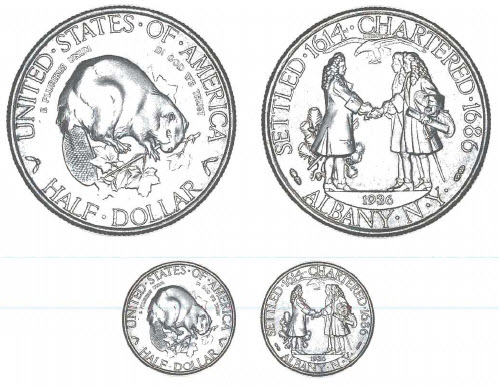
The Albany Dongan Charter Committee selected Miss Gertrude Lathrop to design the pieces. Lathrop, born in Albany on December 24, 1896, had achieved recognition as a sculptress. Her sketches and models depicted on the obverse a beaver (a common mammal in the area) facing to the viewer's right, gnawing on a branch of maple. The reverse depicted a group of three men in colonial costume, standing, representing Governor Dongan bidding goodbye to Peter Schuyler and Robert Livingston. An eagle is above. For once the Commission of Fine Arts was enthusiastic concerning an initial design, and approval was given in short order.
Gertrude K. Lathrop wrote to the editor of The Numismatist to tell of the coin and her work with it: (Letter published in the November 1936 issue.)
"The Albany commemorative half dollar marks the 250th anniversary of the granting of the charter to Albany, N.Y. As Albany is the second oldest chartered city in the United States, I studied its history with a great deal of interest and spent quite a little time at the Metropolitan Museum of Art, the New York Historical Society, the Museum of the City of New York, and the Smithsonian Institution studying the costumes of the settlers of the year 1686 and conferring with authorities.
"On the reverse of the coin I have shown Peter Schuyler, one of the commissaries, who was soon to become Albany's first mayor, with Robert Livingston, secretary, taking leave of Governor Thomas Dongan in New York. On July 22, 1686, Dongan signed the charter which was drawn up during the two weeks stay of Schuyler and Livingston. Schuyler is shown holding the charter. The original document was taken from the safe in the Manuscripts Room of the New York State Library for measurement and study during the making of the design.
"I found very little material about the personal appearance of these three men. My portrayal of the two young gentlemen from Albany was based upon a portrait of each, painted fully thirty years after their historic trip; and that of Dongan, upon a brief description of the 'stalwart and soldierly' Irishman who came from England to be Governor. There is no authentic portrait of him.
"Beavers were plentiful in the vicinity of Albany at that time. The community's wealth and prosperity can be traced to this fact, as trade in beaver pelts was the main industry of the settlers. The beaver was used on the early seals of the city and is also on the present seal. Although the beavers were nearly exterminated in New York State a short time ago, the Conservation Department managed, by protection and careful transplanting of communities of the animals, to increase their number. It was through the kindness of this department that I was able to have a live beaver at my studio for a few days to pose for the model on the obverse. It is occasional contact with such interesting and friendly citizens of the wild that adds spice to one's work. The maple branch is used with the beaver because the maple is the New York State tree, and the introduction of maple leaves on this side and pine cones on the reverse is symbolic of the growth and fertility of the community."
Art historian Cornelius Vermeule saw political overtones in the motif: (Numismatic Art in America, p. 199.) "Gertrude Lathrop's specialty has been animals, thus a beaver gnaws on a maple branch .... The beaver is on the seal of the city and the maple is the New York state tree. The design would then seem to become an allegory of municipal government feeding on the rule of the state!"
Minting and Distribution
In October 1936 the full authorized coinage of 25,000 pieces, plus 13 extra examples for the Assay Commission, was effected at the Philadelphia Mint. The Albany Dongan Charter Coin Committee offered them for sale at $2 each. At first the coins were referred to as Albany Dongan half dollars because of the Committee's name, but later they became known simply as Albany halves. By this point in autumn 1936 interest in commemoratives had dwindled sharply, and despite a lot of advertising puffery and hyperbole on the part of the issuing committee, quantities amounting to thousands of pieces remained unsold.