Commemorative Coins of the United States
Q. David Bowers
1925 Fort Vancouver Centennial Half Dollar
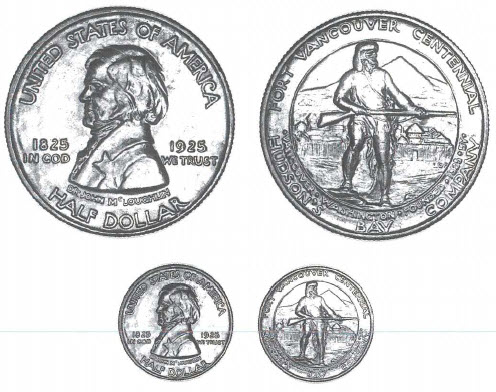
The Centennial of a Fort
The 1925 Fort Vancouver Centennial half dollar, authorized on February 24, 1925 as part of the same legislation which made possible the California Diamond Jubilee and Vermont-Bennington halves, was produced to observe the 100th anniversary of the founding of Fort Vancouver, Washington by Dr. John McLoughlin in 1825.
McLoughlin, born in 1784 of French, Irish, and Scottish stock in the parish of Rivere de Loup, Lower Canada, became apprenticed to a Quebec physician at the age of 14 and is said to have studied medicine in Paris and Edinburgh.! At the age of 19 he entered the employ of the North West Company, a fur-trading group, as a surgeon at Fort William on Lake Superior. In 1814 at the age of 30 he became a partner in the company. He became involved in strenuous competition with the Hudson's Bay Company in the Red River area. McLoughlin went to London in 1821 to represent the North West Company in negotiations which led to the acquisition of the company by the Hudson's Bay Company. In 1824 he headed west to Fort George on the Columbia River, where he remained about a year, after which on behalf of the Hudson's Bay Company he established Fort Vancouver, a fortified outpost which served as the center of trading and protection for about 1,000 white settlers who transacted with approximately 100,000 Indians in the territory. McLoughlin set all of the rules for the fort and its far-flung outposts and governed the area with an iron hand, becoming known as "The King of Old Oregon."
Later, in 1842, McLoughlin founded Oregon City in the same area. During the same decade a great influx of Americans into the Oregon Territory resulted in the district coming under the jurisdiction of a provisional government set up by the new settlers. In 1846 under the Treaty of Oregon the area became part of the United States. McLoughlin resigned his position with the Hudson's Bay Company and retired to Oregon City, where he died in 1857.
Fort Vancouver in Washington, as well as Vancouver Island and Vancouver, the capital of British Columbia, took their names from Captain George Vancouver(1758-1798), who sailed with Captain James Cook on his first and second voyages. After Cook's death the British admiralty gave him command of the Discovery, aboard which ship he explored the Pacific Northwest Coast of North America, first arriving there on April 18, 1792. His travels were chronicled in a book published in 1798, A Voyage of Discovery to the North Pacific Ocean and Round the World in 1790-5.
Design and Production
The commemorative coin project was handled by the Fort Vancouver Centennial Corporation, which intended to use the proceeds to help fund Centennial events. Sidney Bell, a Portland artist, was selected to prepare designs for the half dollar. The portrait of McLoughlin was taken from a sketch by John T. Urquhart. The local committee liked Bell's work, but the Commission of Fine Arts rejected it as unsatisfactory. Laura Gardin Fraser, who by this time was familiar with commemoratives (having designed the 1921 Alabama and 1922 Grant coins), revised the motifs and completed the models from which dies were made.
The obverse depicted a bust of McLoughlin, whereas the reverse showed a pioneer (specifically a trapper, per original correspondence with the Commission of Fine Arts), standing with gun in hand, with the Fort Vancouver stockade in the background, set against Mt. Hood and the Columbia River. Around the rim of the coin appeared the inscriptions FORT VANCOUVER CENTENNIAL and HUDSON'S BAY COMPANY.
Although up to 300,000 pieces were authorized, coinage was cautious, and by August 1, 1925, only 50,028 had been struck at the San Francisco Mint. By error the S mintmark was omitted. As part of the publicity the entire shipment of half dollars, weighing 1,462 pounds (including packing material), was flown by air from San Francisco to Vancouver on August 1st.
An Account of the Delivery
The Oregon Sunday Journal, Portland, Oregon, August 2, 1925, contained the following article, "To San Francisco and back in 11 Hours." The byline noted it was "by Donald Sterling.! managing editor of the Journal, who accompanied Lieutenant Oakley G. Kelly, U.S.A., on a round-trip air flight to San Francisco Saturday [August 1, 1925]." The text is excerpted herewith:
"From Vancouver, Washington, to San Francisco and return, a distance of 1,100 miles, in 10 hours and 55 minutes flying time, was a feat accomplished Saturday by Lieutenant Oakley G. Kelly, U.S.A., in command of the air squadron at Pearson Field, Vancouver barracks, in the first round trip airplane flight to the Bay City to be made in a single day. The purpose of the flight was to receive a consignment of newly-coined 50-cent pieces from the United States Mint at San Francisco designed to commemorate the 100th anniversary of the founding of Fort Vancouver. On its face the new half dollar bears a likeness of Dr. John McLoughlin. On the reverse side is the figure of a Hudson's Bay trapper.
"Upon Kelly's return the coins were received with due ceremony at Pearson field by Herbert Campbell of the Vancouver Columbian, president of the centennial which will be held August 17 to 23. The first coin was presented to Lieutenant Kelly. Others receiving them were Mayor N.E. Allen, Councilman O.W. Stone, Campbell and the writer.
"Breakfast in Portland, lunch in San Francisco and dinner in Portland was the order of the day for Lieutenant Kelly and his passenger. With less ado than the average citizen makes in backing the family flivver from the garage of a morning, Kelly drove his huge De Havilland plane, which is equipped with a 12-cy,linder engine, from its hangar shortly after 5 o'clock. He and his passenger climbed aboard, the engine was started and at 5:15 a.m. the machine soared from Pearson field and sailed southward. Eugene, 110 miles away by air, was reached at 6:15 and a stop of 20 minutes taken for gas. Although the plane's capacity is 100 gallons, Lieutenant Kelly wanted to make sure he had sufficient fuel to reach San Francisco. At 7:45.the fliers passed over Medford, at 9:15 a.m. over Redding, California, and alighted at Crissey field, the Presidio, at 11:20 a.m., an elapsed time of six hours and flying time of five hours 45 minutes.