Commemorative Coins of the United States
Q. David Bowers
1991 Mount Rushmore Anniversary Half Dollars
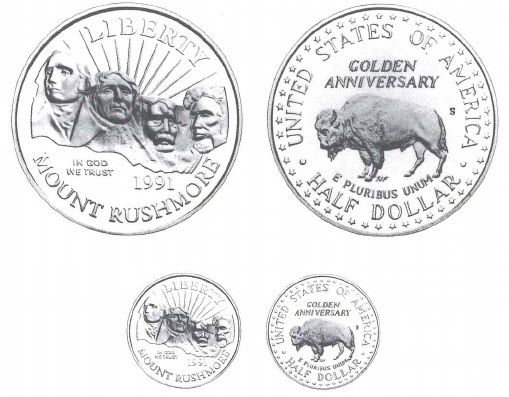
Three Commemoratives
The Mount Rushmore National Memorial Coin Act (public Law 101-332, July 16, 1990) provided the authority to produce three types of 1991-dated commemorative coins in observation of the 50th anniversary of the monumental sculpture in stone. The legislation provided that no more than 500,000 $5 gold coins, 2,500,000 silver dollars, and 2,500,000 copper-nickel clad alloy half dollars be struck. Fifty percent of the income from surcharges to be applied to the coin prices ($35 per half eagle, $7 per silver dollar, and $1 per half dollar, as part of the price charged for each coin) is to go to the Mount Rushmore National Memorial Society of Black Hills for the improvement, enlargement, and renovation of the Memorial, with the balance to go to the U.S. Treasury. Additional funds for the Memorial were raised by the Mount Rushmore Preservation Fund. (Harry M. Conger, national chairman. The National Honorary Committee included such luminaries as Allen H. Neuharth (publisher of USA Today and numerous other newspapers), comedian Bob Hope, one-time presidential candidate George McGovern, entertainment personality Cheryl Ladd, and television commentator Tom Brokaw.)
Coin World, January 30, 1991, reported the following: "As the date for striking coins commemorating the 50th anniversary of the Mount Rushmore National Monument draws near, one of the surcharge recipients is looking for more cash than the law currently provides. If a bill introduced January 14 by Senator Larry Pressler, R-S.D., is approved, the Mount Rushmore National Memorial Society of Black Hills will get up to $18.75 million half of the surcharge money from a theoretical coin sell-out-up front and the U.S. Treasury will get what money, if any, is left. The society is seeking all of the surcharges if the program does not exceed a 50% sell-out. 'Somehow when the bill was drafted the funding was not clarified even though it was the primary intent of the bill to fund the monument,' said Ray Aldrich, the Society's executive vice president. 'We're trying to get started as soon as possible.' The law currently states that the Society and the Treasury will split the surcharges 50-50. S. 108 would alter the law to 'conform to the intent of the Congress,' according to the text of the new bill.... The renovation and expansion of the Mount Rushmore facilities is budgeted at $40 million and is expected to take three to five years, Aldrich said.
"A sell-out of the three-coin Mount Rushmore program would require that 500,000 gold half eagles and 2.5 million each of the silver dollars and clad copper-nickel half dollars are purchased. Of the 15 different commemorative coins struck by the U.S. Mint since 1982, only the 1986 Statue of Liberty gold half eagle struck at West Point sold out."
The Mount Rushmore Memorial
The Mount Rushmore Memorial coins brought into focus the work of sculptor Gutzon Borglum, who was certainly one of the most colorful, outspoken and, talented people ever to be associated with commemorative coinage. He personally designed and modeled the 1925 Stone Mountain half dollar, and, although the 1991 Mount Rushmore Memorial coins were produced 50 years after Borglum's 1941 death, his Mount Rushmore sculptures formed the focal point of the designs for all three denominations.
Mount Rushmore Memorial, the world's largest carved stone sculpture, measuring 60 feet high, features the busts of George Washington, Thomas Jefferson, Theodore Roosevelt, and Abraham Lincoln. As grand as the sculptures are, the Mount Rushmore Memorial at completion in 1941 was only a fraction of the size and scope originally contemplated by the sculptor. (Lillian Taylor, who had been Borglum's secretary in the 1920s during the Stone Mountain Memorial project, kept in correspondence with the sculptor in later years and maintained a correspondence and clipping file pertaining to the early work on Mount Rushmore. It is from this archive, lent to the author by Robert Harwell, that most of the historical information in this section is taken. Refer to the 1925 Stone Mountain Memorial half dollar listing in this work for additional information concerning Borglum.)
The project had its inception in 1923 when Doane Robinson, state historian of South Dakota, sought to increase tourism by developing a mountainous site in the Harney National Forest in the Black Hills. Writing to noted Chicago sculptor Lorado Taft on December 28, 1923, Robinson inquired concerning the artist's interest in carving massive figures of "notable Sioux such as Red Cloud, who lived and died in the shadows of those peaks." Taft was in failing health and could not consider the project, which by the spring of 1924 had expanded in Robinson's mind to include figures in stone of Lewis and Clark, Buffalo Bill, and other notables in addition to Sioux.
On August 24, 1924, Robinson contacted Gutzon Borglum at his Stamford, Connecticut studio to ascertain his possible interest, noting that if the sculptor would take on the project, financing of the project could be arranged. Borglum replied by telegram stating that his work on Stone Mountain was proceeding ahead of schedule and, yes, he was interested and could visit the site in September. As most of the models and plans for his Stone Mountain carvings had been completed by this point, it was no problem for Borglum to go on to other things.
Amid much acclaim by South Dakotans, Borglum visited the Black Hills. Ideas evolved, and before long he suggested that the carvings would cost $600,000 or more, a figure far greater than Robinson or anyone else had envisioned. On March 23, 1925, Congress passed a bill approving the project (for it was to be done in a national park) but not providing financing. In the same year the Mt. Harney Memorial Association was formed. The Mt. Harney site was soon abandoned in favor of nearby Mt. Rushmore, which had a suitable stone out-cropping on its east side. (The mountain was named for Charles Rushmore, a young New York attorney who had visited the area in 1885 to acquire tin mining claims on behalf of the Harney Peak Tin Mining Company. Decades later Rushmore, by then prominent in his profession, donated $5,000 to Borglum's project.) In March 1927 Borglum was officially hired to do the work, which became known as the Mount Rushmore Memorial.