Commemorative Coins of the United States
Q. David Bowers
1935-1939 Arkansas Centennial Half Dollars
Another Controversial Series Is Created
The district comprising Arkansas was explored by Hernando de Soto in 1541, followed over a century later by the French Jesuit Father Marquette in 1673. In 1686 the French formed a settlement known as Arkansas (or Arkansaw, as it was often spelled in the early days). In 1720 the area was granted to John Law, known to history as the promulgator of the South Seas Bubble speculation. In 1762 Spain gained control of the district, then it went back to France in 1780 and in 1803 was sold with the Louisiana Purchase to the United States government. For a time (1812-1819) Arkansas was part of the territory of Missouri. Finally, on June 15, 1836, Arkansas was admitted to the Union as the 25th state.
As the State of Arkansas joined the Union in 1836, most people who contemplated the matter in a reasonable light believed that the logical time to celebrate the centennial would be 100 years later or in 1936. However, such thinkers did not reckon with the profit motive, so when it came to the subject of selling coins, Arkansas started its birthday party early-in 1935-and kept it going for years thereafter until 1939. As was the case with the Boone issues, the prolonging of the Arkansas coins and the creation of multiple varieties from different mints was done simply to create rarities for collectors. What were perceived as erratic and inequitable methods of distribution of the Arkansas issues were the cause for numerous complaints.
Obverse or Reverse?
The coins had their inception with a group known as the Arkansas Honorary Centennial Celebration Commission, another one of the somewhat pretentious names devised by coin-issuing groups (the name was later shortened to Arkansas Centennial Commission). On May 14, 1934, a congressional resolution was approved authorizing the production of 500,000 silver half dollars to be issued only to said commission or its authorized agent, "and at such times as they shall be requested by such commission or any such agent, and upon payment to the United States of the face value of such coins."
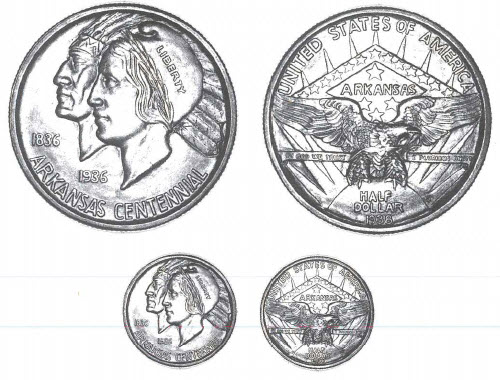
Edward Everett Burr, a Chicago artist, designed the Arkansas half dollar. The models were created by Miss Emily Bates, who at one time was an Arkansas resident. In keeping with practice at the time, the hub dies were prepared by the Medallic Art Company of New York. During the design process various ideas were considered. The one finally implemented showed conjoined portraits facing left of an Indian, intended to be a native Arkansas resident of 1836, and a young girl, representative of an Arkansas citizen of 1936.
The reverse depicted an eagle without stretched wings, standing on the sun(from which prominent rays emanated),with a parallelogram in the background, partly visible, with stars in the border and enclosing additional stars and the word ARKANSAS, adapted from the state flag. There was some confusion as to which was the obverse side and which was the reverse, for the dates 1836 and 1936 appeared on the portrait side, denoting the centennial span, whereas the eagle side displayed the actual date of issue of the coin. However, original correspondence concerning the design, preserved in the National Archives, indicates clearly that the portrait side was intended as the obverse.
The Arkansas design was not on art historian Cornelius Vermeule's list of favorites: (Numismatic Art in America, page 138.) "The vapid, dated, and confused coin which marked the Arkansas Centennial in 1935 is an unfortunate example in the commemorative series of collaboration between an artist who knew little if anything about die design and an amateur full of notions about local patriotism and local lore. The sculptor was Edward Everett Burr of Chicago, and the model was prepared, it is said, by a certain Miss Emily Bates of Arkansas. Other such combinations of local artistic or antiquarian zeal and quasi-professional modeling or finishing will be shown to have been even more unfortunate, in the instances of the half-dollars for the Old Spanish Trail and the Wisconsin Territorial Centennial.
"The Arkansas Centennial coin is one of the last examples to use the time-honored motifs of Liberty and an Indian in combination .... Liberty resembles a chinless society girl of the 1920s, and the Indian is either a weak death mask or a man in a trance. This combination and its formless, pseudo-modern style are flaccid and senseless, an attempt to make Liberty look either like a contemporary department store model or, at best, like a redskin's squaw! The reverse is a jumble of spikes, lines, and curves; the state symbolism is so obscure as to be pointless .... "