Commemorative Coins of the United States
Q. David Bowers
1936 Cleveland-Great Lakes Half Dollar
Another Melish Enterprise
The Cleveland Centennial and Great Lakes Exposition took place in Cleveland from June 27 to October 4, 1936, and was held at a 150-acre site on the shore of Lake Erie. Artistic, industrial, and other accomplishments of the Ohio city were showcased, as were public amusements and other attractions, all in connection with the 100th anniversary of Cleveland's incorporation. Costing about $25 million, the Exposition attracted approximately four million visitors.
Moses Cleaveland, founder of the city, was born in Connecticut in 1754 and studied law at Yale College. In 1796 he was named a brigadier general in the United States army. In the same year he came to Ohio with 50 emigrants from Schenectady, New York to settle and engage in farming. A site was selected at the point at which the Cuyahoga River empties into Lake Erie, earlier the location of a trading post.
At the time the Western Reserve, as that area of Ohio was called, was a magnet for New Englanders, who left the difficult farming conditions of the rocky eastern soil and went west to cultivate richer soil bordering Lake Erie. Reuben Harmon, Ir., the Vermont coiner, was among many to make the journey (although not with Moses Cleaveland).
"Though the place was originally called Cleaveland in his honor, the spelling was to undergo a minor change. When the first newspaper, the Cleveland Advertiser, was established the headline was found to be too long for the form and the editor cut out the letter 'a,' a revision that was readily accepted by the public," historian Stuart Mosher wrote in 1940. Cleveland was incorporated as a city in 1836. One hundred years later in 1936, Cleveland was a leading shipping and manufacturing center and was well known for its interest in the arts.
The act authorizing commemorative half dollars for the anniversary occasion was approved on May 5, 1936, and provided for the coinage of not less than 25,000 but not more than 50,000 silver half dollars to be of a single design and to be coined at a single mint. Numismatic entrepreneur Thomas G. Melish was behind the venture and served as treasurer of the Cleveland Centennial Commemorative Coin Association, which announced its intention to offer the coins to the general public and others for $1.50 each. It will come as no surprise to learn that the Cleveland Centennial Commemorative Coin Association was located not in Cleveland but in Melish' s office at the opposite end of the state in Cincinnati. In fact, it was in the same office used to distribute Cincinnati commemorative half dollars. On this subject Lee Hewitt, editor, commented in the Numismatic Scrapbook, May 1936: "It seems strange that Mr. Melish, living in Cincinnati, should be the distributor of the Cleveland issue."
Melish had asked his friends in Congress to authorize for him several different commemorative half dollars and also to permit additional Cleveland half dollars to be issued with the small date 1937 in addition to the regular date 1936, but these dreams of additional profits did not come true' (By the time the bill reached Congress (H.R. 11771 introduced March 12, 1936) the request for multiple designs was omitted, but the coins were to be "dated 1936 and/or 1937, as it [the Cleveland Centennial Commemorative Coin Association] may determine.")
The Design
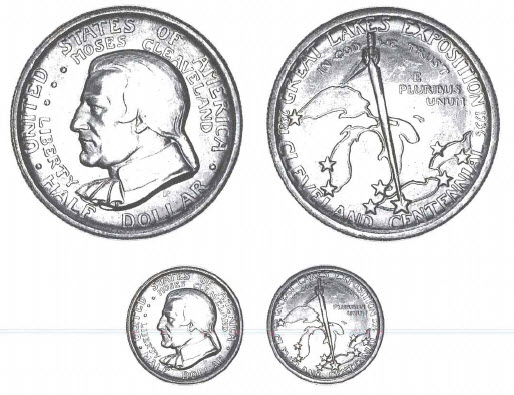
Brenda Putnam, a sculptress of renown, was named as designer of the Cleveland half dollar. A bust of Moses Cleaveland, facing left, dominates the obverse. The reverse shows an outline map of the Great Lakes region with a compass (drawing instrument) describing the area, with the axis on a large star representing the location of Cleveland. Other cities on the Great Lakes are indicated by smaller stars, notably (left to right as they appear on the coin) Duluth, Milwaukee, Chicago, Toledo, Detroit, Buffalo, Toronto, and Rochester. This device was the official insignia of the Great Lakes Exposition.
"The design of this issue is pleasing," noted David M. Bullowa in his 1938 study of commemoratives, who further commented that "the obverse and reverse alike are sharply defined, interesting and not crowded."
Minting and Distribution
The Association ordered the first 25,000 coins in July 1936, in which month the requisite quantity (plus 15 extra for assay) was produced at Philadelphia. Sales took place at the Exposition in Cleveland and through Thomas G. Melish's office in far-away Cincinnati, the latter serving as the depot for mail orders.
In order to promote sales, a form letter was sent to collectors which stated, in part: "We have already been approached by a speculator who wished to buy the entire issue. We advised him that we were not interested." Further: "When these coins are released to the banks in Ohio we anticipate that the entire issue will be sold out within one to three days. All orders will be filled in the rotation received. If you get left on this issue it will be your own fault, not ours." (Undated form letter, circa early May 1936. Bowers and Merena Galleries Reference Collection.)